
Latin name
Elacatinus xanthiprora
Other name
Neongrundel
Identification
The species name xanthiprora comes from the Greek words xanthos (yellow) and pro (forward/front), referring to the characteristic yellow stripe on the snout.
The name "yellowprow" reflects not yellow "eyebrows" in the usual sense, but rather the bright stripe on the snout, which is the main distinguishing feature of this species.
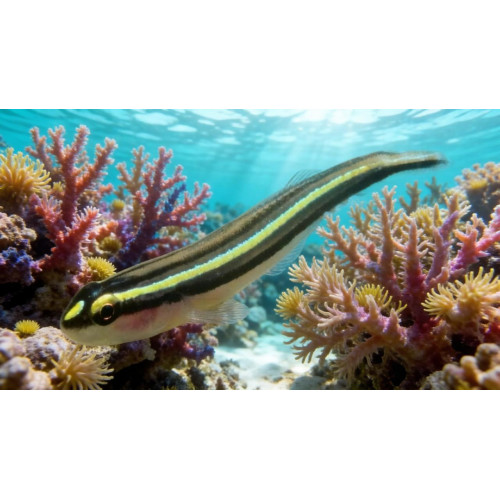
The yellowprow goby has a typical goby-like elongated, spindle-shaped body, compressed laterally. Scales are absent on the body. The mouth is located at the tip of the snout, has a U-shape, and the upper lip is separated from the snout by a characteristic groove.
The bright coloration of the yellowprow goby serves as an identification signal, helping large fish easily locate the "cleaner" so that it can service them.
Features of fish fins
First dorsal fin: consists of 7 spiny rays (spines). It is located in the front part of the back.
Second dorsal fin: begins with 1 spiny ray, followed by 11–13 soft rays (most often 11 or 12). The length of the second dorsal fin's base is greater than the distance from it to the caudal fin.
Anal fin: located under the second dorsal fin. Contains 1 spiny and 10 soft rays.
Pectoral fins: fan-shaped. Consist of 19–20 soft rays (without spines).
Pelvic fins: as in all gobies, fused into a single suction cup (disc), allowing the fish to firmly attach to the substrate. Each fin has 1 spiny and 5 soft rays.
Caudal fin: rounded in shape.
Adipose fin: absent.
The number of fin rays may vary slightly. These subtle differences, especially in the number of rays in the second dorsal fin (10 in E. serranilla vs. 11–12 in E. xanthiprora) and pectoral fins (17–18 in E. colini vs. 19–20 in E. xanthiprora), serve as key features for ichthyologists in identifying closely related species.
Fish coloring
Coloration is the main distinguishing feature of this species. The upper two-thirds of the head and body are blackish. On the snout there is a narrow bright yellow or white vertical stripe — this is precisely what gave the species its name. From the upper edge of the eye to the base of the caudal fin, a narrow bright yellow or white stripe runs. Below the yellow stripe, a narrow dark stripe passes, continuing onto the base of the caudal fin. The belly is pale or grayish-white.
In the scientific literature, a closely related species (Elacatinus colini) is described, which differs by having a white (rather than bright yellow) stripe on the body and a smaller number of pectoral fin rays (17–18 vs. 19–20).
Distribution
The yellowprow goby is widely distributed in the western Atlantic Ocean. Its range extends from North Carolina and southern Florida to Central America, including Jamaica and the coast of the Gulf of Mexico.
Habitat
It is an exclusively marine fish that inhabits coral reefs at depths of 4 to 26 meters (13–85 feet), typically 18–25 meters (59–82 feet). It is most often found in association with tubular sponges, inside which it finds shelter. In the northern part of its range (off Florida), this species sometimes performs the role of a cleaner fish, cleaning other fish of parasites.
Size
A very small fish. Its maximum length is 4 cm (1.6 inches). There is no precise data on maximum weight or lifespan.
Behavior
The most interesting feature of this species' behavior is its ability for facultative (optional) cleaning, which manifests only under certain conditions. Away from coral reefs, this goby remains the only representative of the genus Elacatinus. In the absence of competition and specialized cleaners, it began to perform their role, servicing large client fish. Researchers have recorded that it cleans fish such as groupers and moray eels. In doing so, it may wait for clients while sitting on a hard surface, rather than in its usual sponge. This is not innate but acquired behavior, which appeared due to the absence of other cleaner species in this region. From an evolutionary standpoint, it is not a close relative of cleaner gobies, so its ability to clean other fish is the result of independent adaptation to local conditions, rather than a general trait of its species.
Food and feeding habits
The yellowprow goby is a carnivorous species. Its diet mainly consists of: ectoparasites (when performing the role of a cleaner fish) and small benthic invertebrates (e.g., motile bottom-dwelling worms).
In the northern part of its range (off Florida), this goby may act as a cleaner fish, eating parasites from other fish, but its main strategy is living inside sponges and feeding on small invertebrates.
Reproduction
Information on the reproduction of this species is limited, but it follows the general pattern for goby fish. Fertilization is sexual and external. The eggs are benthic (bottom-dwelling), laid on the bottom.
The larvae lead a pelagic lifestyle after hatching.
Fishing
The species is a target of commercial fishing, but not as a food product — rather for the aquarium trade.
Relationship with a person
This species is completely safe for humans.
Thanks to its bright coloration and small size, it is valued among aquarists.
The International Union for Conservation of Nature (IUCN) has assigned this species a conservation status of Least Concern.
| Classification | |
| Phylum | Chordata |
| Class | Actinopterygii |
| Squad | Gobiiformes |
| Family | Gobiidae |
| Genus | Elacatinus |
| Species | E. xanthiprora |
| Features | |
| Conservation status | Vulnerable |
| Habitat | Demersal |
| Latin name | No information |
| Maximum body weight, kg | No information |
| Maximum length, cm | 4 |
| Sailing speed, m/s | No information |
| Threat to people | Not edible |
| Way of eating | Carnivore |
Yellowprow Goby
Tags: yellowprow goby