
Latin name
Elacatinus horsti
Other name
Barber goby, golden neon goby, gobio de banda amarilla, limpiador lista amarilla.
Identification
The species is named in honor of the Dutch ichthyologist Cornelis Horst, who first described this fish.
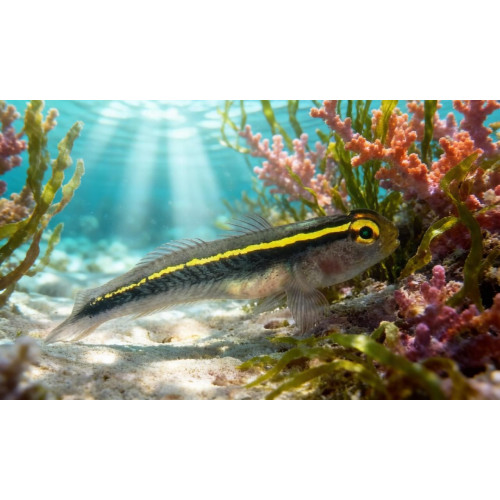
The yellowline goby has a typical goby-like elongated, spindle-shaped body, perfectly adapted for life among sponges and corals. The head is compressed laterally, and the mouth is located at the tip of the snout, separated from it by a characteristic groove.
Features of fish fins
The yellowline goby has a standard goby fin set, but with a characteristic feature of this family. This fish has two dorsal fins — the first is short and consists of only seven spiny rays, while the second, located slightly behind, is longer and soft, with eleven to twelve soft rays. It has a single anal fin, located under the second dorsal fin, with one spiny and ten to eleven soft rays. The pectoral fins are paired, fan-shaped, consisting of eighteen to nineteen soft rays. The pelvic fins of this goby are fused into a single suction cup — this is the main distinguishing feature of all gobies, allowing them to firmly attach to rocks and sponges even in strong currents. Each of the pelvic fins has one spiny and five soft rays. The caudal fin of the yellowline goby is truncated or slightly rounded. The adipose fin is completely absent in this species, as in all representatives of its family.
Fish coloring
Coloration is the main calling card of this species. The upper part of the body and head are dark gray or black. The ventral side gradually lightens to grayish-white. A narrow bright yellow or white stripe runs from the upper edge of the eye to the base of the caudal fin. Below the yellow stripe, a broad dark stripe passes, ending in an oval dark spot in the lower part of the caudal fin. The snout is usually dark or yellowish-gray, sometimes with a small yellow spot. Juveniles differ by having a shorter yellow stripe that ends above the base of the pectoral fins. There are two color forms: one has a yellow stripe, while the other has a white stripe that may transition to bluish-white at the base of the tail.
The bright coloration makes yellowline gobies very conspicuous against the reef background, which would seem dangerous, but in fact serves as a clear signal: "I am a cleaner!"
Distribution
The yellowline goby is widely distributed in the tropical and subtropical waters of the western Atlantic. Its range covers the coast of southern Florida, the Bahamas, the Gulf of Mexico, the Caribbean Sea, as well as the waters off the coasts of Curaçao and Panama.
Habitat
It is an exclusively marine fish that inhabits coral reefs at depths of 1 to 40 meters (3–131 feet). It is most commonly found at depths of 7–27 meters (23–89 feet). This fish always lives in close association with sponges — both tubular and massive (e.g., barrel-shaped).
Size
This is a very small fish. Its maximum length is 5 cm (2 inches). There is no precise data on maximum weight or lifespan.
Behavior
The yellowline goby leads a bottom-dwelling lifestyle and rarely strays far from its sponge shelter. It is known as a cleaner fish, but its behavior differs from that of other cleaners. Instead of servicing large fish, it specializes in eating parasitic worms (Haplosyllis spongicola) that live inside the sponges that serve as its home. It may also feed on other small benthic invertebrates.
Food and feeding habits
The main feature of this goby is that it lives inside tubular sponges. It finds its food right where it lives.
Its main "delicacy" in the sponge is the small parasitic worm Haplosyllis spongicola, which lives in the sponge tissues. By eating them, the goby helps its "apartment" stay healthy. This feeding method is very beneficial for the sponge. Studies confirm that when this goby lives inside a sponge, the sponge can filter water and obtain food more quickly. This is a classic example of mutual beneficial cooperation (mutualism): the goby gets food and shelter, and the sponge gets protection from parasites.
Although eating parasites in the sponge is its "signature" method, the goby's menu is not limited to them. It also does not turn down more conventional food for small fish. Its diet includes zooplankton (small animals floating in the water column), as well as various invertebrates it can find on the bottom.
Notably, unlike some of its close relatives (e.g., the famous neon cleaner gobies), this goby almost never provides the classic "service" of cleaning large client fish. This is likely because it has adapted so well to life inside the sponge and feeding within it that the need to "work as a doctor" outside the home has disappeared.
Reproduction
Information on the reproduction of this species is limited, but it follows the general pattern for goby fish. Reproduction occurs sexually. Eggs are laid on the bottom (benthic), and the larvae lead a pelagic lifestyle. Detailed data on breeding behavior and lifespan are unavailable.
Fishing
The yellowline goby is a commercial species, but its capture has its own specifics. Fishing is likely carried out manually using small nets directly in the fish's habitat — on coral reefs among sponges. This method allows for the selection of live and undamaged individuals for sale. Within the general fisheries, these fish may accidentally be caught in nets and traps intended for other species. Their very small size (up to 5 cm / 2 inches) makes them an unlikely target for large-scale industrial fishing.
Relationship with a person
This species is completely safe for humans. The yellowline goby is a popular inhabitant of marine aquariums due to its size, peaceful nature, and useful role as a "cleaner." Although commercial trade is often conducted under the name Elacatinus figaro (a closely related species), the care requirements are similar.
The International Union for Conservation of Nature (IUCN) has assigned this species a conservation status of Least Concern.
| Classification | |
| Phylum | Chordata |
| Class | Actinopterygii |
| Squad | Gobiiformes |
| Family | Gobiidae |
| Genus | Elacatinus |
| Species | E. horsti |
| Features | |
| Conservation status | Least Concern |
| Habitat | Demersal |
| Life span, years | No information |
| Maximum body weight, kg | No information |
| Maximum length, cm | 5 |
| Sailing speed, m/s | No information |
| Threat to people | Not edible |
| Way of eating | Carnivore |
Yellowline Goby
Tags: yellowline goby