
Latin name
Macrourus whitsoni
Other name
Macrourus whitsoni
Identification
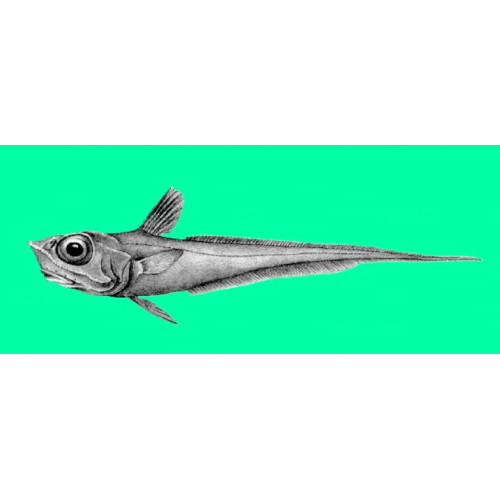
The eyes of the Whitson's grenadier are relatively large. The muzzle is short, moderately pointed, usually somewhat rounded, with a high dorsal profile in adults, but often with protruding tubercles at the tip and lateral corners. The mouth is large with thin lips. Lower jaw with one row (sometimes 2 rows at the tip) of long, thin, closely spaced teeth. Upper jaw with 3-5 rows of teeth, the teeth in the outer row being larger than those in the inner row. As well as covering the entire body, scales also cover the head, which in most is armed with numerous cloves. Often on the head these cloves are transformed into powerful spines, forming very characteristic ridges. The pyloric blind intestines are between 18 and 28 mm long.
Features of fish fins
Dorsal spines (total): 2; Dorsal soft rays (total): 124 - 125; Anal spines: 0; Anal soft rays: 110.
Fish colouring
The overall colouration of most individuals is dark brown to swarthy, but some are much lighter. Fins and lips are blackish.
Distribution
Common in the Southern Ocean: Circumpolar (usually found within the Convergence, except around the Falkland Islands).
Habitat
Bathypelagic deep-water oceanodromous species. Depth range 400-3185 m.
Size
The maximum length of this species is 84.0 cm. The maximum recorded weight is 5.1 kg.
Behavior
The Whitson's grenadier is capable of producing sounds that can travel hundreds or thousands of metres. A pair of powerful drum muscles, whose contractions cause the swim bladder to vibrate, is usually only found in males. The peculiarities of the structure of the auditory apparatus testify to its high sensitivity.
Food and feeding habits
The stomachs of the three individuals examined contained remains of large crustaceans (mainly euphausiids), polychaetes and fish (gonostomatids).
Reproduction
Spawning takes place in winter and early spring (December to March).
Fishing
This species is commercially important in fisheries.
Relationship with a person
Harmless.
Interesting facts
The large eyes of Whitson's grenadier are an important adaptation to life in the deep sea, where there is practically no light.
Here are the key reasons:
The main function of large eyes is to capture available light as efficiently as possible in the darkness. This can be either remnants of sunlight from the surface or the bioluminescent glow of potential prey and other organisms.
Large eyes give this predator an important advantage when hunting. Its diet consists of planktonic crustaceans and small fish, and good vision helps it spot and catch prey in extremely low-light conditions.
It is worth noting that this adaptation is especially important at early stages of life. Studies show that in larvae of Whitson's grenadier, the eyes are not just large but enormous, reaching 40% of the head length. This underscores the critical importance of vision for the survival of juveniles in the pelagic zone of the ocean.
| Classification | |
| Phylum | Chordata |
| Class | Actinopterygii |
| Squad | Gadiformes |
| Family | Macrouridae |
| Genus | Macrourus |
| Species | M. whitsoni |
| Features | |
| Conservation status | Not Evaluated |
| Habitat | Pelagic |
| Life span, years | No information |
| Maximum body weight, kg | 5,1 |
| Maximum length, cm | 84 |
| Sailing speed, m/s | No information |
| Threat to people | Edible |
| Way of eating | Predator |
Whitson's grenadier
Tags: whitson's grenadier