
Latin name
Latimeria chalumnae
Other Names
The West Indian Ocean coelacanth is also known simply as the coelacanth or African coelacanth. Its scientific name, Latimeria chalumnae, was given by Smith in 1939. The genus name honors Marjorie Courtenay-Latimer, the curator who first recognized the fish's significance, while the species name chalumnae refers to the Chalumna River in South Africa, near where the first specimen was caught.
Identification
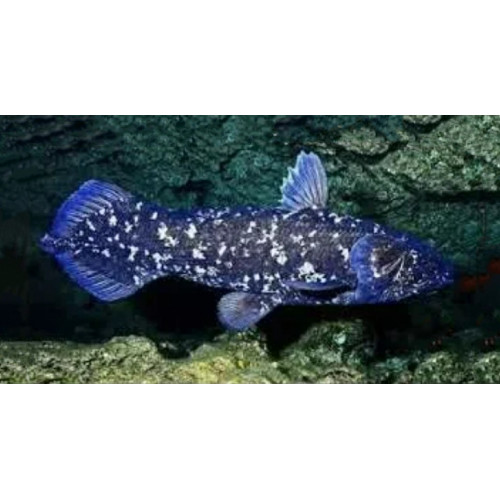
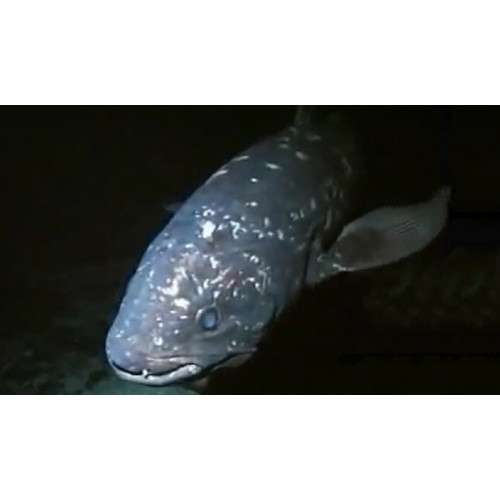
The coelacanth has a large, fusiform (spindle-shaped) body that is thick and heavy, tapering to a relatively small tail. The head is massive, and the mouth is terminal with a large gape. A key identifying feature is the paired, fleshy, lobed fins that extend from the body like limbs, moving in an alternating pattern. The first dorsal fin is supported by a bony plate, while the second is more like the paired fins. The tail is diphycercal (the vertebral column extends into the tail fin), with a small median lobe. The species possesses a number of unique characteristics: an intracranial joint that allows the anterior portion of the skull to swing upwards, widening the mouth; a rostral organ, a specialized electroreceptive organ in the snout; thick, overlapping cosmoid scales; a hollow, oil-filled notochord instead of fully ossified vertebrae; and a brain that occupies only about 1% of the cranial cavity in adults.
Features of Fish Fins
The coelacanth has the following fin characteristics: first dorsal fin with 8 spines and 30-31 soft rays, second dorsal fin with fin rays only, anal fin with 27-31 soft rays, pectoral fins with 29-32 soft rays (fleshy, lobe-like), pelvic fins with 29-33 soft rays (fleshy, lobe-like), and a truncate caudal fin with a small median lobe. The fin "spines" of coelacanths are hollow, which is the meaning of the name coelacanth (coel — hollow, acanth — spine). The pectoral and pelvic fins are highly mobile and are used for slow, controlled movement.
Fish Colouring
In life, the West Indian Ocean coelacanth is a dark metallic blue with irregular white or pale bluish spots covering the head and body. This colouration provides camouflage against the dark lava and rocky walls of its deep-sea habitat, which are often encrusted with white oyster shells. After death, the striking blue colour fades to dark brownish-black.
Distribution
The West Indian Ocean coelacanth is widely but sparsely distributed around the rim of the western Indian Ocean. Its known range includes the Comoros Islands (Grand Comoro and Anjouan), South Africa (the site of the first discovery), and Madagascar, Mozambique, Tanzania, and Kenya. The species is non-migratory.
Habitat
This species is a marine, demersal fish that inhabits steep rocky shores and slopes, typically at depths of 150 to 700 meters (though most commonly found between 90–200 m). During the day, it shelters in caves in small groups, sometimes with up to 14 individuals in a single cave. At night, it leaves the caves to forage along the coastal incline. It prefers water temperatures of approximately 13.4–18.3°C.
Size
The coelacanth can reach almost 2 meters in length and weigh up to 68 kg. However, one "giant" female from Mozambique was recorded at 1.8 m long and 95 kg, and another gravid female measured 179 cm and weighed 98 kg. Males are generally smaller than females, averaging under 1.65 m. Adults are larger than juveniles.
Behavior
The coelacanth is a slow-moving, opportunistic predator. It is primarily active at night, leaving its daytime cave shelter to forage singly over open substrate. It may drift passively with the current or swim slowly, using its paired fins and second dorsal and anal fins. This foraging can take it as far as 8 km in a single night. Before dawn, it retreats to the nearest cave. Tagged individuals have been observed to follow a regular schedule, leaving caves at the same time each afternoon. The species has been observed performing "headstands" as a feeding behavior, allowing it to slurp prey from crevices.
Food and Feeding Habits
The coelacanth is an opportunistic carnivore that feeds on a variety of prey found in its deep reef and volcanic slope habitats. Stomach contents have been found to include lantern fishes, stout beard fishes, cardinal fishes, snipe eels, deep water snappers, cuttlefishes, squids, and small sharks. Its electroreceptive rostral organ likely aids in locating prey.
Reproduction
The coelacanth is ovoviviparous, meaning eggs are fertilized internally, and the young develop inside the mother's body, feeding off a large yolk sac until birth. Females give birth to as many as 26 live pups. A 2013 paternity study found evidence that coelacanths may have a monogamous mating system. Individuals may live as long as 60 years, though this is uncertain.
Fishing
The coelacanth has little to no commercial or recreational fishing value. It is not targeted by fisheries, but it is occasionally caught as bycatch in deep-set lines and demersal trawls, which poses a significant threat to its populations. Historically, fishermen in the Comoros were familiar with this unusual fish, which they caught occasionally.
Relationship with a Person
The coelacanth is not a threat to humans and is classified as harmless. It is, however, one of the most scientifically and culturally significant fish in the world. Its 1938 rediscovery was widely regarded as the zoological find of the 20th century. The species is of immense scientific interest as a "living fossil" and the closest living relative of the ancestors of all tetrapods (land vertebrates). The species is listed as Critically Endangered on the IUCN Red List. It is also listed under Appendix I of CITES, which forbids international trade for commercial purposes.
The West Indian Ocean coelacanth — a living fossil
This discovery became one of the greatest sensations in 20th-century biology. Until 1938, scientists were certain that coelacanths, like dinosaurs, had gone extinct about 65 million years ago at the end of the Cretaceous period. However, everything changed in December, when a living specimen was caught off the coast of South Africa, near the mouth of the Chalumna River.
An unexpected find: The fish was discovered by Marjorie Courtenay-Latimer, the curator of the local museum in East London. She was brought an unusual blue catch, and not knowing what kind of fish it was, she sent a drawing to the ichthyologist Professor J. L. B. Smith. He immediately realized it was a coelacanth.
A sensation: The capture of a living coelacanth became a scientific sensation, as scientists were able to study the anatomy and physiology of a fish that had previously only been known from fossils. The coelacanth turned out to be the closest living relative of the ancient ancestors of all land vertebrates — the lobe-finned fishes.
Significance: This find marked the beginning of many years of searching for new specimens and in-depth study of this amazing 'living fossil,' which still lives in deep-sea caves off the eastern coast of Africa and the Comoros Islands.
| Classification | |
| Phylum | Chordata |
| Class | Sarcopterygii |
| Squad | Coelacanthiformes |
| Family | Latimeriidae |
| Genus | Latimeria |
| Species | Latimeria chalumnae |
| Features | |
| Conservation status | Critically Endangered |
| Habitat | Bottom |
| Life span, years | 60 |
| Maximum body weight, kg | 95 |
| Maximum length, cm | 180 |
| Sailing speed, m/s | No information |
| Threat to people | Not edible |
| Way of eating | Predator |