
Latin name
Uranoscopus cognatus
Identification
The species is named in honor of Theodore Cantor — a Danish physician, zoologist, and botanist who first described this species in 1849 based on specimens collected in Malaysia.
The genus name Uranoscopus comes from the Greek words uranos (sky) and skopeo (to look), literally meaning "looking at the sky" — a direct reference to the placement of the eyes on the top of the head.
Like all members of the stargazer family, this species has a specialized appearance, perfectly adapted for ambush hunting.
Body shape: elongated, cylindrical, tapering toward the tail. The head is large, massive, flattened on top, with eyes directed vertically upward — hence the name "stargazer" (looks at the sky/stars). The mouth is large and directed upward.
Distinctive features (identification key):
A short black cirrus (small fleshy appendage) on the eye, located directly on the eyeball.
A respiratory valve inside the lower jaw has a thin, pale, thread-like projection.
Both nasal valves are long and tubular (extended into tubes).
Two basipterygial processes — bony projections that make this species easily distinguishable from other stargazers (most species have one process).
The upper edge of the preopercle is directed backward and downward (descending backward).
Features of fish fins
First dorsal fin: short, consists of 4 (sometimes 3) spiny rays.
Second dorsal fin: has 13–14 soft rays.
Anal fin: has 12–15 soft rays.
Fish coloring
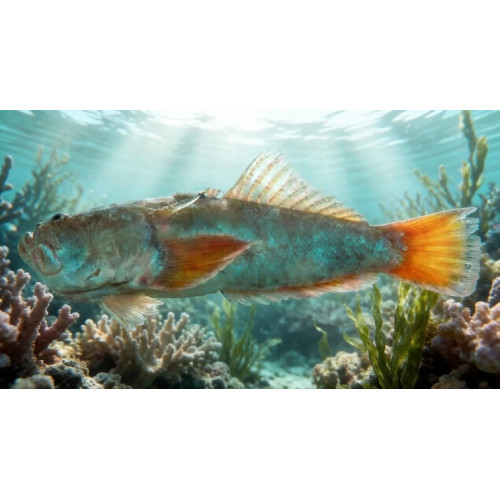
The body coloration is brownish above with fine dark brown speckling and a marbled pattern. The belly is light. The main distinguishing feature, reflected in the English name, is the coloration of the caudal and pectoral fins. In this species, they have a bright orange or yellowish-brown coloration.
Distribution
They are distributed in the tropical waters of the eastern Indian Ocean and the western Pacific Ocean. They are found off the coasts of Indonesia, northern and northwestern Australia, and off the coasts of Papua New Guinea. They also inhabit the coastal waters of Thailand (western coast), Malaysia (eastern coast of the peninsula), and Bangladesh (in the Sundarbans region — the largest mangrove forest in the world).
Habitat
This is a marine, demersal (bottom-dwelling) species. It inhabits coastal zones, preferring sandy or muddy substrates into which it can completely bury itself, leaving only its eyes and mouth on the surface for hunting.
Size
The greatest recorded length of this species is 16.5 cm (6.5 inches). Studies show that in the natural environment, individuals of different ages and sexes vary in size. Juveniles are found in the range of 5.1–9.2 cm (2–3.6 inches). Males typically have a length of 9.6 cm to 17.4 cm (3.8–6.9 inches). Females are larger than males and are found in the range of 9.3–18.9 cm (3.7–7.4 inches).
The weight of caught individuals varies widely — from 3 to 132 grams (0.1–4.7 oz). As expected, weight is closely related to the size and sex of the fish. Males weigh from 15 to 71 grams (0.5–2.5 oz). Females reach weights of up to 132 grams (4.7 oz), which correlates with their larger maximum size.
The exact maximum age of these fish in the wild is not given, but scientists have calculated an important parameter — population resilience. This species has very high resilience. This means that the population can double in less than 15 months. Such a high rate of reproduction and renewal is typical of species with short lifespans (usually 1–3 years) and high fecundity.
Behavior
Although there are no direct indications for this species, its close relatives (e.g., the Atlantic stargazer U. scaber) are capable of generating both sound and electrical impulses. It is likely that U. cognatus also possesses this ability.
Food and feeding habits
There is no precise data on the diet of this species, but based on the biology of the family, it can be assumed that it feeds on small fish and benthic invertebrates (crustaceans, worms) that fall directly into its open mouth when they swim too close.
Like all stargazers, the two-spined yellow-tail stargazer leads a sedentary lifestyle, lying in ambush for prey. It is almost invisible on the bottom due to its camouflage coloration.
Many stargazers have a special movable appendage (a worm-like lure) on the floor of their mouth, which they wiggle to attract curious fish directly into their mouth — it is possible that U. cognatus also has this feature.
Reproduction
The two-spined yellow-tail stargazer grows and reaches sexual maturity at a length of about 13 cm (5.1 inches). Fertilization in this species is external. The male and female likely rise into the water column, where the female releases a batch of eggs, and the male immediately fertilizes them. Spawning is repeated several times per season. After fertilization, the eggs drift in the water column or settle to the bottom. The parents do not guard the clutch or care for the larvae. After the spawning season ends, a significant portion of adults likely die, making way for juveniles (although the study does not state this directly, this cycle is characteristic of many short-lived fish).
Fishing
This species has no commercial value. However, it regularly appears as bycatch in bottom trawls when fishing for shrimp and other fish. In Malaysia and Thailand, it is caught in huge quantities and is usually discarded overboard, as it is of no interest for sale.
Relationship with a person
Despite its lack of economic value, this species is the subject of genetic research. Scientists study its population structure to understand the impact of trawl fisheries on the genetic diversity of bottom-dwelling species. Studies have shown that populations from different regions (e.g., the western coast of Thailand and the eastern coast of Malaysia) are genetically distinct, which is associated with historical sea level changes (barriers during ice age periods).
The two-spined yellow-tail stargazer is edible and is consumed in some Asian countries. However, when cleaning it, extreme caution is critically important to avoid being pricked by its venomous spines. When cooked, the fish is safe, as the venom is destroyed by heat, but one should remember the potential risk of ciguatera depending on the region of capture.
This species is not listed on the IUCN Red List and has a conservation status of Not Evaluated.
| Classification | |
| Phylum | Chordata |
| Class | Actinopterygii |
| Squad | Trachiniformes |
| Family | Uranoscopidae |
| Genus | Uranoscopus |
| Species | U. cognatus |
| Features | |
| Conservation status | Not Evaluated |
| Habitat | Demersal |
| Life span, years | No information |
| Maximum body weight, kg | 0,132 |
| Maximum length, cm | 16,5 |
| Sailing speed, m/s | No information |
| Threat to people | Edible |
| Way of eating | Predator |