
Latin name
Stylophorus chordatus
Other Name
Thread-tail
Identification
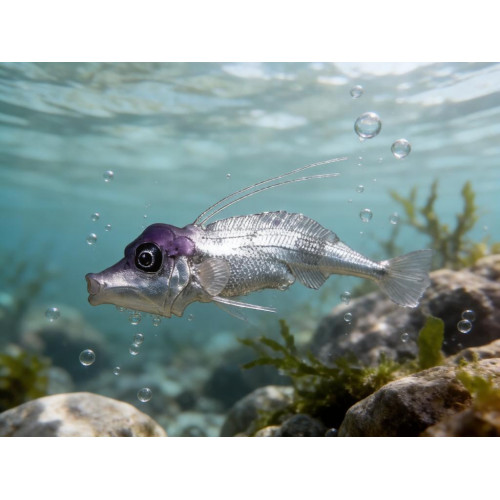
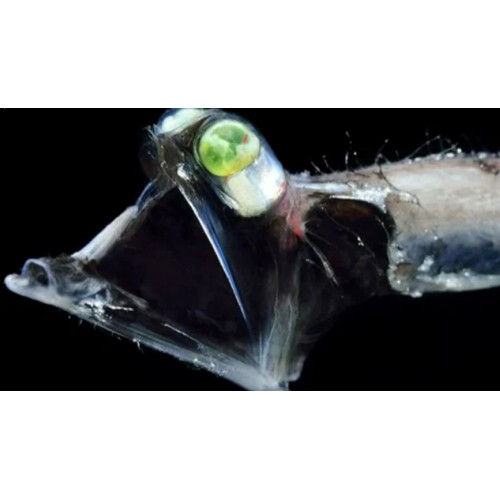
Stylephorus chordatus is a small to moderately sized fish (<30 cm TL) of bizarre appearance. Its body is extremely elongated and grows to only 28 cm (11 in) long, but its pair of tail fin rays triple its length to about 90 cm (35 in). The species is named for its eyes, which are tubular and telescopic, resembling a pair of binoculars ("Stylephorus" — tube-eye). They can rotate and look forward and backward. It also has a tubular mouth.
Features of Fish Fins
The dorsal fin has 119-124 soft rays, and the anal fin has 14-16 soft rays. There are no dorsal or anal spines. The paired tail fin rays are extremely long, exceeding the body length ("chordatus" — rope-like).
Fish Colouring
The body is silvery, and the head is dark violet.
Distribution
This species is found in tropical to subtropical waters across all oceans. In the western Atlantic, its range extends from southeastern Florida and the northeastern Gulf of Mexico through the Lesser Antilles. In the eastern Atlantic, it is known from the Canary Islands and numerous specimens collected between the equator and approximately 20°N.
Habitat
The tube-eye is a marine, bathypelagic species found at depths of 300-800 meters. It is a mesopelagic fish, occurring at 300-600 meters at night and 625-800 meters during the day. It likely migrates over 200-300 meters vertically each day-night cycle. Specimens have been captured between 640 and 1000 meters depth.
Size
The maximum recorded length is 28.0 cm SL (standard length).
Behavior
The tube-eye swims in a vertical position. It is an uncommon species that likely hangs vertically in the water column, searching for zooplankton prey with its highly modified eyes. It makes daily vertical migrations through the water column, staying closer to the surface at night and descending to greater depths during the day, following the plankton it feeds upon.
Food and Feeding Habits
The tube-eye feeds on copepods. It has a unique feeding mechanism: when prey is detected, the head rotates upward and snaps backward, the jaw protrudes forward, and a loose membrane connecting the cranium to the lower jaw is stretched. The resulting fully expanded buccal cavity has a volume approximately 40 times larger than the closed mouth. The velocity of water entering the mouth during this feeding event has been estimated at over 300 cm/sec.
Reproduction
The tube-eye is oviparous (egg-laying).
Fishing
This species is of no commercial interest and is rarely encountered in fishing nets.
Relationship with a Person
The tube-eye is considered harmless to humans. It is listed as Least Concern on the IUCN Red List, indicating that the species is not currently facing a high risk of extinction in the wild.
| Classification | |
| Phylum | Chordata |
| Class | Actinopterygii |
| Squad | Stylephoriformes |
| Family | Stylephoridae |
| Genus | Stylephorus |
| Species | Stylephorus chordatus |
| Features | |
| Conservation status | Least Concern |
| Habitat | Bathypelagic |
| Life span, years | No information |
| Maximum body weight, kg | No information |
| Maximum length, cm | 28 |
| Sailing speed, m/s | No information |
| Threat to people | Not edible |
| Way of eating | Planktonophage |
Tube-eye
Tags: tube-eye