
Latin name
Scarus niger
Other name
Dusky parrotfish, and black parrotfish.
Identification
The swarthy parrotfish is famous for its ability to radically change appearance throughout its life. These are not just age-related changes but part of complex social behavior.
Their body is robust, oval-shaped, with a large head resembling a parrot's beak (hence the family name). The jaws are fused into a powerful beak-like structure, which they use to scrape algae off corals.
At night, these fish secrete a transparent mucus cocoon from their mouths that completely envelops their bodies. This "sleeping bag" is believed to protect the fish from parasites and mask its scent from nocturnal predators such as moray eels.
When a parrotfish scrapes algae off a coral, it inevitably also ingests particles of the coral's limestone skeleton. These particles are ground up in its stomach and excreted as white sand. Thus, many tropical white-sand beaches owe their existence to the work of parrotfish.
Features of fish fins
These fish have one long dorsal fin. The number of rays: 9 spiny and 10 soft. The anal fin has 3 spiny and 9 soft rays.
Fish coloring
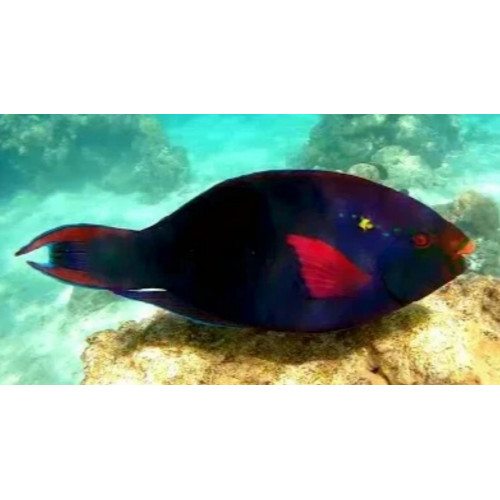
Females (initial phase) typically have a reddish head, belly, and fins, with wavy black and white stripes along their sides. They have dark green stripes around the mouth and eyes.
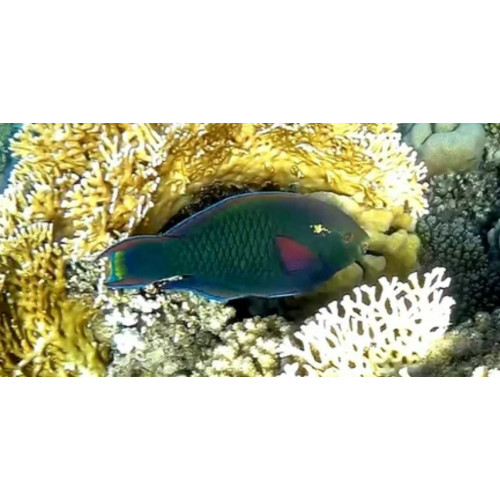
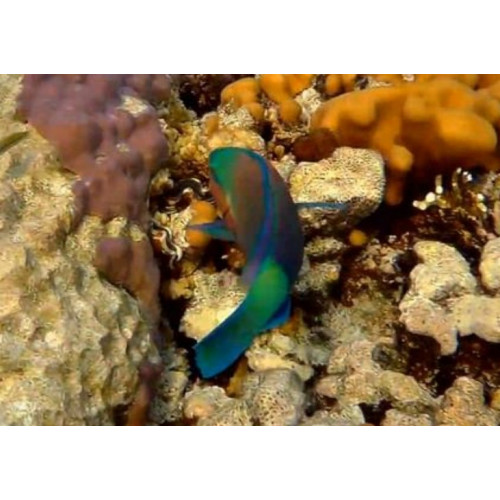
Males (terminal phase) look completely different. Their body is reddish-brown in front and greenish in the back, with a dark margin along the edges of the scales. The upper lip is red, with dark stripes around the mouth. On the head, at the end of the line running from the mouth through the eye to the gill cover, there is a characteristic bright spot — yellow or green with a dark border.
Distribution
Widely distributed in the warm waters of the Indo-Pacific region. It is found from the Red Sea to the coasts of Japan, Australia, and the islands of French Polynesia.
Habitat
Prefers coral reefs at depths of 2 to 20 meters (6.5 to 66 feet) — both on reef flats and slopes.
Size
This is a medium-sized fish, growing to a length of 44.4 cm (17.5 inches) and reaching a weight of 2 kg (4.4 lbs). It is a long-lived species and under favorable conditions can live 10 to 20 years in the wild, with most growth occurring in the first years of life.
Behavior
They live alone or in small groups consisting of one male and several females. This is a diurnal fish that is active during daylight hours.
The swarthy parrotfish is the main "cleaner" of the reefs. It constantly grazes, scraping algae off the coral surfaces. In doing so, it prevents algae from overgrowing and smothering the corals, helping the reefs remain healthy. The presence of this species contributes to the biodiversity and resilience of the reef ecosystem.
This species is not very aggressive. Its feeding territory can range from 5 to 33 square meters (54 to 355 square feet). In areas with high densities of other parrotfish, it may reduce its territory to avoid competition.
Food and feeding habits
Strict herbivores. They feed mainly on filamentous algae (algae of the genus Nitella) that grow on hard substrates, as well as on dead corals. They mostly feed in the morning and afternoon, avoiding the midday heat and dangerous twilight hours.
Reproduction
All swarthy parrotfish are born females. This is called protogyny. When the need arises within a group, the largest and most dominant female transforms into a male. This ability ensures population stability: if a group lacks a male, one naturally appears. During spawning, the male and female form a pair.
Spawning is paired: the male and female release eggs into the water column, showing no parental care. These fish, like many reef inhabitants, have a rapid growth phase.
Fishing
The capture of this species occurs within artisanal (traditional) fisheries, rather than large-scale industrial fishing. These fish, which have high commercial value, are caught on coral reefs at shallow depths using primitive methods. Fishermen use ordinary fishing rods with hooks and lines. In some regions, special traps (pots) are set to attract the fish.
Relationship with a person
To date, the species has a conservation status of Least Concern, meaning its global populations are not currently threatened. However, like all reef inhabitants, they suffer from climate change, coral reef destruction, and ocean pollution.
The swarthy parrotfish is a desirable but extremely challenging inhabitant for a home aquarium. Due to its size, its immense need for swimming space, and its herbivorous diet requiring powerful filtration, it is only suitable for very large public aquariums or oceanariums. It is rarely kept in home aquariums.
This fish species is edible, but its consumption carries a real risk of ciguatera poisoning.
| Classification | |
| Phylum | Chordata |
| Class | Actinopterygii |
| Squad | Labriformes |
| Family | Labridae |
| Genus | Scarus |
| Species | S. niger |
| Features | |
| Conservation status | Least Concern |
| Habitat | Reef |
| Life span, years | 20 |
| Maximum body weight, kg | 2 |
| Maximum length, cm | 44,4 |
| Sailing speed, m/s | No information |
| Threat to people | Edible |
| Way of eating | Herbivorous |
Swarthy parrotfish
Tags: swarthy parrotfish