
Latin name
Acipenser transmontanus
Other names
Sturgeon, Columbia sturgeon, Oregon sturgeon, Pacific sturgeon, Sacramento sturgeon; French: esturgeon blanc.
Identification
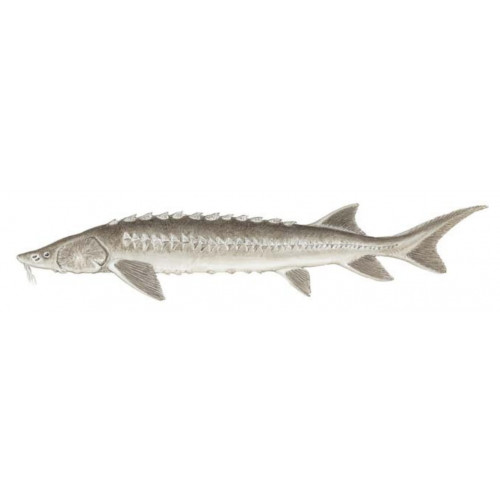
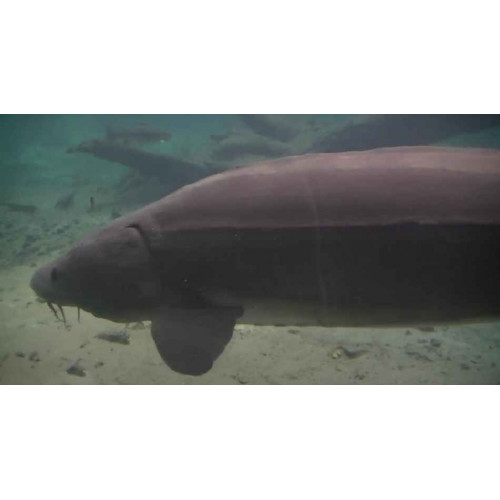
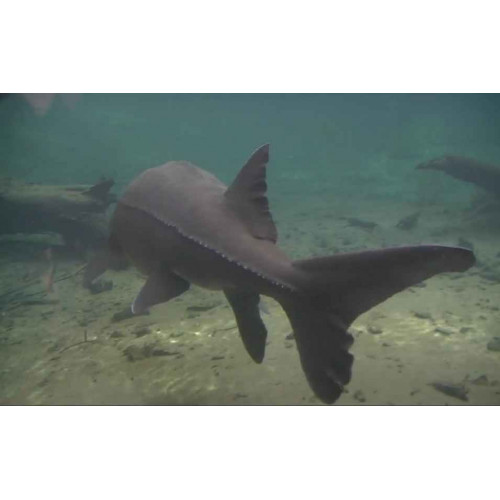
The adult white sturgeon has a moderately blunt snout, spines closer to the tip of the snout than to the mouth, and no obvious scales (bony, scale-like plates) behind the dorsal and anal fins. The fish is gray to pale olive on the upper body and white to pale gray on the ventral side. It has 28-30 anal rays, 11-14 scales on the back, and 38-48 scales on the sides.
Distribution
White sturgeon inhabit only the Pacific coast from the Aleutian Islands, Alaska, to Monterey Bay, California, although it travels far inland to spawn. It can be found in the Fraser River system, the Columbia River above Revelstoke (British Columbia), Lake Duncan, Vancouver Island and possibly Lake Okanagan and other coastal bodies of water. In Idaho, white sturgeon are found in the Snake River downstream from Shoshone Falls and in the Clearwater and Salmon Rivers. It is also landlocked in some reservoirs.
Habitat
White sturgeon mainly lives in estuaries and bays of large rivers, as well as in deep river basins.
Size
The age of the white sturgeon, according to some reports, exceeds 100 years. Most of the oldest individuals of the current era are about 40-60 years old. Historical catch reports a maximum weight of 1,300 to 2,000 pounds and a length of 20 feet. Today, fish less than 6 feet long and weighing 60-70 pounds are usually caught, and fish from 6 to 9 feet long and weighing 200-500 pounds are also possible.
Life history and Behavior
The white sturgeon is an anadromous species that migrates from the ocean to fresh water to spawn. Spawning usually occurs from April through early July, when water temperatures range from 50° to 64 °F, during the highest daily flow of the river. Spawning occurs in fast water. After hatching, the larvae with their yolk sac drift into deeper waters with slower flows, where they grow rapidly, sometimes up to 15 inches or more in the first year. Females usually become sexually mature between 16 and 35 years of age, at about 47 inches in length.
Food and feeding habits
Adult white sturgeon are fish-eaters and feed in fresh water. Common baits include worms, ghost shrimp, grass shrimp, squawfish and carp.
Reproduction
These are among the slowest-growing and latest-maturing fish in the world.
Males become sexually mature at about 9 years of age, while females require 13–19 years. Females do not spawn every year, with intervals of 2 to 4 years, and sometimes longer. Males, as a rule, participate in spawning more frequently. Spawning occurs during the warm season, but the timing depends on the river. In the Sacramento River, it lasts from mid-February to late May, while in the Columbia River, it lasts from late April to early July. The process itself takes place in the water column near the bottom, where the female releases a huge number of eggs. Fecundity directly depends on the size of the female. On average, for every 1 kg (2.2 lbs) of the female's weight, there are about 5,600 eggs. A large female (about 2.4 m / 8 ft) can spawn from 0.7 to 4 million eggs! The eggs themselves are adhesive, dark, about 3.5 mm (0.14 inches) in diameter, and after fertilization, they attach to stones and gravel on the bottom.
The life of the new generation is full of dangers, and only a small portion survives. Eggs develop over 4 to 12 days, depending on water temperature (optimally 10–18 °C / 50–64 °F). Hatched larvae initially feed on their yolk sac. Then they hide among stones, and after some time, they begin a nocturnal drift downstream, sometimes for hundreds of kilometers, to find suitable feeding grounds. During the first few years, juveniles live in the fresh water of rivers and estuaries, feeding on small crustaceans, then, as they grow, they switch to a fish diet and gradually migrate back to adult habitats.
Interesting facts
Scientists have confirmed cases where white sturgeon traveled distances of over 1,000 km (620 miles).
For example: a sturgeon tagged in the San Francisco estuary was later caught in the Columbia River estuary, and then another 1,000 km (620 miles) upstream in that river. Another individual, tagged in the Klamath River, was tracked to the Fraser River in British Columbia, which is also a journey of enormous distance. Historically, white sturgeon ascended the Snake River in Idaho to spawn, indicating their ability to travel thousands of kilometers from the ocean. The white sturgeon is a possible record holder. It is the most likely candidate, as its range extends from the Aleutian Islands (where Adak is located) to rivers flowing into the Pacific Ocean and leading to Idaho. Its well-known ability to make long-distance migrations makes such a route theoretically possible.
| Classification | |
| Phylum | Chordata |
| Class | Actinopterygii |
| Squad | Acipenseriformes |
| Family | Acipenseridae |
| Genus | Acipenser |
| Species | A. transmontanus |
| Features | |
| Conservation status | Vulnerable |
| Habitat | Pelagic |
| Life span, years | 34 |
| Maximum body weight, kg | 630 |
| Maximum length, cm | 280 |
| Sailing speed, m/s | No information |
| Threat to people | Edible |
| Way of eating | Predator |