
Latin name
Malacosteus niger
Other Names
The stoplight loosejaw is also known as the northern stoplight loosejaw, lightless loosejaw, black loosejaw, and black hinged-head. Its scientific name, Malacosteus niger, was given by Ayres in 1848. The genus name Malacosteus comes from the Greek words "malakos" (soft) and "osteon" (bone), referring to its soft, unossified bones.
Identification
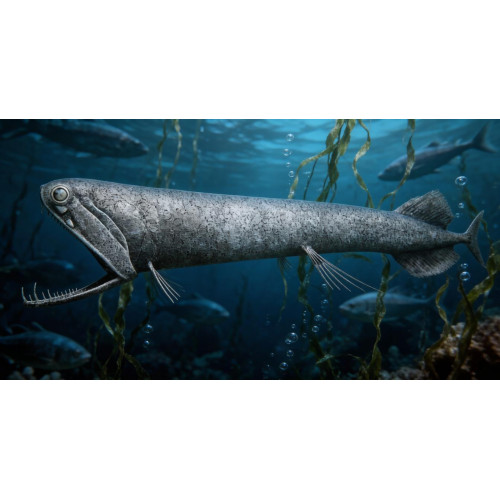
The stoplight loosejaw has an elongated body with one of the largest relative gapes of any fish. The lower jaw is approximately one-quarter of the fish's standard length. It possesses enlarged, curved fangs that prevent prey from escaping, and lacks gill rakers and gill teeth. A key identifying feature is the absence of a "floor" in its mouth (no skin between the mandibular rami), which reduces resistance when closing the jaws and allows it to consume larger prey. The anterior vertebrae are unossified, enabling the fish to "throw back its head" to take large prey.
Features of Fish Fins
The stoplight loosejaw has no spines in its fins. The dorsal fin contains 17–21 soft rays, and the anal fin contains 18–24 soft rays.
Fish Colouring
The stoplight loosejaw is uniformly dark brown to blackish, as its name niger (Latin for "black") suggests. The eyes have yellow lenses, which filter out blue light and increase sensitivity to longer wavelengths, enhancing the perception of red bioluminescence. The body lacks scales and has a soft, gelatinous texture.
Distribution
The stoplight loosejaw has a cosmopolitan distribution and is found worldwide in all oceans from Arctic latitudes at 66°N to approximately 30°S in the southern hemisphere, except for the Mediterranean Sea. In Australian waters, it is recorded off northwestern Western Australia and the Coral Sea off Queensland.
Habitat
This species is meso- and bathypelagic, inhabiting deep waters from 500 to 3,886 meters (1,640–12,750 feet). It is suggested that this species does not undergo substantial diel vertical migration and remains below 500 meters.
Size
The stoplight loosejaw can reach a maximum total length of 25.6 cm (about 10 inches). The maximum published weight is not specified in available sources.
Behavior
The stoplight loosejaw is unique among vertebrates in possessing both a long-wave (red) bioluminescence system and a bacteriochlorophyll-derived retinal photosensitizer that allows long-wave visual sensitivity. It has two types of photophores: a suborbital organ that produces red bioluminescence (peak emission at approximately 705 nanometers in the far red) and a postorbital organ that emits blue luminescence (maxima between 470–480 nanometers). As red light cannot penetrate into deep oceanic waters, most deep-sea animals have lost the ability to see red. This allows the stoplight loosejaw to shine an essentially invisible beam of light, giving it a huge advantage in its dark environment. The species is also notable for its flexible connection between the occiput and the first vertebra, allowing it to swallow large prey items by bending its head far back to widen its gape. It is a slow-growing, relatively long-lived species.
Food and Feeding Habits
The stoplight loosejaw has an enigmatic feeding ecology that diverges from its morphological adaptations. Despite having huge fangs and an enormous gape typical of predators of large prey, it is primarily a zooplanktivore. Large calanoid copepods make up 69–83% of prey numbers and 9–47% of prey biomass in specimens from different ocean basins. Of 62 specimens containing prey, 43 (69%) contained copepods and 19 (31%) contained only copepods. The species also consumes small fishes and decapod shrimps. This unusual feeding mode is explained by a two-part theory: (1) the combination of long-wave bioluminescence and vision systems allows the fish to search small volumes for food, sustaining itself by "snacking" on copepods between rare encounters with large prey, and (2) the fish may gain the raw material (chlorophyll derivative) for its long-wave visual sensitivity from the consumption of copepods.
Reproduction
The stoplight loosejaw reproduces through sexual reproduction with external fertilization. The species exhibits sexual dimorphism, with differences in the size of the postorbital photophore between males (5.8–11.9% upper jaw length) and females (2.8–8.1% upper jaw length). Specific details on breeding season or reproductive behavior are not documented in available sources.
Fishing
The stoplight loosejaw is not a commercial species and has no economic value. It is caught primarily as bycatch in scientific deep-sea trawling surveys. The species is of scientific interest due to its unique bioluminescent capabilities and unusual feeding ecology.
Relationship with a Person
The stoplight loosejaw is not considered a threat to humans and is classified as harmless. It is a deep-sea fish that lives at depths of 500–3,886 meters and is never encountered by swimmers or recreational divers. The species is of scientific interest due to its remarkable red bioluminescence and unique visual system. The species is listed as Least Concern (LC) on the IUCN Red List, assessed on 20 May 2013.
| Classification | |
| Phylum | Chordata |
| Class | Actinopterygii |
| Squad | Stomiiformes |
| Family | Stomiidae |
| Genus | Malacosteus |
| Species | Malacosteus niger |
| Features | |
| Conservation status | Least Concern |
| Habitat | Bathypelagic |
| Life span, years | No information |
| Maximum body weight, kg | No information |
| Maximum length, cm | 25,6 |
| Sailing speed, m/s | No information |
| Threat to people | Not edible |
| Way of eating | Predator |
Stoplight loosejaw
Tags: stoplight loosejaw