
Latin name
Myctophum punctatum
Other Names
The spotted lanternfish is also known simply as the spotted lanterfish. Its scientific name, Myctophum punctatum, was given by Rafinesque in 1810. The genus name Myctophum comes from the Greek words "mykter" (nose) and "ophis" (serpent), referring to its snout shape.
Identification
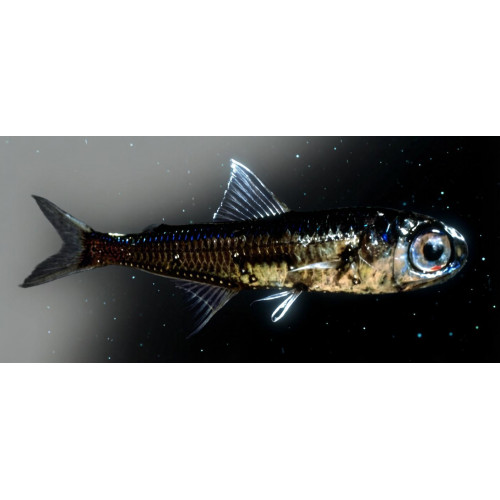
The spotted lanternfish has a fusiform (spindle-shaped) body typical of lanternfishes. A key identifying feature is the presence of stalked eyes in the larvae, which are elongated and enable the detection of a greater range of prey. The species has a high-oceanic, mesopelagic lifestyle.
Features of Fish Fins
The spotted lanternfish has the following fin characteristics: Dorsal fin: 13–14 soft rays. Anal fin: 20–22 soft rays. Pectoral fins: 14–15 rays. There are no spines in the dorsal or anal fins. The species has 25 (22–27) gill rakers.
Fish Colouring
The spotted lanternfish, like other members of the family Myctophidae, has photophores (light-producing organs) arranged in specific patterns on its body. Males possess 2–4 overlapping luminous scales supracaudally (above the tail), while females have 4–5 partially overlapping luminous patches infra-caudally (below the tail). The species has an AO series of photophores numbering 8 + 9, total 17 (15–16).
Distribution
The spotted lanternfish is found in the Northern Atlantic and the Mediterranean Sea. In the eastern Atlantic, its range extends from the Mauritanian Upwelling Region (15°N–20°N) with isolates as far as 30°N, and includes the Mediterranean Sea. In the western Atlantic, it is found from Greenland to the USA. It is also present in the Sea of Marmara. The species is one of the dominant species in midwater assemblages near the Mid-Atlantic Ridge.
Habitat
This species is marine and bathypelagic to mesopelagic, inhabiting depths from the surface down to 1,000 meters. During the day, it is found between 225–750 meters, with maximum abundance at 700–800 meters in the Mediterranean. At night, it rises to the surface and down to 125–190 meters (nyctoepipelagic). The species is oceanodromous, performing diurnal migrations.
Size
The spotted lanternfish can reach a maximum standard length of 11.0 cm (about 4.3 inches). It is an iteroparous species, capable of reproducing more than once in a lifetime.
Behavior
The spotted lanternfish is a nyctoepipelagic species that performs daily vertical migrations, rising to the surface at dusk to feed and returning to deeper waters during the day. It is a solitary carnivore. The species exhibits size stratification with depth: smaller specimens are found in deeper water at night. In the Mediterranean, its spawning season continues at a low level until summer. The larvae have stalked, elongated eyes and a pure rod-like retina, which is an adaptation for foraging at low light intensities.
Food and Feeding Habits
The spotted lanternfish is a carnivorous predator that feeds mainly on copepods and euphausiids (krill). Its diet also includes zoea stages of Brachyura (crab larvae) and fish fry (young fish). Larvae exhibit an ontogenetic change in diet, consuming larger prey items as they grow. Feeding activity is highest at dawn and dusk.
Reproduction
The spotted lanternfish is oviparous with sexual reproduction. The species is a batch spawner. Females produce 8–900 eggs per spawning event. Sexual maturity is reached at about 50 mm (5 cm) in length. Caudal glands develop in males at 35 mm and in females at 38 mm. Spawning occurs in the Atlantic south of the Secondary Polar Front(s) in late winter to early spring, and in the Mediterranean continuing at a low level until summer.
Fishing
The spotted lanternfish is not a commercial species. It is caught primarily as bycatch in scientific deep-sea trawling surveys. Its occurrence is described as common.
Relationship with a Person
The spotted lanternfish is not considered a threat to humans. It is a small deep-sea fish that lives at depths of 0–1,000 meters and is never encountered by swimmers or recreational divers. The species is of scientific interest due to its bioluminescent photophores, vertical migration behavior, and the unique stalked eyes of its larvae. The species is listed as Least Concern (LC) on the IUCN Red List, assessed on 11 July 2012.
| Classification | |
| Phylum | Chordata |
| Class | Actinopterygii |
| Squad | Myctophiformes |
| Family | Myctophidae |
| Genus | Myctophum |
| Species | Myctophum punctatum |
| Features | |
| Conservation status | Least Concern |
| Habitat | Bathypelagic |
| Life span, years | No information |
| Maximum body weight, kg | No information |
| Maximum length, cm | 11 |
| Sailing speed, m/s | No information |
| Threat to people | Edible |
| Way of eating | Predator |
Spotted lanternfish
Tags: spotted lanternfish