
Latin name
Diodon hystrix
Other name
Spotted porcupinefish, black-spotted porcupinefish or simply porcupinefish.
Identification
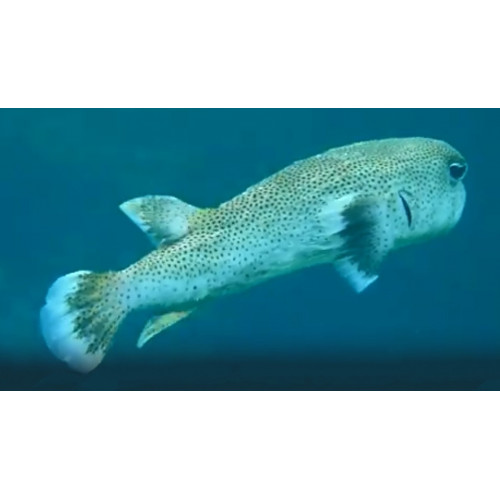
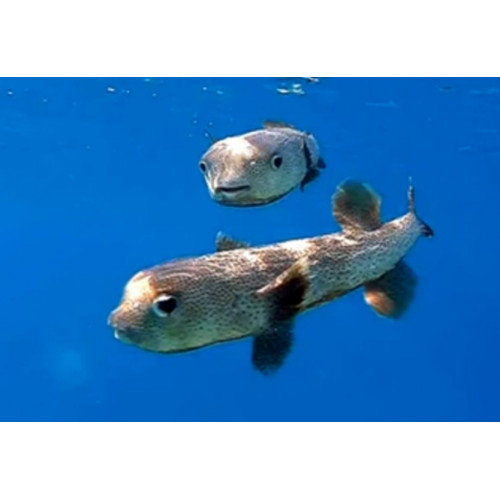
The body of the spot-fin porcupinefish is elongated with smooth skin covered with long, sharp spines that are modified scales. Each spike has two roots. The head is spherical with large eyes. The width of the head is 2.4-3.3 times the standard body length. The mouth is large and wide, terminal and almost always open. The teeth are fused in plates. The incisor plates on the upper and lower jaws are continuous, i.e. not separated by a suture. The mouth with jaws and incisors resembles the beak of a parrot. The gill openings are small and located at the bases of the pectoral fins.
Features of fish fins
The dorsal and anal fins are shifted to the caudal peduncle and have no barb rays. The dorsal fin has 14-17 soft rays and the anal fin has 14-16 soft rays. In adults, these fins and the caudal fin have rounded edges. The pectoral fins have 22-25 (rarely 21) soft rays. The pelvic fins are absent.
Fish colouring
The upper body, sides and fins are yellowish-brown, brown or gray. Numerous small dark spots are scattered over the entire surface of the body, head and fins, no large spots. The belly is white.
Distribution
Widespread in tropical and subtropical waters of all oceans. Western Indian Ocean: from southern Africa to the Red Sea, Sri Lanka and all major island groups. Australia: along the west and east coasts. Western Pacifica: New Caledonia, Kermadec archipelago, Hawaiian Islands, southern Japan. East Pacifica: from Mexico to Chile. Western Atlantic: 36°N to 20°S Central Atlantic: Ascension and St. Helena Islands. Western Atlantic: Bioko Island.
Habitat
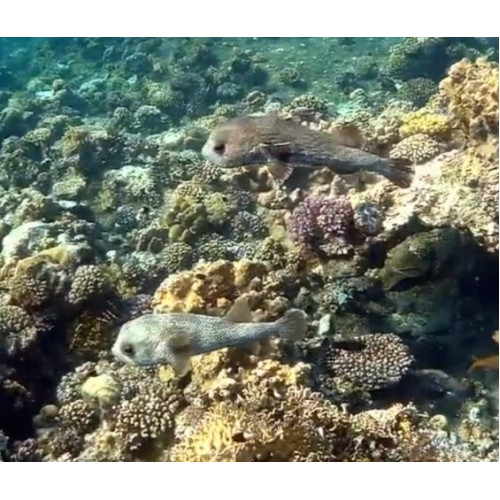
A subtropical marine species. Its depth range is from 2 to 50 meters, more commonly from 3 to 20 meters. Usually found in caves and burrows on shallow reefs.
Size
It is the largest fish in the family with a maximum length of 91 cm, usually around 40 cm. The maximum recorded body mass is 2.8 kg.
Behavior
Like other members of the family, when in danger, this fish can fill with water, stretching the stomach, and the whole body inflates and assumes a spherical shape. In this case, all spines are mobile and can rise up to 90°. When the fish is in a calm state, the spines are pressed against the body. Spot-fin porcupinefish are solitary (except during the breeding season) and predominantly nocturnal. During the day they hide in crevices, caves or under rocky ledges. They are most active at dawn and dusk.
Food and feeding habits
They feed mainly on sea urchins, snails and crustaceans. The structure of their teeth allows them to break through hard shells.
Reproduction
Females lay eggs in large gelatinous masses, often attached to rocks or other structures. Males fertilize the eggs, and after a few days, larvae develop. The larvae swim in the water column until they are ready to settle on the bottom. As they grow, the larvae feed on plankton and other small organisms.
Fishing
The species is of minor commercial interest. Fished for sale to aquariums.
Relationship with a person
Poisonous to eat. The skin and guts of these fish can be toxic due to the accumulation of tetrodotoxin.
Interesting facts
The spot-fin porcupinefish got its name due to its striking external resemblance to the terrestrial porcupine. This resemblance is based on two key features of its anatomy and behavior.
The main reasons for this name:
Like the porcupine, the entire body and head of this fish are covered with numerous long, sharp, and movable spines. At the slightest threat, the fish swallows water and inflates into a ball, becoming a practically impenetrable "spiny sphere." In this state, its spines stand erect, making the fish very similar to a curled-up porcupine. The word "porcupine" itself comes from the Latin and means "spiny pig" (porcus — pig and spina — thorn, spine). The species name hystrix also has ancient Greek origins and translates as "porcupine," which is a direct reference to the main feature of this fish.
| Classification | |
| Phylum | Chordata |
| Class | Actinopterygii |
| Squad | Tetraodontiformes |
| Family | Diodontidae |
| Genus | Diodon |
| Species | D. hystrix |
| Features | |
| Conservation status | Least Concern |
| Habitat | Pelagic |
| Life span, years | No information |
| Maximum body weight, kg | 2,8 |
| Maximum length, cm | 91 |
| Sailing speed, m/s | No information |
| Threat to people | Not edible |
| Way of eating | Planktonophage |
Spot-fin porcupinefish
Tags: spot-fin porcupinefish