
Latin name
Limanda punctatissima
Other Names
The speckled flounder is also known as the longsnout flounder, sand flounder, and sunagarei. Its scientific name, Limanda punctatissima, was given by Steindachner in 1879. The species is also known by the synonyms Hippoglossoides punctatissimus, Pleuronectes punctatissimus, and Limanda iridorum.
Identification
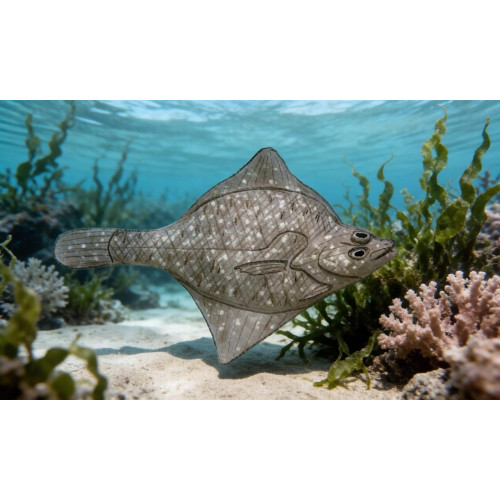
The speckled flounder has a strongly compressed, oval body typical of flatfishes. Its most distinctive feature is the elongated snout, which gives the fish its common name "longsnout flounder". The head profile above the eye is concave, and the snout length exceeds the eye diameter. The species has a single lateral line that forms a high arch above the pectoral fin base. The eyes are located on the right side of the body (right-eyed flounder), and the mouth is relatively large.
Features of Fish Fins
The speckled flounder has a long dorsal fin with 62–69 soft rays and a long anal fin with 46–50 soft rays. The pectoral fin on the eyed side contains 12 rays. The caudal fin has 11–12 branched rays. The pelvic fins are located on the underside of the body.
Fish Colouring
The speckled flounder is greyish-brown on the eyed (upper) side with numerous small light spots, which gives the species its common name "speckled flounder". The blind (lower) side is bright yellow. The body is covered with scales, and the lateral line contains 60–80 scales.
Distribution
This species is found in the northwestern Pacific Ocean. Its range extends from the southern Sea of Okhotsk and the Kuril Islands to the Sea of Japan, including coastal areas of Japan, Korea, and Russia (northern Primorye, southern Sakhalin). It is a temperate water species.
Habitat
The speckled flounder is a demersal (bottom-dwelling) species that lives on sandy and sandy-mud bottoms. It is an elittoral species, found from the shoreline down to 400 meters. Juveniles are most abundant at depths of less than 5 meters, while adults prefer depths of 5–30 meters. Juveniles are often found near reefs and macrophyte beds, while adults prefer sandy bottoms with seagrass (Zostera asiatica). In winter, adults migrate to depths of 180–300 meters.
Size
The speckled flounder can reach a maximum total length of 40 cm (about 16 inches) and a maximum weight of 450–530 g (about 1 lb). The common length is around 25–28 cm. Females grow larger and live longer than males. In the northern Primorye, the species reaches an age of 12 years.
Behavior
The speckled flounder is a demersal fish that spends most of its time on or near the bottom. Juveniles are found at shallower depths than adults. The species forms schools in shallows, particularly near freshened areas. Seasonal abundance peaks during the spawning period (June–July) and decreases during the high-temperature period (August–September). The species is known to migrate seasonally: adults move to deeper waters for wintering and return to shallower waters for spawning.
Food and Feeding Habits
The speckled flounder is a benthic feeder. Immature fish feed on nekto-benthic hydrobionts (small animals living near the bottom), while mature fish are benthophages, feeding on organisms living on or in the seafloor.
Reproduction
Spawning occurs in late May to mid-July at depths of more than 3 meters. Males reach sexual maturity at 2 years at a length of about 13 cm. Females mature at 3 years at a length of about 19 cm. Females grow faster, live longer, and reach larger sizes than males.
Fishing
The speckled flounder is a commercial species in parts of its range, particularly in Japan, Korea, and Russia. In Japan, it is sold in supermarkets as a small, affordable flatfish for home cooking. In the northern Primorye, it makes up a notable portion of flounder catches.
Relationship with a Person
The speckled flounder is not considered a threat to humans. It is classified as harmless. The species is valued as a food fish and is often prepared by frying, grilling, or simmering. It is primarily consumed in the regions where it is caught, making it somewhat of a regional delicacy in northern Japan and the Russian Far East.
Interesting facts
The long-snouted flounder (Limanda punctatissima) is capable of changing its coloration to blend in with the surrounding substrate. This is one of the most famous examples of camouflage in the fish world. This ability is due to special pigment cells in the skin — chromatophores. By changing their size and shape under the control of the nervous system, the fish can quickly adjust its appearance to match the color and texture of the bottom. In addition to changing color, the flounder often buries itself in the substrate, leaving only its eyes exposed on the surface. This makes it practically invisible to both predators and potential prey.
| Classification | |
| Phylum | Chordata |
| Class | Actinopterygii |
| Squad | Pleuronectiformes |
| Family | Pleuronectidae |
| Genus | Limanda |
| Species | Limanda punctatissima |
| Features | |
| Conservation status | Not Evaluated |
| Habitat | Bottom |
| Life span, years | 12 |
| Maximum body weight, kg | 0,53 |
| Maximum length, cm | 40 |
| Sailing speed, m/s | No information |
| Threat to people | Edible |
| Way of eating | Bentophage |
Speckled flounder
Tags: speckled flounder