
Latin name
Ceratias tentaculatus
Identification
The generic name Ceratias comes from the Greek keras ("horn"), referring to the prominent "fishing rod" (illicium) on the snout.
Like all anglerfish, this species exhibits extreme sexual dimorphism: females are gigantic predators with a classic "sea devil" appearance, while males are tiny, parasitic creatures.
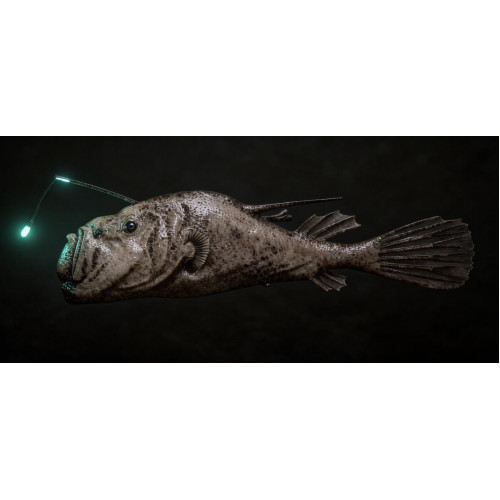
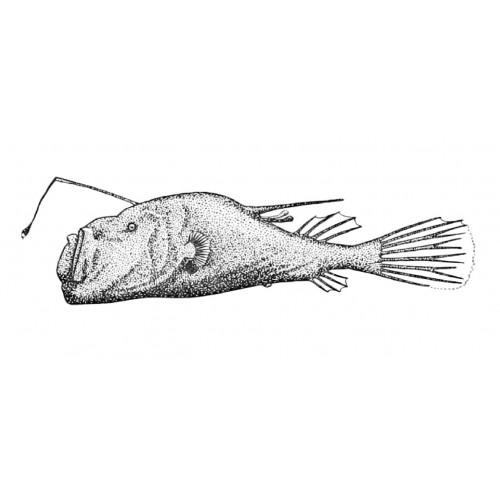
Females of the southern seadevil are the epitome of a deep-sea monster. They have a large, spherical body tapering toward the tail, and an enormous, wide mouth filled with needle-sharp teeth. Their soft bones and elastic stomach allow them to swallow prey nearly twice their own size. Above the mouth hangs a movable, thin appendage (the illicium), tipped with a bioluminescent lure (the esca). In this species, the esca has a unique shape: its front part is dark and massive, while the tip bears two thin, almost always split or branching appendages.
Males are drastically different. They are tens of times smaller than the females (reaching only a few centimeters). They lack a luminous lure, and their stomachs and teeth are not adapted for independent feeding. Their sole purpose in life is to find a female and permanently latch onto her with their teeth.
Features of fish fins
The southern seadevil has an unusual set of fins, the main one of which has been transformed into a hunting "fishing rod."
First dorsal fin: Short fin of 4 soft rays, located far back on the body.
Anal fin: Symmetrical to the second dorsal fin, located beneath it, also consisting of 4 soft rays.
Caudal fin: Large and rounded, with 9 soft rays.
Pectoral fins: Small, rounded fins on movable bases, containing 15–19 soft rays.
Pelvic fins: Completely absent, as is the adipose fin.
Fish coloring
The body and appendages of females are dark, which in total darkness makes the fish itself inconspicuous while brightly highlighting its glowing lure. Given the biology of related deep-sea anglerfish species, it can be assumed that males are also most likely dark. Like most pelagic deep-sea fish, their coloration probably ranges from dark brown to black. Such "uniform" serves as camouflage in the total darkness of the ocean depths.
Distribution
As its name suggests, this species inhabits the Southern Hemisphere, living in the waters of the Southern Ocean, as well as off the coasts of South Africa and Mozambique.
Habitat
This is a typical deep-sea species, found at depths ranging from 100 to nearly 3,000 meters (9,800 feet). This is the zone of eternal darkness, where sunlight does not penetrate.
Size
The maximum recorded total length is 88.0 cm (34.6 inches). However, it is important to understand that this data applies only to females. Males, which lead a parasitic lifestyle, remain dwarfed and grow to only a few centimeters. Exact data on body weight are unavailable.
Deep-sea species are characterized by slow metabolism, late sexual maturation, and consequently, a relatively long life. Some anglerfish species from other families live 20–30 years, so it can be assumed that Ceratias tentaculatus is also a long-lived species.
Behavior
Sexual parasitism is the most striking feature of all ceratiid anglerfish.
Guided only by pheromones, the male finds the female in complete darkness and bites into her skin. After this, their circulatory systems literally fuse. The male becomes a parasitic appendage: he completely loses his eyes, fins, and internal organs except for his gonads, receiving all nutrients from the female's bloodstream. A single large female may carry up to six such males, which are constantly ready to fertilize her eggs. In this way, nature has solved the problem of finding a mate in the vast and barren depths.
Food and feeding habits
An ambush predator. During the day, it stays near the bottom (bathydemersal species), rising higher into the water column at night. Its main hunting method is to lie motionless in the water and wiggle its glowing "fishing rod" in front of an unwary fish.
The diet of females consists of any creatures that fit into their enormous mouths: small and medium-sized fish, squid, and crustaceans. Thanks to their huge mouths and flexible stomachs, they can swallow prey nearly as large as themselves. Males do not feed independently.
Reproduction
Little is known about the reproduction of this specific species, but it follows the general pattern of the family Ceratiidae. The female releases a huge number of eggs into the water, which contain nutrients allowing the larvae to develop for a long time in the surface layers of the water. The larvae are completely unlike the adult fish: they have long spines and filaments that help them float in the water column. As they mature, they descend to greater depths.
Fishing
This fish species has no commercial value. It is encountered extremely rarely. All specimens known to science have been caught as bycatch in deep-sea trawls.
Relationship with a person
It is completely harmless to humans. Despite its rarity, the IUCN has assigned this species a conservation status of "Least Concern" due to its very wide range in the ocean.
This is a theoretically edible fish, but its meat is not eaten.
| Classification | |
| Phylum | Chordata |
| Class | Actinopterygii |
| Squad | Lophiiformes |
| Family | Ceratiidae |
| Genus | Ceratias |
| Species | C. tentaculatus |
| Features | |
| Conservation status | Least Concern |
| Habitat | Demersal |
| Life span, years | 30 |
| Maximum body weight, kg | No information |
| Maximum length, cm | 88 |
| Sailing speed, m/s | No information |
| Threat to people | Edible |
| Way of eating | Predator |
Southern seadevil
Tags: southern seadevil