
Latin name
Simenchelys parasitica
Other name
Pug-nosed eel, slime eel, or snub-nose parasitic eel.
Identification
Simenchelys parasitica is the only species in its genus Simenchelys and in the subfamily Simenchelyinae. It represents a unique evolutionary branch among eels.
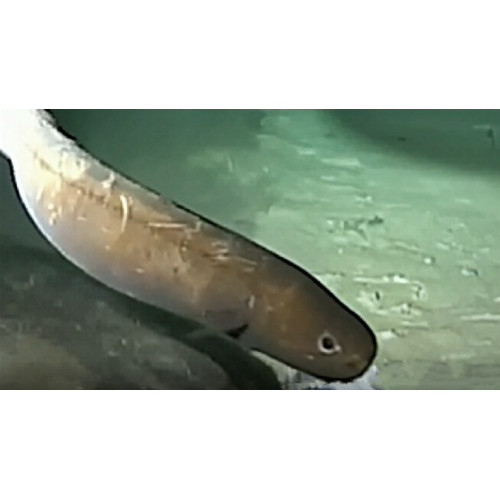
The snubnosed eel gets its name from its uniquely shaped head, which sharply distinguishes it from other eels. Its body is elongated, eel-like, and moderately compressed laterally. The main distinguishing feature is its very blunt, cylindrical head, which looks as though it has been "cut off." It is precisely because of this characteristic that the fish received its English name "snubnosed." The mouth is small, slit-like, located terminally (at the tip of the snout), and does not reach the level of the eyes. The body is covered with small, rudimentary (underdeveloped) scales that are embedded in the skin and arranged in groups, forming a right-angle basketweave pattern. The lateral line has 44 pores before the anal opening. The gill slits are widely spaced and located ventrolaterally (on the lower sides). This is an important systematic characteristic of the family Synaphobranchidae. The teeth have cutting edges and are arranged in a single row on both jaws.
Features of fish fins
The dorsal and anal fins fuse with the caudal fin, forming a single fringe around the posterior part of the body. The pectoral fins are well-developed and present. The pelvic fins, as in all eels, are absent.
Fish coloring
The snubnosed eel is colored in a uniform gray or grayish-brown. The edges of the dorsal and anal fins, as well as the area along the lateral line, are usually darker than the background color. In juveniles, the coloration is lighter, and the belly may be black.
Distribution
A cosmopolitan species, found in temperate and tropical waters around the world. The species is widely distributed in the Atlantic Ocean (from France to Madeira, the Azores, South Africa, as well as off the coast of the United States), in the Indian Ocean, and the western Pacific Ocean (off the coasts of Japan, Australia, New Zealand).
Habitat
It inhabits the continental slope and upper abyssal (deep-sea) zones at depths from 100 to 3,000 meters. It prefers water temperatures between 4 and 9°C. It leads a benthopelagic lifestyle—meaning it stays near the bottom but can rise into the water column.
Size
The maximum length of fish of this species reaches up to 61 cm, but individuals typically range from 30 to 60 cm in length. There is no precise data on weight. Sexual maturity is reached at a length of about 45 cm. Lifespan and population resilience: the population recovery rate is medium (population doubling in 1.4–4.4 years), which is typical for slow-growing deep-sea species.
Behavior
Thanks to its body shape and powerful muscles, the snubnosed eel is able to quickly burrow into soft sediment to escape predators or ambush prey.
Food and feeding habits
It feeds on small benthic invertebrates—epibenthic copepods and amphipods, as well as fish. This species has been repeatedly recorded as a parasite of other fish. The exact mechanism is still not fully understood. It is believed that snubnosed eels may bore tunnels into the bodies of large fish (including sharks), penetrating their internal organs and cavities. The blunt, "snubnosed" head and powerful teeth allow them to literally "gnaw" into the flesh of their victim. Some researchers believe they may not be active parasites but necrophages (scavengers) that penetrate the body of an already dead or weakened fish. However, finds of live snubnosed eels inside the heart of a living shark support active parasitism.
Reproduction
Little is known about the reproduction of these fish. It most likely reproduces by laying pelagic eggs that drift in the water column. The larval stage is a leptocephalus (a transparent, leaf-shaped larva typical of all eels), but it has not yet been positively identified. Only one late metamorphic specimen is known, found in the central North Pacific Ocean.
Fishing
Although the meat of this fish is not poisonous and it could potentially be used for food, its deep-sea lifestyle, small size, and biological characteristics make it unattractive for fisheries. It is not targeted commercially but is caught as bycatch during deep-sea research or fishing for other species.
Relationship with a person
Harmless. The International Union for Conservation of Nature (IUCN) has assigned the species Simenchelys parasitica the status of Least Concern. This means that the species' populations are currently not under any threat.
| Classification | |
| Phylum | Chordata |
| Class | Actinopterygii |
| Squad | Anguilliformes |
| Family | Synaphobranchidae |
| Genus | Simenchelys |
| Species | S. parasitica |
| Features | |
| Conservation status | Least Concern |
| Habitat | Pelagic |
| Life span, years | No information |
| Maximum body weight, kg | No information |
| Maximum length, cm | 61 |
| Sailing speed, m/s | No information |
| Threat to people | Edible |
| Way of eating | Parasite |
Snubnosed eel
Tags: snubnosed eel