
Latin name
Gempylus serpens
Other Names
The snake mackerel is the sole species in its genus and is known simply as the snake mackerel or common snake mackerel. Its scientific name, Gempylus serpens, was given by Cuvier in 1829. The genus name Gempylus comes from the Greek word "gempylos," meaning a kind of fish, while the species name serpens is Latin for "snake-like," referring to its elongated body. In Hawaii, this fish is locally known as hāuliuli.
Identification
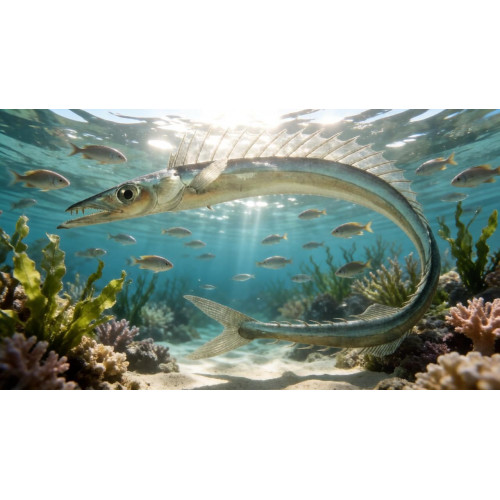
The snake mackerel has a greatly elongated, strongly compressed body. Its body depth is about 15–18 times into standard length, giving it a very slender, snakelike appearance. The head is long and pointed, measuring 17–18% of the standard length. A key identifying feature is the large mouth with a protruding lower jaw. Both jaws are densely packed with sharp, fang-like teeth, with the first few teeth in the upper jaw enlarged into fangs. A distinctive characteristic is the presence of two lateral lines on each side of the body. The upper lateral line runs along the dorsal contour to the end of the first dorsal fin base, while the lower lateral line descends gradually to about the tip of the pectoral fin and then runs mid-laterally. The pelvic fins are reduced to a single small spine and 3–4 soft rays. Scales are mostly absent, with scales only present on the posterior half of the body.
Features of Fish Fins
The snake mackerel has two dorsal fins. The first dorsal fin is long and low, containing 27–33 spines. The second dorsal fin is short, consisting of 1 tiny spine and 11–14 soft rays. The anal fin is positioned opposite the second dorsal fin and consists of 2 free spines followed by 1 spine and 10–12 soft rays. Both the second dorsal and anal fins are followed by a series of finlets: 5–7 finlets behind the second dorsal fin and 5–7 finlets behind the anal fin. The pectoral fins contain 12–15 rays, and the pelvic fins are tiny, located beneath the pectorals, containing 1 small spine and 3–4 soft rays. The caudal fin is deeply forked, and the tail base lacks keels. All fins are dark brown with somewhat darker margins.
Fish Colouring
The snake mackerel is uniformly dark brown to blackish, with a metallic or silvery reflection. All fins are dark brown, with the fin margins being somewhat darker than the rest of the fin.
Distribution
The snake mackerel has a cosmopolitan distribution and is found worldwide in tropical and subtropical seas between approximately 42°N and 40°S. Adults are also often caught in temperate waters. In the western Atlantic, it is found throughout the region, south to Chile. In Australian waters, it is found around the north of the continent, from Shark Bay (Western Australia) to Wollongong (New South Wales). Populations from the Atlantic and the Indo-Pacific differ in vertebral count (51–55 versus 48–50) and the number of first dorsal fin spines (30–32 versus 26–30), suggesting they may represent separate species.
Habitat
This species is strictly oceanic and pelagic, inhabiting surface to midwater depths. It is typically found from the surface down to 200 meters, but has been recorded at depths of up to 600 meters. Adults are usually solitary, while larvae and juveniles may be found in different depth zones.
Size
The snake mackerel can reach a maximum total length of 100 cm (about 3.3 feet), with a common length around 60 cm SL. Some sources report a maximum size of 125 cm. Males mature at about 43 cm SL, while females mature at about 50 cm SL. The species is known to weigh up to 5 kg.
Behavior
The snake mackerel is a strictly oceanic and usually solitary species. Adults conduct a diel vertical migration, staying in deeper water during the day and rising to the surface at night to feed. Larvae and juveniles exhibit an opposite migration pattern, staying near the surface during the day and moving deeper at night. The species is known to spawn throughout the year in tropical waters. As the fish mature and move into deeper water where there is less available light, they lose the cone cells in their eyes in favor of rod cells, an adaptation to low-light conditions.
Food and Feeding Habits
The snake mackerel is a carnivorous predator that feeds on a variety of prey. Its diet includes small fishes such as lanternfishes (myctophids), sauries, flying fishes, mackerels, and other bony fishes. It also feeds on cephalopods (squid) and pelagic crustaceans. It is in turn preyed upon by larger predators, including tuna and marlin.
Reproduction
The snake mackerel is an oviparous species, meaning it reproduces by laying eggs. Spawning occurs throughout the year in tropical waters. Females produce between 300,000 to 1 million eggs, depending on their size. Eggs and larvae are pelagic, drifting in the open ocean. Males reach sexual maturity at about 43 cm SL, while females mature at about 50 cm SL.
Fishing
The snake mackerel is of minor commercial importance and is caught primarily as bycatch in tuna longline fisheries. It is sometimes taken by recreational anglers. The species is marketed fresh, frozen, salted, or dried. It is not eaten raw but can be cooked in any way, and is also processed into fish sausages and fish cakes.
Relationship with a Person
The snake mackerel is not considered a threat to humans and is classified as harmless. It is sometimes encountered by anglers fishing at night in tropical waters. Thor Heyerdahl described a memorable encounter with a snake mackerel during the Kon-Tiki expedition, where the crew caught a fish that was "over three feet long, as slender as a snake, with dull black eyes and long snout with a greedy jaw full of long sharp teeth". In Hawaii, the fish is considered good eating cooked or dried. The species is listed as Least Concern on the IUCN Red List.
| Classification | |
| Phylum | Chordata |
| Class | Actinopterygii |
| Squad | Scombriformes |
| Family | Gempylidae |
| Genus | Gempylus |
| Species | G. serpens |
| Features | |
| Conservation status | Least Concern |
| Habitat | Pelagic |
| Life span, years | No information |
| Maximum body weight, kg | 5 |
| Maximum length, cm | 125 |
| Sailing speed, m/s | No information |
| Threat to people | Edible |
| Way of eating | Predator |
Snake mackerel
Tags: snake mackerel