
Latin name
Bathytoshia brevicaudata
Other Names
The short-tail stingray is also known as the smooth stingray, giant stingray, bull ray, and giant black ray. Its scientific name, Bathytoshia brevicaudata, was given by Hutton in 1875. The species was previously known as Dasyatis brevicaudata. The genus name Bathytoshia comes from the Greek "bathys" (deep) and "toshia" (a ray), while brevicaudata means "short-tailed" in Latin, referring to the tail being shorter than the disc in adults. The species is named in honor of Frederick Wollaston Hutton, a New Zealand scientist who first described it.
Identification
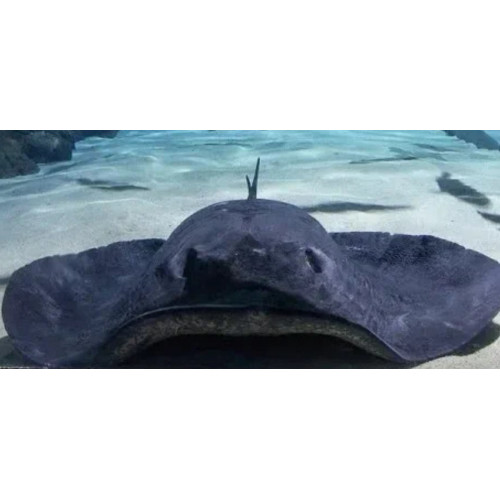
The short-tail stingray has a broad, diamond-shaped pectoral fin disc that is wider than it is long. The body is very thick and heavy, with a blunt, obtuse snout that barely extends beyond the disc. The eyes are small, and the interorbital space (distance between the eyes) is broad, up to four times the orbit length in adults. The mouth is located on the underside and often has 5–7 oral papillae. The tail is short, thick at the base, and strongly tapering; it is often shorter than the disc width. The skin is smooth, with no dermal denticles. However, in specimens larger than 45 cm disc width, a row of spear-shaped or starry-based thorns and tubercles appears on the midline of the tail before the sting. A key identifying feature is the presence of two spiracles behind the eyes on the dorsal surface, which draw in water for respiration. There are also white pores around the side of the head and a diagonal row of pores on each side of the anterior disc, which are part of the sensory system. The tail bears a prominent, venomous caudal sting (often one) with a short but noticeable ventral fin fold that extends just beyond the tip of the sting. The dorsal fin fold is reduced to a hard ridge.
Features of Fish Fins
The short-tail stingray has no spines or soft rays in its dorsal or anal fins (total dorsal spines: 0; total dorsal soft rays: 0; anal spines: 0; anal soft rays: 0). The pectoral fins are large and continuous with the head, forming the disc. The pelvic fins are rather small with narrowly-rounded apices. The caudal fin is absent; instead, the tail ends in a pointed tip. An adipose fin is absent.
Fish Colouring
The colouration of the short-tail stingray is generally plain and uniform. The dorsal (upper) surface is greyish-brown, sometimes with a bluish tint. The ventral (lower) surface is white, but the disc margin and undersurface of the tail are dusky. A distinctive feature is the presence of oblique rows of white spots on the dorsal surface of the pectoral fins in some individuals. The tail tip and the area above the eye are the darkest parts of the body. The inside of the spiracles is white. The eyes are small and set laterally on the head. The body is smooth and lacks scales.
Distribution
The short-tail stingray is found exclusively in the southern hemisphere, in temperate waters of the Indo-Pacific. Its range includes South Africa (from Cape Town to the Zambezi River in Mozambique), southern Australia, New Zealand, and has also been recorded off Japan and eastern Russia. It is a common species throughout its range and is considered abundant in many areas.
Habitat
This species is a marine, demersal fish that inhabits both marine and brackish waters. It is found over a wide depth range, from 0 to 476 meters, but is usually found at depths of 0 to 200 meters. It occupies a wide variety of habitats, including shallow coastal bays, estuaries, large inlets, harbors, rocky reefs, offshore islands, and the open sea floor. It is often found on sandy bottoms. The species is usually found offshore on the outer shelf and uppermost slope, but sometimes occurs close inshore in very shallow water. It prefers temperatures between 14.6°C and 28.5°C.
Size
The short-tail stingray is one of the largest stingrays in the world. It can reach a maximum disc width of 2.1 meters (7 feet) and a total length of 4.3 meters (14 feet). Its maximum published weight is 350 kg (770 lb). The common length is around 125 cm total length. Females are generally larger than males. Newborns measure about 32–36 cm disc width.
Behavior
The short-tail stingray is generally a slow-moving, bottom-dwelling species. It is mainly active at night (nocturnal) but can also be active during the day. It is known to form large seasonal aggregations, particularly in summer at the Poor Knights Islands in New Zealand and Hamelin Bay in Western Australia, which are thought to be related to mating or pupping. Individuals tend to stay within a relatively limited home range of under 25 km and do not undertake long migrations. The species is defensive by nature and harmless unless threatened. When approached, it frequently raises its tail in a scorpion-like fashion as a warning, but this is considered more inquisitive than aggressive. It can achieve sudden bursts of speed, flapping its pectoral fins with enough force to create an audible "bang" through cavitation. Body size, tide, and time of day all influence its fine-scale movement: smaller rays swim with more regular bursts of speed and greater sinuosity, rays swim faster on high tide, and they are more likely to exhibit bursts of speed at noon than at other times. Smaller fishes have been observed using swimming rays for cover while hunting. Known predators include copper sharks, smooth hammerheads, great white sharks, and killer whales.
Food and Feeding Habits
The short-tail stingray is a carnivorous benthic predator that feeds primarily on bony fishes and invertebrates. Its diet includes molluscs (bivalves and squid), crustaceans, worms, and small fishes. The species is a foraging generalist and will also consume pelagic invertebrates such as salps and hyperiid amphipods. It uses its electroreceptors (ampullae of Lorenzini) and highly developed senses of smell and touch to locate buried prey. The lateral line system on its underside allows it to detect the minute water jets produced by buried bivalves and spoon worms, which are then extracted by suction; excess water is expelled through the spiracles. Off South Africa, it has been observed patrolling the egg beds of chokka squid during mass spawnings, capturing squid that descend to the bottom to spawn.
Reproduction
The short-tail stingray is aplacental viviparous (ovoviviparous), meaning that eggs are fertilized and hatched inside the mother's body, and the young are born live. Embryos are initially nourished by a yolk sac and later by histotroph ("uterine milk"), a protein- and lipid-rich substance produced by the mother and delivered through specialized uterine extensions called trophonemata. The species forms large spawning aggregations during the summer (January to April) at specific locations, which serve as both mating and pupping grounds. Courtship and mating occur in midwater, where males follow receptive females and attempt to bite and grip their disc. Successful males flip upside down beneath the female, insert one of their claspers into her vent, and copulate for 3–5 minutes. Females may mate with multiple males. Litter size is typically 6 to 10 pups, but can be up to 15. Newborns measure 32–36 cm disc width and are independent from birth, receiving no parental care. The species reaches maturity at a disc width of about 120 cm. There is no published information on the age of first reproduction or lifespan.
Fishing
The short-tail stingray is caught as bycatch in various commercial fisheries, including inshore trawls, seines, snapper longlines, and purse seines. It is also a popular game fish for recreational anglers, who sometimes spear or harpoon it for sport. The fish is usually discarded or released after the tail is removed, and divers often observe rays without tails, suggesting they survive capture and release. The species is also kept in public aquarium facilities and adapts well to display. The species is of minor commercial importance globally.
Relationship with a Person
The short-tail stingray is not aggressive towards humans and causes harm only when startled or threatened. However, its barbed tail spine can inflict a severe or potentially fatal wound, as the spine contains a venomous neurotoxin. The species often raises its tail in a scorpion-like fashion when approached, which is a warning sign. Divers should give the ray space and avoid provoking or cornering it.
It is an edible fish. The 'wings' (pectoral fins) and the part of the head around the eyes are eaten. Stingray meat is not considered a delicacy and requires special preparation, as it may have a characteristic ammonia (urea) smell. This odor is removed by soaking in salt water or vinegar.
The species is currently listed as Least Concern (LC) on the IUCN Red List, with a stable population trend. However, it faces threats from habitat destruction, fishing, and pollution. The species is vulnerable to human activities due to its shallow coastal habitat and is a sentinel organism for monitoring the health of coastal ecosystems.
| Classification | |
| Phylum | Chordata |
| Class | Chondrichthyes |
| Squad | Myliobatiformes |
| Family | Dasyatidae |
| Genus | Bathytoshia |
| Species | B. brevicaudata |
| Features | |
| Conservation status | Least Concern |
| Habitat | Bottom |
| Life span, years | No information |
| Maximum body weight, kg | 350 |
| Maximum length, cm | 430 |
| Sailing speed, m/s | No information |
| Threat to people | Edible |
| Way of eating | Predator |
Short-tail stingray
Tags: short-tail stingray