


Latin name
Histrio histrio
Other name
Sargassumfish, sargassum anglerfish, sargassum frogfish, frogfish, marbled angler, mouse fish, anglerfish.
Identification
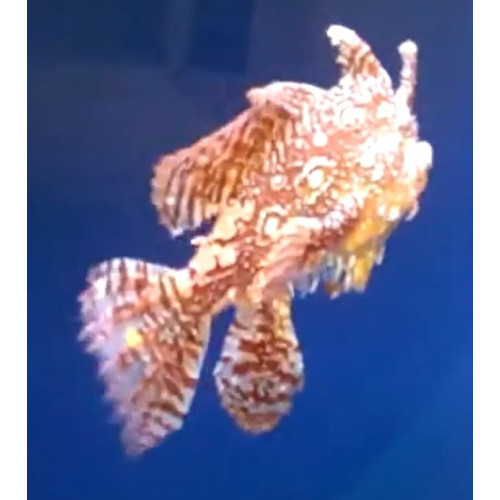
The sargassum fish is an unusual-looking fish that is well camouflaged among the seaweed beds where it lives. It is laterally compressed. The body and fins are covered with numerous growths resembling algae, but otherwise the skin is smooth, without dermal spines. The anterior spiny ray is modified into a thin projection on the upper lip called the illicium, at the tip of which is a fleshy growth called the esca. The boundary between the head and body is indistinct due to the absence of gill slits; the gills open as pores at the base of the pectoral fins.
Features of fish fins
The dorsal fin has three spines and 11–13 soft rays. The anal fin has no spines, with seven to 13 soft rays. The pelvic fins are large, the pectoral fins have 9–11 rays, are attached to the body, and are capable of grasping objects. The outer rays of the caudal fin are simple, while the central rays are forked.
Fish coloring
The coloration of the body and the large oral cavity is highly variable, but typically yellow, green, and brown spots and speckles appear on a lighter background, and the fins often have several dark stripes or spots. The fish can change color rapidly, becoming light, then dark, and back again.
Distribution
The sargassum fish has a cosmopolitan distribution in tropical and subtropical seas. They are found in parts of the Atlantic Ocean and the Indo-Pacific Ocean where drifting seaweed accumulates. In the western Atlantic, their range extends from the Gulf of Maine south to Uruguay. Sightings of this species have been reported in northern Norway, but this is likely due to being carried by the North Atlantic Current. In the Indian Ocean, they are found from the Western Cape Province eastward through the Mascarene Islands to India and Sri Lanka, and then in the western Pacific Ocean — east to the Mariana Islands, south to Perth in Western Australia and New Zealand, and north to Hokkaido.
Habitat
This species is a pelagic inhabitant. However, larvae and post-larvae up to 4 mm in length have been found at depths of 50 to 600 m (164 to 1,969 ft), while all individuals longer than 4 mm have been collected only at depths above 50 m (164 ft). Among sargassum seaweed, no fish smaller than 6 mm have been recorded, meaning that adult fish have always been caught only among sargassum seaweed.
Size
This fish species can reach a size of 15–30 cm (6–12 inches).
Behavior
This fish is preyed upon by larger fish and seabirds. To avoid underwater dangers, it can jump out of the water onto seaweed masses. It can also survive out of water for some time. Under normal conditions, excluding spawning periods, these are not schooling fish but solitary predators, characterized by inter- and intraspecific aggressive behavior when defending their territory. In such situations, they assume threatening postures and may even instantly inflate their bodies.
Food and feeding habits
A voracious predator that ambushes its prey and is a cannibal. One individual was found to have 16 fry in its stomach. They stalk prey among tangled algae, relying on their cryptic camouflage for concealment. They can maneuver through algal thickets and cling to stems using their grasping pectoral fins. The fish wave their esca like a fishing lure to attract small fish, shrimp, and other invertebrates. They can lunge forward rapidly to seize prey, forcefully expelling water through their gill openings. They can also expand their mouth several times its size in a fraction of a second, sucking in prey like a suction cup, and swallow prey larger than themselves.
Reproduction
This is a dioecious (separate sexes) species. During the breeding season, the male courts the female by persistently following her. When the female is ready to spawn, she quickly rises to the surface and lays eggs that are held together by gelatinous mucus. The eggs attach to algae, where they are fertilized by the male. After hatching, each larva is covered by a sheath, has a large rounded head, fully formed fins, and eyes with double notches. As the larva develops into a fry, this sheath fuses with the skin.
Fishing
The sargassum fish is not a commercial fishery species but is an object of aquaculture.
Relationship with a person
Reports of ciguatera poisoning.
| Classification | |
| Phylum | Chordata |
| Class | Actinopterygii |
| Squad | Lophiiformes |
| Family | Antennariidae |
| Genus | Histrio |
| Species | H. histrio |
| Features | |
| Conservation status | Least Concern |
| Habitat | Pelagic |
| Life span, years | No information |
| Maximum body weight, kg | No information |
| Maximum length, cm | 30 |
| Sailing speed, m/s | No information |
| Threat to people | Not edible |
| Way of eating | Predator |
Sargassum fish
Tags: sargassum fish