
Latin name
Alosa saposchnikowii
Other name
The scientific name of the species is Alosa saposchnikowii. It is commonly known as the Saposhnikovi shad . A synonym of the scientific name is Alosa saposhnikovi .
Identification
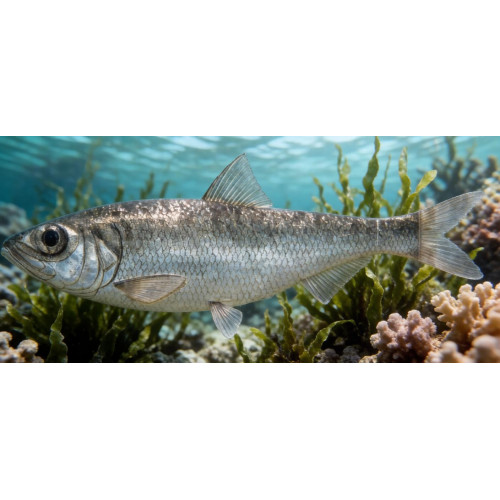
This fish has a typical "shad-like" body shape. A key identifying feature is its head, which has straight profiles on both the upper and lower sides. It has well-developed teeth in both jaws. On the upper side of the gill arches, Saposhnikovi shad has numerous soft, delicate gill rakers that filter tiny organisms out of the water.
This species is very similar to other shads in the Caspian Sea but can be distinguished by a combination of traits. Unlike the A. sphaerocephala (another Caspian shad), which has a blunter head with rounded profiles, the Saposhnikovi shad's head is straighter. It has fewer gill rakers (50 to 180) compared to the A. caspia (Caspian shad), and its body is less slender and herring-like than that of A. brashnikovi (Brashnikovi shad).
Features of fish fins
The Saposhnikovi shad has typical fin characteristics of the herring family:
Dorsal Fin: Single, with no spines.
Anal Fin: Single, with no spines.
Pelvic Fins: Located on the underside of the body (abdominal position), originating below the front of the dorsal fin. They have 9 soft rays.
Pectoral Fins: Normally developed.
Caudal Fin: Forked.
Adipose Fin: Absent.
Fish colouring
Males and females have a similar appearance with no significant differences in color. The exact details of the coloration are unknown.
Distribution
This species is found in the Caspian Sea, which is located between Europe and Central Asia.
Habitat
The Saposhnikovi shad inhabits both freshwater and brackish (slightly salty) water . It is a pelagic fish, meaning it lives in the open water column rather than near the bottom . It is euryhaline (tolerant of a wide range of salinity) and potamodromous (migrates within freshwater systems, not from sea to river) . The species is known to prefer colder waters compared to other shads in the Caspian Sea.
Size
Maximum Length: 38.1 cm total length (TL).
Common Length: 21.0 cm standard length (SL).
Maximum Weight: 469.00 grams.
Maximum Age: 9 years.
Behavior
The Saposhnikovi shad is a migratory species, but it is non-anadromous (it does not migrate from the sea into freshwater rivers to breed). Instead, it is considered one of the most cold-loving Alosa species in the Caspian Sea and is among the first to migrate north in the spring.
Food and feeding habits
This shad is a predatory fish. Its diet consists mainly of nekton (actively swimming aquatic organisms).
Main Food: It feeds on large crustaceans and small fishes.
Trophic Level: Studies indicate it is a high-level predator. The diet of juveniles and adults is primarily composed of nekton, with trophic levels ranging from 3.5 to 4.4, confirming its role as a carnivore.
Reproduction
The Saposhnikovi shad is a batch spawner that reproduces via external fertilization and provides no parental care to its offspring.
Spawning Grounds: It spawns in the northern Caspian Sea.
Spawning Season: Spawning occurs from the end of April, with a peak in the middle of May.
Spawning Habitat: They move into very shallow water to spawn, at depths of 1-6 meters, where the salinity ranges from 0.07 to 11 ppt.
Post-Spawning: After spawning, the young fish (juveniles) later move southward, though some may remain in the northern part of the sea.
Fishing
There is no information regarding commercial or recreational fishing for this fish species.
Relationship with a person
According to the IUCN Red List, the Saposhnikovi shad is classified as Data Deficient (DD), with the last assessment on 17 July 2017 . This means there is currently insufficient information to assess its risk of extinction. The species is considered harmless to humans.
| Classification | |
| Phylum | Chordata |
| Class | Actinopterygii |
| Squad | Clupeiformes |
| Family | Alosidae |
| Genus | Alosa |
| Species | A. saposchnikowii |
| Features | |
| Conservation status | Data Deficient |
| Habitat | Pelagic |
| Life span, years | 9 |
| Maximum body weight, kg | 0,469 |
| Maximum length, cm | 38,1 |
| Sailing speed, m/s | No information |
| Threat to people | Edible |
| Way of eating | Predator |
Saposhnikovi shad
Tags: saposhnikovi shad