
Latin name
Neogobius melanostomus
Identification
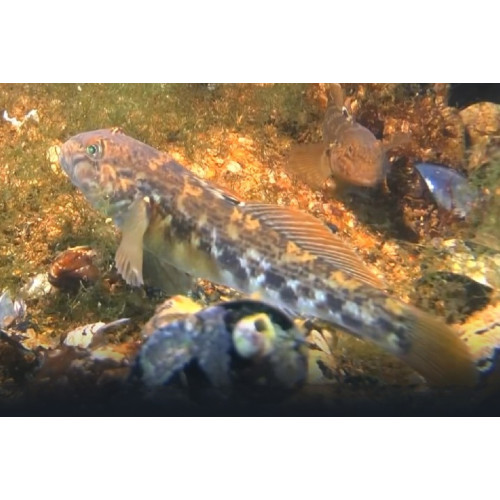
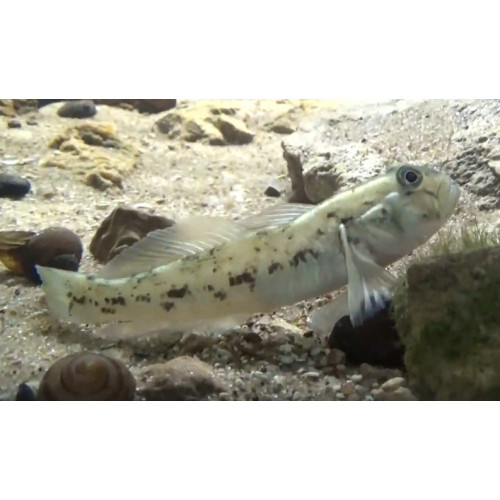
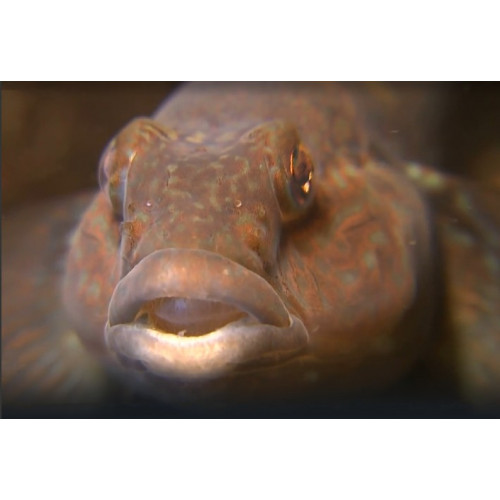
The body of the round goby is stocky and fully scaled, with scales extending onto the nape. The caudal fin is truncated. The system of lateral line canals and pores is well-developed, particularly on the head. The mouth is of moderate length, its corners not reaching beyond the eyes. Vertebral count: 31-34.
This species is distinguished from other gobies inhabiting European freshwater bodies by the following characters: the first branched ray of the second dorsal fin is approximately the same length as the penultimate ray; scales are absent on the midline of the nape in front of the predorsal area; the pelvic disc has small rounded lobes and its length is less than 1/6 of its basal width; the number of scales in the midlateral series is 45-54 + 2-3; a large black spot is present on the posterior part of the first dorsal fin.
Features of Fish Fins
Dorsal spines (total): 7 - 8; Dorsal soft rays (total): 12 - 17; Anal spines: 1; Anal soft rays: 9 - 14.
Fish Coloration
Coloration in the round goby is variable, ranging from light grey with indistinct side spots to brown with a distinct pattern or black. However, a key characteristic of this species is a distinct black spot, sometimes edged with yellowish, on the posterior part of the first dorsal fin. The head is generally darker than the body; the fins are grey.
Distribution
Inhabits the basins of the Black, Azov, and Caspian Seas. The species was introduced, likely via ship ballast water, into the North American Great Lakes.
Habitat
A marine, bottom-dwelling, amphidromous species preferring a temperate climate. Found in both saltwater and freshwater. Depth range: 0 to 30 meters. Ascends far up rivers.
Size
Body length ranges from 15 to 25 cm, with a weight up to 250 grams. Lifespan is approximately two and a half years.
Behavior
Prefers shallow waters, found in lagoons, lakes, large rivers, harbors, and over sandy or rocky substrates. Primarily inhabits well-vegetated or rocky bottoms. Can tolerate a temperature range of 0 to 30°C but thrives mainly in warm temperate waters; capable of enduring low-oxygen water for several days.
Food and Feeding Habits
Feeds on a wide range of invertebrates and small fish, primarily mollusks.
Reproduction
Spawning occurs from April to September. The female lays between 320 and 1000 large, oval-shaped eggs (2.2 × 3.9 mm), which are attached to stones. Juveniles hatch fully developed after about two weeks. Females reach sexual maturity in 2-3 years, males in 3-4 years.
The male's body turns entirely black during the spawning season. Males guard the eggs until hatching and typically die after spawning. It is suggested that egg clutches are sometimes transported attached to ship hulls, facilitating their spread to other areas.
Fishing
A commercial fish in the Black and Caspian Seas.
Relationship with Humans
Potential pest. Several countries have reported adverse environmental impacts following its introduction.Used in aquariums.
| Classification | |
| Phylum | Chordata |
| Class | Actinopterygii |
| Squad | Gobiiformes |
| Family | Gobiidae |
| Genus | Neogobius |
| Species | N. melanostomus |
| Features | |
| Conservation status | Least Concern |
| Habitat | Bottom |
| Life span, years | 2,5 |
| Maximum body weight, kg | 0,25 |
| Maximum length, cm | 25 |
| Sailing speed, m/s | No information |
| Threat to people | Edible |
| Way of eating | Predator |
Round goby
Tags: round goby