
Latin name
Solenostomus cyanopterus
Other name
Blue-finned ghost pipefish, racek's ghost pipefish, robust-snouted ghost pipefish, or the squaretail ghost-pipefish.
Identification
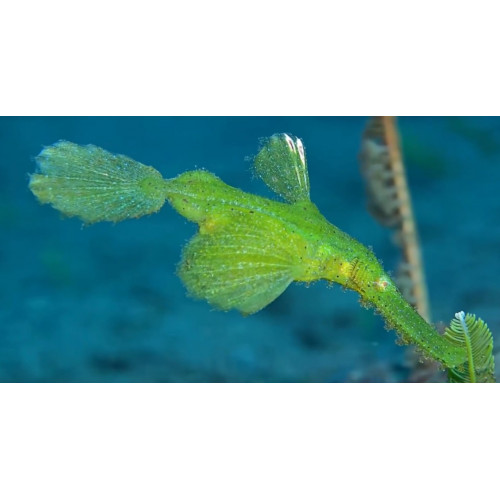
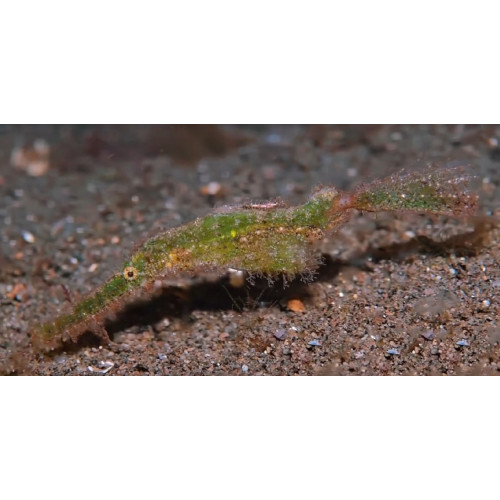
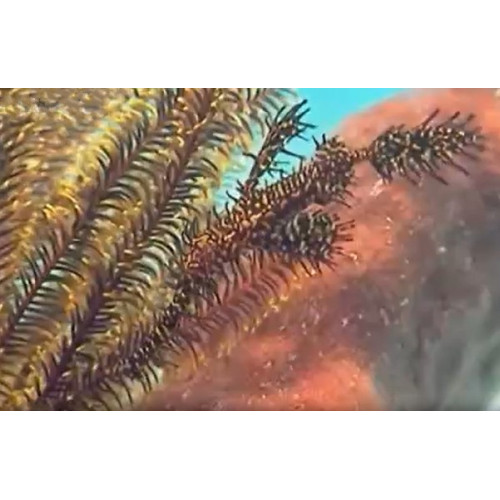
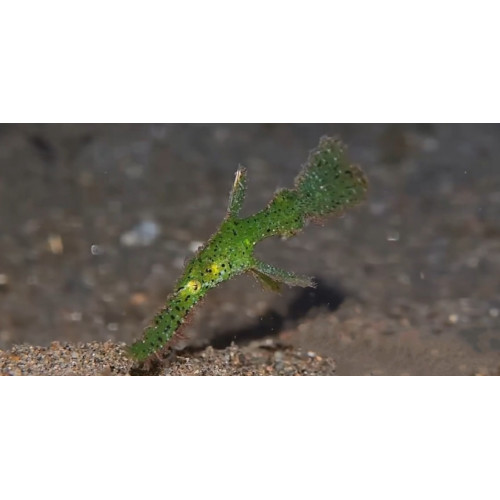
This species is a true chameleon of the underwater world. Its appearance is an ideal combination of shape and coloration that serves one purpose — to remain unnoticed.
Its body is laterally compressed, elongated, yet quite deep. The head ends in a long, tubular snout without teeth. The body is covered not with scales, but with 25–35 star-shaped (stellate) bony plates that serve as a kind of armor. The caudal peduncle is very short; in large females, it may be almost invisible. This is associated with one of the species' names — "squaretail."
Features of fish fins
First dorsal fin: consists of 5 spiny rays; is tall and "sail-shaped."
Second dorsal and anal fins: positioned opposite each other closer to the tail and consist of 17–22 soft rays.
Pectoral fins: broad, fan-shaped.
Pelvic fins (sexual dimorphism): in males, they are small and ordinary; in females, they are greatly enlarged, fused together, and form a "brood pouch" (marsupium) that the female holds under her belly.
Fish coloring
Coloration (main feature): This fish can change color within 24–36 hours, adapting to its surroundings. Coloration ranges from red, purple, and brown to yellow, green, or even pink. An important detail: between the first three rays of the dorsal fin are two elongated dark blue (almost black) spots. The body and fins are often covered with small black and white dots and a marbled pattern.
Distribution
Widely distributed in the warm waters of the Indo-Pacific region.
It is found from the Red Sea and the eastern coast of Africa to Fiji, north to southern Japan, and south to the northern coast of Australia.
Habitat
A demersal (bottom-dwelling) species. It inhabits sheltered coral and rocky reefs, as well as deep, clear estuaries with seagrass beds and macroalgae, at depths of up to 28 meters (92 feet).
Size
This is a fairly small species that does not grow to impressive sizes. The maximum recorded length of this species is only 17 cm (6.7 inches), with females typically slightly larger than males. On average, these fish reach a length of about 15 cm (6 inches).
Regarding weight, precise data on body mass for this species is unavailable. This can be explained by the fact that the robust ghost pipefish has a very light, almost "translucent" body with thin bony plates instead of scales, and even at its maximum length, it presumably weighs only a few tens of grams.
Behavior
A very slow-moving and calm fish. It leads a secretive lifestyle, hovering upside down among seagrass or corals. This species is monogamous and lives in permanent pairs (male + female).
Food and feeding habits
Despite lacking teeth, it is a predator, but its hunting strategy is based on stealth.
It feeds on small benthic and pelagic invertebrates, particularly mysid shrimp and other small crustaceans. It is an ambush predator, using its incredible camouflage. It freezes among the algae, and when prey swims close enough, it sucks it in with its long, tubular mouth (creating a vacuum) in a fraction of a second.
Reproduction
This is one of the most interesting aspects of their biology. Unlike true pipefish (seahorses), where the male carries the eggs, in ghost pipefish, it is the female who does so. The enlarged pelvic fins of the female fuse together, forming a pouch in which she carries the eggs. This species has a very short life. They reproduce only once and die soon after. Fully developed larvae, about 3 mm (0.12 inches) long, hatch from the eggs, with pigmented eyes, a formed mouth, and spines on their bodies. They lead a planktonic lifestyle.
Fishing
This fish species is not targeted for fishing — it has no commercial value and is too rare to be a commercial target. The primary way the robust ghost pipefish ends up in human hands is as bycatch in shrimp trawling. During the breeding season, they descend to coral reefs or muddy bottoms, where they become less visible and more vulnerable to bottom trawls. It is during this period that they are most often accidentally caught. Despite their exotic appearance, they are hardly ever collected for sale to aquariums, as they are extremely difficult to keep, requiring specific live food (small crustaceans) and ideal water conditions.
Relationship with a person
This fish is completely safe for humans. Theoretically, this fish could be eaten, like thousands of other species, but in practice, it is not a food product. When encountering it in the water, it is better to admire its amazing camouflage and grace than to think about eating it — due to its rarity, lack of culinary value, and the potential danger of unknown toxicity.
Despite its rarity, the species has a wide range and is listed on the IUCN Red List as Least Concern.
| Classification | |
| Phylum | Chordata |
| Class | Actinopterygii |
| Squad | Syngnathiformes |
| Family | Solenostomidae |
| Genus | Solenostomus |
| Species | S. cyanopterus |
| Features | |
| Conservation status | Least Concern |
| Habitat | Bottom |
| Life span, years | No information |
| Maximum body weight, kg | No information |
| Maximum length, cm | 17 |
| Sailing speed, m/s | No information |
| Threat to people | Edible |
| Way of eating | Predator |
Robust ghost pipefish
Tags: robust ghost pipefish