
Latin name
Rhynchactis macrothrix
Other Names
The long-filament whipnose anglerfish is known in Chinese as 長絲吻巨棘鮟鱇 (long-snouted giant-spined anglerfish) or 巨絲吻巨棘角鮟鱇. Its scientific name, Rhynchactis macrothrix, was given by Bertelsen and Pietsch in 1998. The genus name Rhynchactis comes from the Greek words "rhynch" (beak or snout) and "aktis" (ray), referring to the illicium (fishing rod) that arises near the tip of the snout. The species name macrothrix refers to the relatively long secondary filaments of the illicium.
Identification
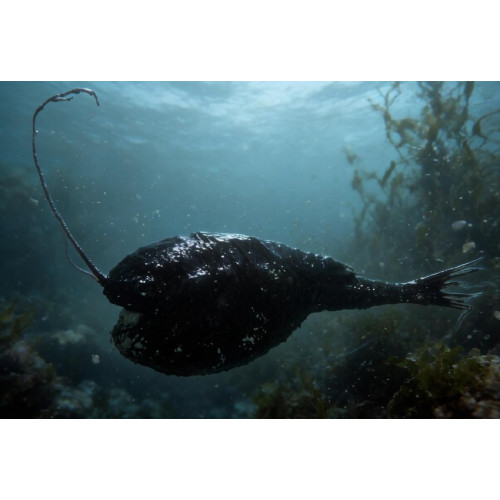
The long-filament whipnose anglerfish has an elongated, slightly compressed body with a small head that is about 35% or less of standard length (SL). The illicium (fishing rod) arises from the snout just behind its tip and lacks a terminal bait (esca). Key identifying features include:
Illcium length: The illicium is exceptionally long, measuring 109–144% of standard length.
Filaments: The distal tip bears 3–4 small unpigmented filaments, some with tiny distal swelling; the distal 28–57% of the illicial length bears 11–20 secondary filaments, with the five longest measuring 6–15% SL.
Teeth: The lower jaw lacks teeth; after metamorphosis, the dentary teeth degenerate in females. Smaller specimens may have upper jaw teeth.
Oral gland: An oral gland, resembling papillae or fish eggs, is present in the upper part of the mouth.
Skin: Large specimens have distinct fine spines on the skin surface, while smaller ones lack them.
Features of Fish Fins
The long-filament whipnose anglerfish has a single dorsal fin containing 3–4 soft rays, and a single anal fin with 3 soft rays. The pectoral fins have 17–18 soft rays. There is no adipose fin. The longest caudal fin rays measure 34–37% of standard length. As with all members of the family Gigantactinidae, the pelvic fins are absent.
Fish Colouring
The colouration of Rhynchactis macrothrix is not extensively documented, but some details are available: The secondary filaments are darkly pigmented to the base of the terminal filaments in large specimens (110–113 mm), divided on each side by a narrow, well-defined longitudinal transparent band. The distal tip filaments are unpigmented. The body is generally darkly pigmented, as is typical for deep-sea anglerfishes.
Distribution
Rhynchactis macrothrix has a wide but scattered distribution:
Atlantic Ocean: Found in both the western and eastern Atlantic.
Western Indian Ocean: Recorded in this region.
Western Pacific: Reported from Taiwan, making it the only Pacific record for this species.
Habitat
This species is marine and bathypelagic, inhabiting deep waters from 300 to 2,000 meters. Juveniles are pelagic, living in the food-rich upper layers of the ocean, while post-metamorphic fish live in the midwater or deep layers of the open ocean.
Size
Rhynchactis macrothrix exhibits the following size characteristics: Maximum size for females: 15.2 cm SL (standard length). Recorded specimens: Extremely rare, with only five specimens known worldwide.
Behavior
Little is known about the behavior of Rhynchactis macrothrix due to its extreme rarity. As a member of the family Gigantactinidae (whipnose anglers), it is likely an active predator that uses its extraordinarily long illicium to attract prey. The illicium, which can be longer than the body, is equipped with numerous filaments that may mimic small organisms, luring prey toward the waiting mouth.
Food and Feeding Habits
Specific dietary information for Rhynchactis macrothrix is not available in the search results. Based on the biology of other whipnose anglers (Gigantactinidae), it likely feeds on a variety of midwater organisms, including small fishes and invertebrates.
Reproduction
Rhynchactis macrothrix reproduces through sexual reproduction. The species exhibits sexual dimorphism, with females being significantly larger than males (as is typical for deep-sea anglerfishes). Specific details on breeding season or reproductive behavior are not documented in available sources.
Fishing
Rhynchactis macrothrix is not a commercial species and has no economic value. It is known only from scientific deep-sea trawling surveys. The species is extremely rare, with only five specimens collected worldwide as of the latest records. It is of scientific interest only.
Relationship with a Person
Rhynchactis macrothrix is not considered a threat to humans and is classified as harmless. It is a deep-sea anglerfish that lives at depths of 300–2,000 meters and is never encountered by swimmers or recreational divers. The species is of scientific interest due to its remarkable morphology and extreme rarity. The species is listed as Data Deficient (DD) on the IUCN Red List, assessed on 8 July 2014. Conservation actions include monitoring its population and habitat due to its restricted distribution and vulnerability to deep-sea fishing.
| Classification | |
| Phylum | Chordata |
| Class | Actinopterygii |
| Squad | Lophiiformes |
| Family | Gigantactinidae |
| Genus | Rhynchactis |
| Species | Rhynchactis macrothrix |
| Features | |
| Conservation status | Data Deficient |
| Habitat | Bathypelagic |
| Life span, years | No information |
| Maximum body weight, kg | No information |
| Maximum length, cm | 15,2 |
| Sailing speed, m/s | No information |
| Threat to people | Not edible |
| Way of eating | Predator |
Rhynchactis macrothrix
Tags: rhynchactis macrothrix