
Latin name
Gorgasia sillneri
Other name
Sillner's garden eel
Identification
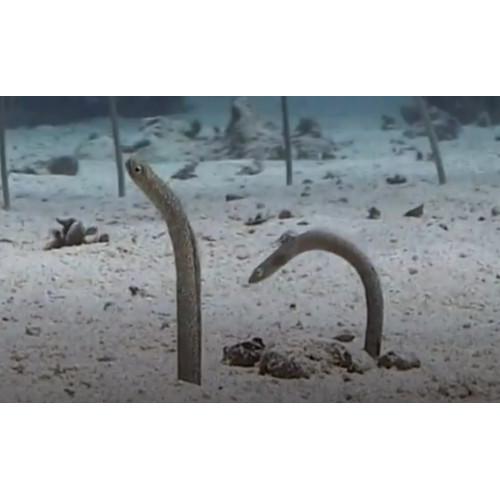
The Red Sea garden eel has an extremely elongated, cylindrical body shape. It is particularly long and thin, with the tail exceeding the combined length of the head and trunk, which allows it to effectively anchor itself and move within its self-made burrows. Scales are completely absent; instead, the body is covered with a smooth, mucus-coated layer that provides protection against abrasion from sediment particles. The head is small and slender, with a very short snout whose length is less than the diameter of the eye, and a moderately sized, slightly oblique terminal mouth suited for capturing planktonic prey. The eyes are well developed. Internally, the skin consists of a thick, multilayered epidermis (up to 2 mm thick) covered by a dense collagenous dermis richly populated with saccular and goblet cells that secrete large amounts of mucus for lubrication, adhering sediment to the burrow walls, and protection against mechanical damage. The musculature has a complex myotomic structure divided into four separate bundles, which support low-power undulatory movements for maintaining the burrow and anchoring the tail, rather than for prolonged swimming. A prominent lateral line system is present on the head, connected by a supra-temporal canal, facilitating sensory perception within the confined spaces of the burrow.
Features of fish fins
Pectoral fins are present but reduced in size, while pelvic fins are absent; the dorsal fin begins near the gill opening, and the dorsal and anal fins do not form a continuous structure around the tail, contributing to the overall streamlined profile for burrowing. The tail ends in a reinforced, pointed tip that allows the eel to anchor itself and burrow into the sand tail-first.
Fish coloring
The body of the Red Sea garden eel is pale yellowish-white, accented by darker bands or spots, particularly noticeable on the head and fins. This coloration may intensify during feeding. Differences in appearance are minimal, and sexual dimorphism is virtually absent. Juveniles have a paler coloration with fewer markings compared to adults. Geographic variations in coloration have not been recorded, consistent with the limited range of this species in the Red Sea.
Distribution
They are distributed in the Gulf of Aqaba in the Red Sea, in the western Indian Ocean. Potential range expansion beyond the Red Sea is constrained by ecological barriers, particularly the hypersaline conditions of the Bitter Lakes in the Suez Canal, which have historically restricted bidirectional migration between the Red Sea and the Mediterranean Sea.
Habitat
This is a marine tropical eel. It inhabits muddy or sandy flats adjacent to coral reefs, where soft sediments allow them to dig burrows. Such habitats are typically found at depths of 4 to 55 meters (13 to 180 feet), often near seagrass beds, which provide stable substrates for colony formation. This species thrives in the tropical waters of the northern Red Sea, especially the Gulf of Aqaba, with preferred temperatures ranging from 24 to 30°C (75 to 86°F) and salinities of 40 to 42‰. Areas with weak currents, characterized by fluctuating tidal flows averaging about 10 cm/s (4 inches/s), facilitate plankton drift without pushing the eels out of their burrows. These fish avoid rocky substrates and areas with high sedimentation, which impede burrowing and stability.
Size
Males can reach a maximum total length of 83.8 centimeters (33.0 inches). The diameter of the slender body is approximately 0.5–1 cm (0.2–0.4 inches).
Behavior
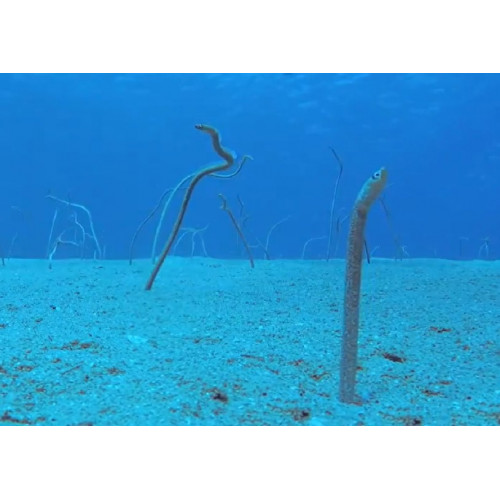
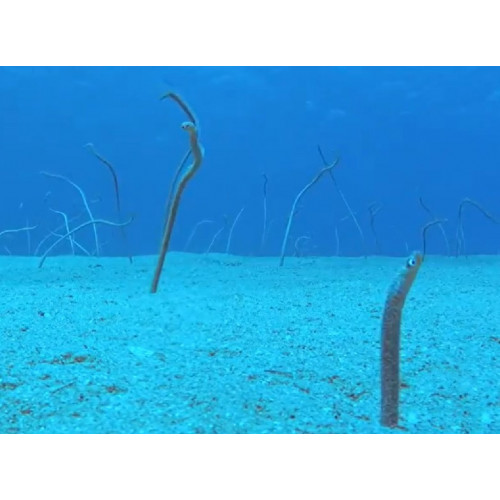
The Red Sea garden eel is a "sedentary" fish. It digs a burrow up to 50 centimeters (20 inches) long in the substrate and binds its walls with mucus. When everything is calm, the eel sits in the burrow, half-exposed. But as soon as a predator appears, the fish vanishes into the burrow and plugs the entrance with sand. Colonies of these fish can reach densities of hundreds of individuals per square meter in optimal soft-sediment areas, with distances between nearest neighbors averaging about 52 cm (20 inches), minimizing competition while ensuring group cohesion. Although this species forms large monospecific colonies, it coexists with other garden eel species in shared soft-bottom habitats, but no symbiotic relationships have been documented.
Food and feeding habits
Planktivorous fish that primarily feed on drifting zooplankton, including copepods, gelatinous zooplankton, arrow worms, and other small invertebrates captured from the water column. This diet is well-suited to their burrowing lifestyle, where prey is carried by currents rather than actively pursued.
When feeding, Gorgasia sillneri emerge from their burrows, exposing approximately 70–75% of their bodies, swaying and striking at prey within a distance of 15–20 cm (6–8 inches). Using short, rapid head lunges powered not by fins but by undulatory body movements, they employ an expanding mouth to intercept drifting prey.
The eels actively feed during daylight hours under fluctuating tidal currents (typically 10–50 cm/s or 4–20 inches/s) and retreat fully into their burrows at night or when threatened.
Reproduction
They reproduce in dense burrow colonies on sandy substrate, where adults lead a largely sedentary lifestyle but shift burrow positions to facilitate mating. Before spawning, prospective males establish their burrows in close proximity to one another, although it remains unclear which sex initiates the relocation; males actively guard the female from rival males, often engaging in prolonged and vigorous fights for mating rights. Such territorial behavior suggests a mating system involving male guarding of females, potentially allowing access to multiple partners within the colony.
Courtship behaviors are exhibited through intensified body swaying and trunk extension observed among colony members. On the day of spawning, the male emerges from his burrow toward the female, and both individuals widely spread their dorsal fins in display. The male then rubs his head against the female's body; if the female does not respond, she retreats into her burrow, but if receptive, she extends outward and wraps her body around the male once or twice, aligning their urogenital openings for gamete transfer. This embrace may last up to nine hours or longer, culminating in external fertilization.
This species undergoes a complex life cycle beginning with a larval leptocephalus stage. These transparent, leaf-shaped larvae drift in the epipelagic zone, feeding on plankton and being carried by ocean currents. Leptocephalus larvae range in total length from 9.2 to 68.0 mm, with most (10–30 mm) being in early and mid-stages of development; the maximum larval length before metamorphosis is estimated at 100–110 mm. Metamorphosis marks the transition from leptocephalus to a more eel-like juvenile form, occurring at approximately 100–110 mm after a prolonged pelagic phase lasting several months, as inferred from related species. After metamorphosis, juveniles settle on sandy substrate in coastal shallow waters, where they excavate permanent burrows using their tails and mouths; colonies often form soon after settlement. Post-settlement growth is initially relatively rapid, with juveniles establishing burrows and feeding on plankton from an elevated position.
Fishing
This species is not commercially important.
Relationship with a person
The Red Sea garden eel is not eaten; it is mainly used for keeping in aquariums.
| Classification | |
| Phylum | Chordata |
| Class | Actinopterygii |
| Squad | Anguilliformes |
| Family | Congridae |
| Genus | Gorgasia |
| Species | G. sillneri |
| Features | |
| Conservation status | Data Deficient |
| Habitat | Bottom |
| Life span, years | No information |
| Maximum body weight, kg | No information |
| Maximum length, cm | 83,8 |
| Sailing speed, m/s | No information |
| Threat to people | Not edible |
| Way of eating | Planktonophage |
Red Sea garden eel
Tags: red sea garden eel