
Latin name
Amphiprion bicinctus
Other name
Two-banded anemonefish, twoband anemonefish.
Identification
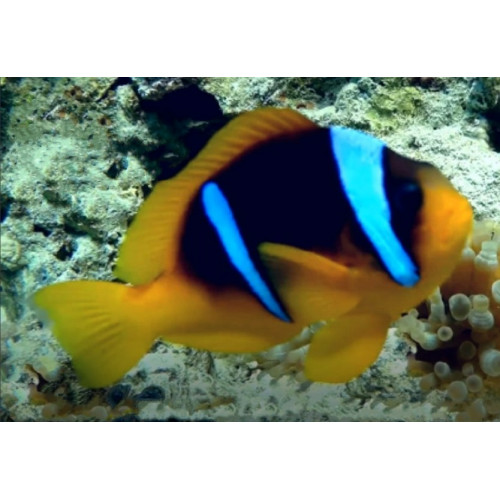
Small fish with a spindle-shaped body. The cross-section is compressed.
Features of fish fins
There are 9–10 dorsal spines, 2 anal spines, 15–17 dorsal soft rays, and 13–14 anal soft rays.
Fish coloring
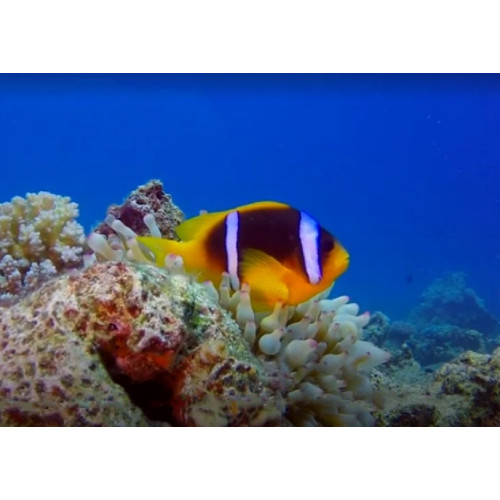
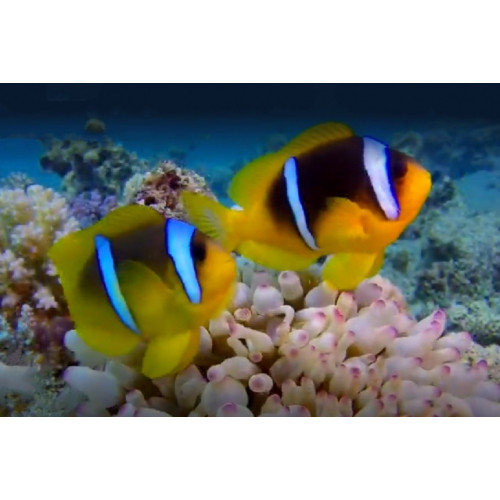
The body of these fish can range from yellow-orange to dark brown in color. Most often, the coloration is bright, with a yellow-orange base color and two white stripes. Within the species, there may be variations in coloration, most commonly depending on distribution, but also depending on sex, age, and host species.
Distribution
They are distributed in the warm waters of the Indian and Pacific Oceans. They are the only clownfish species inhabiting the reefs of the Red Sea. They are also present in the Gulf of Aden and around the Chagos Archipelago.
Habitat
A marine tropical species. It inhabits sheltered reefs or shallow lagoons at depths of up to 30 meters (98 feet). It is non-migratory.
Size
Males grow up to 10 centimeters (3.9 inches) in length, and females up to 14 centimeters (5.5 inches).
Behavior
A territorial and aggressive species that lives in pairs among the stinging tentacles of sea anemones, which provide protection from predators. Within the coral reef community, they exist in symbiosis with sea anemones of the species Entacmaea quadricolor, Heteractis aurora, H. crispa, H. magnifica, and Stichodactyla gigantea.
Within the Red Sea clownfish group, there is a strict dominance hierarchy. The largest and most aggressive fish is the female, who is at the top.
Food and feeding habits
The Red Sea clownfish feeds on algae, invertebrates, and leftover food from its protector anemone. However, it does not live solely on the anemone's table scraps—it also catches some prey on its own. Moreover, it always carries its catch home and gives a portion of it to the anemone. It turns out that this partnership is beneficial to both parties.
Reproduction
Oviparous (egg-laying); they mate during reproduction. Both obligate and social monogamous pairing are observed. Eggs are demersal and adhere to the substrate. Males guard the eggs and fan them. Sex change occurs within 26–145 days. During observations, a functional male laid eggs 26 days after the female left the area. They are protandrous hermaphrodites, meaning they first develop into males and then, as they mature, become females.
Fishing
They have no commercial value as a food source. They are too small for human consumption.
Relationship with a person
Harmless. It is not an edible fish. It can be kept in marine aquariums.
| Classification | |
| Phylum | Chordata |
| Class | Actinopterygii |
| Squad | Blenniiformes |
| Family | Pomacentridae |
| Genus | Amphiprion |
| Species | A. bicinctus |
| Features | |
| Conservation status | Least Concern |
| Habitat | Reef |
| Life span, years | No information |
| Maximum body weight, kg | No information |
| Maximum length, cm | 14 |
| Sailing speed, m/s | No information |
| Threat to people | Not edible |
| Way of eating | Omnivore |
Red Sea Clownfish
Tags: red sea clownfish