
Latin name
Balistes vetula
Other Names
The queen triggerfish is known by several alternative names, including old wife. Its scientific name, Balistes vetula, was given by Linnaeus in 1758. The genus name Balistes comes from the Latin word "balista," meaning crossbowman, which in Greek relates to "ballo" — to throw. In other languages, it is known as Königin-Drückerfisch (German), Koningin trekkervis (Dutch), Baliste royal (French), and Pesce balestra regina (Italian).
Identification
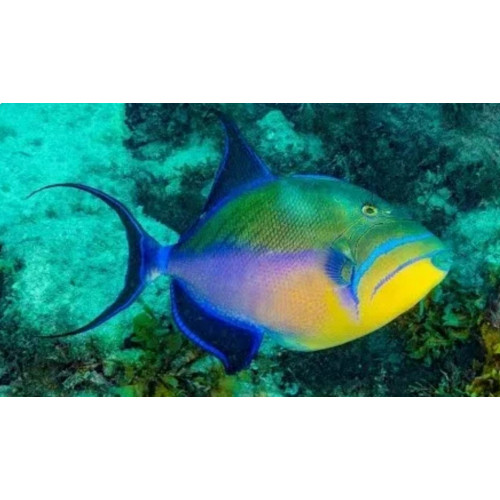
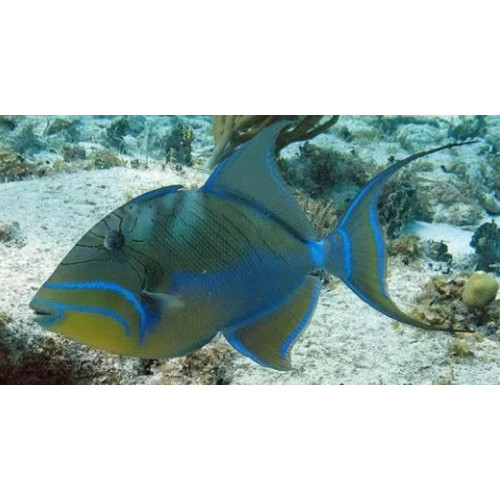
The queen triggerfish has a large, oval-shaped body that is laterally compressed. The eyes are located towards the top of the head and have the remarkable ability to move independently of each other. The mouth and snout are positioned forward, with the mouth having a distinct shape. A key identifying feature is the triggerfish's characteristic dorsal fin arrangement.
Features of Fish Fins
The queen triggerfish has two dorsal fins. The first dorsal fin consists of 3 spines (total dorsal spines: 3), and the second dorsal fin has 29–32 soft rays. There are no anal spines, but the anal fin has 27–29 soft rays. The pectoral fins have 13–15 soft rays, and there are no pelvic fins.
The Trigger Mechanism
The name "triggerfish" comes from the unique locking mechanism of the first two dorsal spines. The fish can erect the first spine, and the second spine locks it into an upright position. This mechanism is used defensively: when threatened, the triggerfish can wedge itself into a crevice and erect the spine, making it extremely difficult for predators to remove.
Fish Colouring
The colouration of the queen triggerfish is striking and distinctive. The back is greenish or bluish gray, while the lower part of the head and abdomen are orange-yellow. Two broad, diagonal, curved bright blue bands run from the snout to below and in front of the pectoral fins. The lowermost band is continuous with a blue ring around the lips. A broad blue bar runs across the caudal peduncle (base of the tail), and there are blue submarginal bands in the median fins. Small lines radiate from around the eyes. Juveniles are silver to gray with yellowish tints and have rows of small spots forming diagonal lines on the back.
Distribution
The queen triggerfish is found in the Western and Eastern Atlantic Ocean. In the western Atlantic, its range extends from Canada to southern Brazil, including Florida, the Bahamas, Bermuda, the Gulf of Mexico, and the Caribbean. In the eastern Atlantic, it is found at Ascension Island, Cape Verde, the Azores, and south to Angola.
Habitat
This species is a marine, reef-associated fish. It is typically found over rocky or coral areas at depths of 3 to 30 meters (9.8–98.4 ft), but it can occur as deep as 275 meters (902 ft). It may also be found over areas with sand or seagrass.
Size
The queen triggerfish can reach a maximum total length of 60 cm (about 24 inches). The common length is around 30 cm. Its maximum published weight is 5.4 kg. It can reach a maximum recorded age of 23 years.
Behavior
The queen triggerfish is generally a solitary species, but it may occasionally form schools. It is diurnal (active during the day) and is often seen moving in its environment. While it is typically fearful of divers, it is well-known for its defensive "trigger" mechanism, where it locks itself into crevices using its dorsal spines when threatened. It can also produce a throbbing sound by using a specialized membrane beneath its pectoral fin as a warning to predators.
Food and Feeding Habits
The queen triggerfish is primarily a carnivore that feeds mainly on benthic invertebrates. Its diet consists largely of sea urchins, crabs, bivalves, shrimp, starfish, sea cucumbers, and polychaetes. It also occasionally eats algae. It has a remarkable hunting strategy for sea urchins: it blows water to overturn the urchin and then attacks the area where the spines are short.
Reproduction
The queen triggerfish reaches maturity at a length of about 23 cm. The species is gonochoristic (individuals are either male or female). Spawning occurs when males establish territories and court females. The eggs are pelagic and are released into the water column.
Fishing
The queen triggerfish is caught using various methods, including line fishing, spearfishing, and fish traps. It is considered an excellent food fish but is only of minor commercial importance. It is also a popular gamefish and is sometimes kept in very large marine aquaria.
Relationship with a Person
The queen triggerfish poses a significant health risk to humans if eaten. It is classified as poisonous to eat. This toxicity is occasional and specifically linked to the fish's liver, which can cause intoxication. In addition to the toxicity of its liver, this species is also included in the list of fish that can be carriers of ciguatera — a severe food poisoning that affects the nervous system. The species is in great demand and highly appreciated, both as a food fish (despite the risk) and for the aquarium trade. It is currently classified as Near Threatened on the IUCN Red List.
| Classification | |
| Phylum | Chordata |
| Class | Actinopterygii |
| Squad | Tetraodontiformes |
| Family | Balistidae |
| Genus | Balistes |
| Species | B. vetula |
| Features | |
| Conservation status | Near Threatened |
| Habitat | Reef |
| Life span, years | 23 |
| Maximum body weight, kg | 5,4 |
| Maximum length, cm | 60 |
| Sailing speed, m/s | No information |
| Threat to people | Edible |
| Way of eating | Carnivore |
Queen triggerfish
Tags: queen triggerfish