
Latin name
Encheliophis boraborensis
Other name
Carapus parvipinnis
Carapus boraborensis
Encheliophis parvipinnis
Fierasfer boraborensis
Fierasfer kagoshimanus
Fierasfer parvipinnis
Jordanicus parvipinnis
Rhizoiketicus carolinensis
Identification
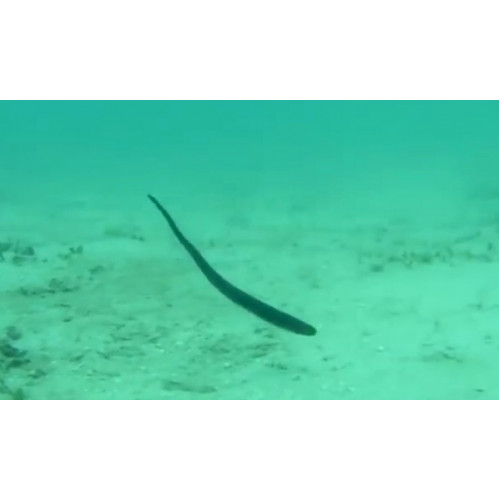
The pinhead pearlfish is a slender, tapered fish resembling an eel. Body depth ranges from moderate to small. The upper jaw is free and movable. Teeth are heart-shaped. Gill membranes are partially or completely fused. The swim bladder has a thin terminal membrane or bulb. It is significantly enlarged and occupies most of the body cavity. These fish have very small eyes, and star-shaped melanophores are located near the jaws, becoming more numerous in older specimens. Scales are absent.
Features of fish fins
Dorsal soft rays (total): 31–42; anal soft rays: 45–57; vertebrae: 119–126.
This fish species has no pelvic fins but does have short pectoral fins and an elongated dorsal fin with 31–42 soft rays. The equally long anal fin has 45 to 57 soft rays, and C. boraborensis is the only species in the family with melanophores on the anal fins.
Fish coloring
The pinhead pearlfish is medium brown in color.
Distribution
It is distributed throughout the Indo-Pacific. Its range extends from Mauritius and the Society Islands north to Taiwan and the Yaeyama Islands, including the Mariana and Caroline Islands.
Habitat
A marine tropical demersal species. Its depth range is from 1 to 150 meters (490 feet).
Size
The pinhead pearlfish can reach a length of 30 cm (12 inches).
Behavior
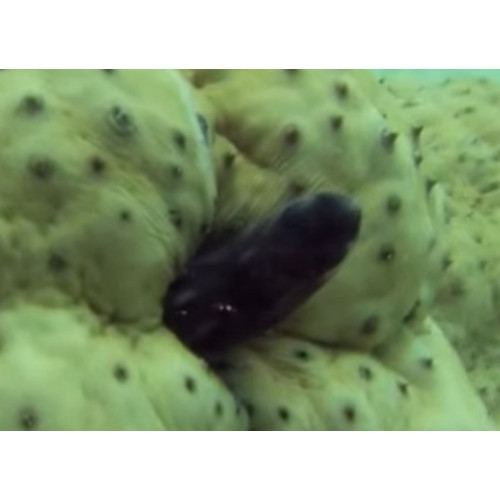
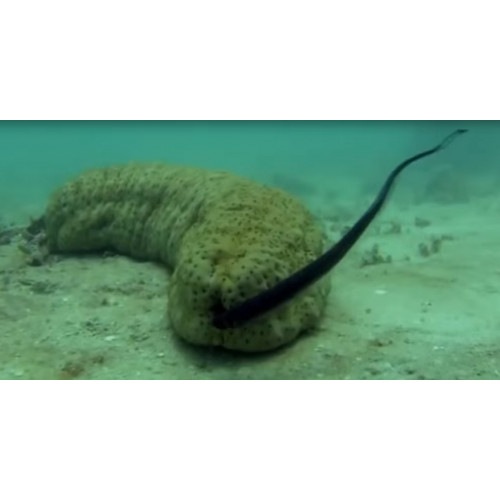
They typically inhabit the body cavity of sea cucumbers, entering through the anus. Competition among pearlfishes occurs for the right to occupy the host. It has been observed that two adult males fought inside a sea cucumber until one of them was killed; another fish showed bite marks on its tail, and the stomach of one adult individual contained a juvenile of the silver pearlfish (Encheliophis homei).
When E. boraborensis enters a host and finds that a pearlfish is already present, it produces sounds. The sounds produced consist of regular pulse beats, and the timing differs between males and females, so the sex of the fish can be determined by the sounds they make. If the fish already present is closely related, the call often becomes a single longer pulse. When E. homei enters a sea cucumber already occupied by E. boraborensis, its call also often shortens to a single pulse, but in this case, it is shorter than its usual call. Both fish are capable of modifying their calls, adapting them to any species of fish they encounter inside their hosts.
Food and feeding habits
The pinhead pearlfish, with its small eyes and specialized mouthparts, may feed, at least partially, on the host's tissues. Preference is given to the leopard sea cucumber (B. argus), as well as the pineapple sea cucumber (T. ananas), which is also used for this purpose.
Reproduction
No specific information is available on the reproductive characteristics of this fish species. However, it is known that in some species of Carapidae, pairs of males and females may inhabit the same sea cucumber, suggesting that mating and spawning occur inside the host's body.
Fishing
This fish species is not targeted as an independent object of commercial fishing.
Relationship with a person
Harmless. It is not an edible fish for humans.
| Classification | |
| Phylum | Chordata |
| Class | Actinopterygii |
| Squad | Ophidiiformes |
| Family | Carapidae |
| Genus | Encheliophis |
| Species | E. boraborensis |
| Features | |
| Conservation status | Least Concern |
| Habitat | Bottom |
| Life span, years | No information |
| Maximum body weight, kg | No information |
| Maximum length, cm | 30 |
| Sailing speed, m/s | No information |
| Threat to people | Not edible |
| Way of eating | Parasite |
Pinhead pearlfish
Tags: pinhead pearlfish