
Latin name
Huso persicus
Other name
Acipenser güldenstädti persicus
Identification
Until recently, it was assigned to the genus Acipenser and called Acipenser persicus. However, in 2025, based on phylogenetic studies showing the paraphyly of this genus, the species was reclassified into the genus Huso. Its synonymy also includes the name Acipenser gueldenstaedti persicus.
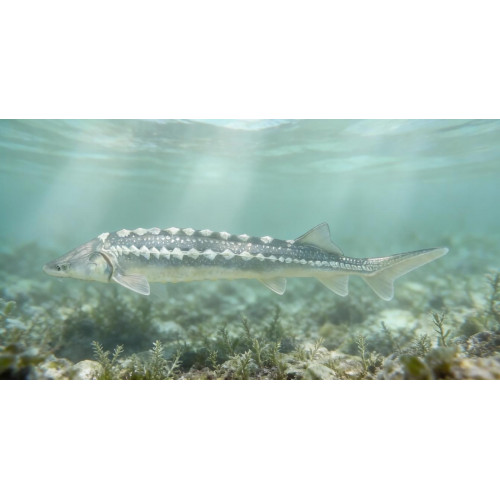
This is a large fish with a characteristic sturgeon-like elongated, massive body that has a bluish tint. Like other sturgeons, the body is covered with rows of bony scutes, and the snout is elongated.
Features of fish fins
Like all sturgeons, this species has a number of characteristic features in the structure of its fins that distinguish it from many other fish.
Pectoral fins: located low on the body, just behind the gill covers. In sturgeons, the first ray of the pectoral fin is modified and is a thick, pointed bony spine. It serves for defense and possibly for support when moving along the bottom.
Dorsal fin: located in the posterior part of the body, shifted closer to the tail, which is one of the distinguishing features of sturgeons.
Anal fin: located under the caudal section, opposite the dorsal fin, but closer to the tail.
Like many primitive fish, the caudal fin of sturgeons is heterocercal (unequal-lobed). This means that the upper lobe is significantly longer than the lower lobe, and the end of the spine extends into it. Externally, this gives the tail a "shark-like" shape.
In sturgeons, unlike many salmonids, the adipose fin is absent.
Its fins (particularly the pectoral ones) must be powerful and resilient enough to match its large size and bottom-dwelling, migratory lifestyle.
Fish coloring
The main body tone is gray-bluish or ash-gray, with a distinct bluish tint. The belly of the fish is light, almost white. The back may be dark blue-black. Overall, its body appears more slender and lighter compared to the Russian sturgeon.
Distribution
Its main range is the Caspian Sea basin, where it is most numerous in its southern part. Individual specimens are also found in the eastern part of the Black Sea.
Habitat
The Persian sturgeon is an anadromous fish, inhabiting the salty and brackish waters of the seas. It leads a bottom-dwelling lifestyle, inhabiting coastal and estuarine zones of the sea. As a typical anadromous fish, it undertakes long spawning migrations from the Caspian Sea into rivers. During the spawning run, adults ascend rivers with fast currents, choosing large, deep channels with rocky or pebbly bottoms for spawning. After spawning, adults likely return to the sea to feed. Juveniles, after hatching, spend their first summer in river biotopes.
Size
This is one of the large fish of the Caspian basin. The maximum recorded total body length is 255 cm (100 inches), and weight can reach 70 kg (154 lbs). According to other data, the maximum length for females can reach 176 cm (69 inches). Fish reach sexual maturity at a length of about 137 cm (54 inches).
Like all sturgeons, the Persian sturgeon is characterized by slow growth and late maturation, which indirectly indicates a significant lifespan. For comparison, its close relative — the beluga sturgeon (Huso huso) — has a maximum recorded age of 46 years, and some individuals could live over 100 years.
Behavior
The Persian sturgeon spends most of its life in the Caspian Sea, preferring its southern and middle parts. For feeding, it can use almost the entire sea area, but its distribution depends on temperature, depth, and water clarity. In winter, it is more often found on the continental slope of the Northern Caspian and the eastern shelf of the Middle Caspian.
With the onset of the breeding season, sturgeons head to the rivers. This migration has its own features. The main spawning rivers for this species are the Kura River and rivers flowing into the Caspian off the Iranian coast (e.g., the Sefidrud). In the Volga, this species enters in significantly smaller numbers, and there it is the least numerous sturgeon species. The population in the Volga is mainly represented by the spring race, which enters the river in spring, but there is also a small portion of the winter race, which migrates in autumn. The bulk of the spawners travel along the Main Bank of the Volga delta. This sturgeon prefers short, fast mountain rivers and does not ascend them high. In the Volga, it spawns on the remaining channel ridges in the lower tailwater. For spawning, the sturgeon chooses areas with strong currents on rocky or pebbly bottoms.
Food and feeding habits
The diet of these fish changes throughout life. Juveniles feed on small benthic invertebrates, such as mysids, chironomid larvae, and amphipods. As they mature, at the age of 2–3 years, they transition to feeding on crabs and fish. Adults are predators, with fish forming the basis of their diet.
Reproduction
Like all sturgeons, this is a slow-growing and late-maturing fish. It reaches sexual maturity at a length of about 137 cm (54 inches). For spawning, it ascends into rivers, searching for areas with strong currents, large and deep channels, as well as rocky or pebbly bottoms. Spawning occurs at fairly high water temperatures — 20–25°C (68–77°F). Timing varies depending on the river.
Volga River: from late July to early August.
Kura River: from April to mid-September.
Ural River: from June to July.
Fishing
The capture of this fish is likely completely prohibited, except perhaps for highly specialized scientific or aquaculture purposes. In Iran, where about 80% of the population is concentrated, work is being carried out on artificial breeding and release of juveniles to maintain population numbers.
Relationship with a person
This is an edible fish, and it is highly valued for its gastronomic qualities. However, its consumption is associated with important caveats due to its conservation status.
The International Union for Conservation of Nature (IUCN) has assigned the Persian sturgeon a conservation status of Critically Endangered. The main threats to its existence are related to human activities. These include: poaching, dam construction, and the loss and degradation of spawning grounds due to river pollution.
| Classification | |
| Phylum | Chordata |
| Class | Actinopterygii |
| Squad | Acipenseriformes |
| Family | Acipenseridae |
| Genus | Huso |
| Species | H. persicus |
| Features | |
| Conservation status | Critically Endangered |
| Habitat | Demersal |
| Life span, years | 100 |
| Maximum body weight, kg | 70 |
| Maximum length, cm | 255 |
| Sailing speed, m/s | No information |
| Threat to people | Edible |
| Way of eating | Predator |
Persian sturgeon
Tags: persian sturgeon