
Latin name
Saccopharynx ampullaceus
Other Names
The gulper eel is known by several alternative names, including pelican-fish, gulper, and taillight gulper. Its scientific name, Saccopharynx ampullaceus, was given by Harwood in 1827. The genus name Saccopharynx comes from the Latin "saccus" (sack) and the Greek "pharynx" (throat), referring to its large, bag-like mouth. The species is also known by the synonyms Ophiognathus ampullaceus and Saccopharynx flagellum. In Chinese, it is called 囊咽鰻 (囊鳃鳗).
Identification
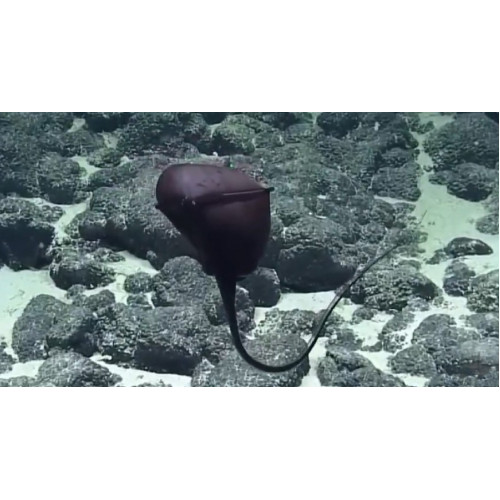
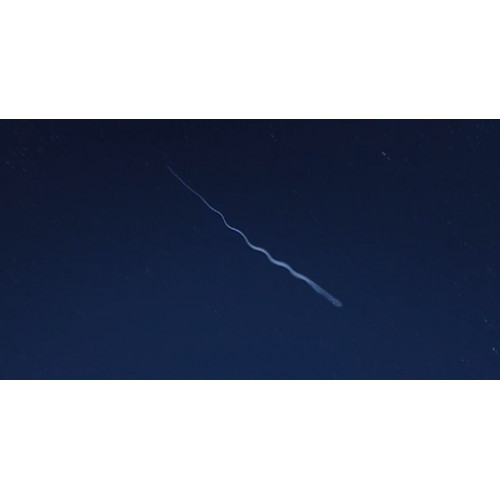
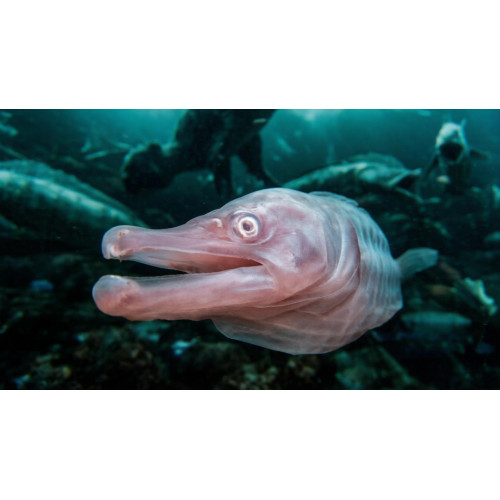
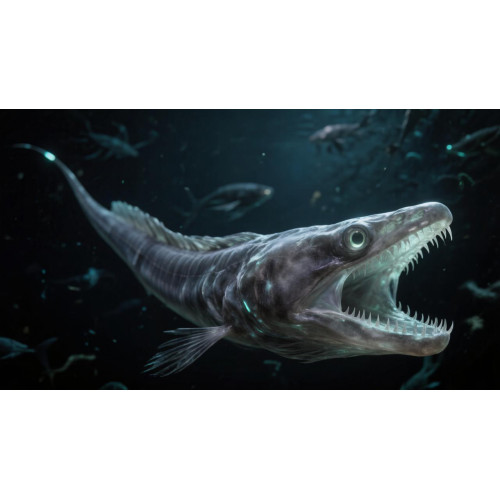
The gulper eel has a long, slender body that is laterally compressed and tapering towards the tail. The head is small with a large, bag-like mouth that can be opened wide to swallow prey. The upper jaw is slightly longer than the lower jaw. Both jaws contain 3–4 rows of small teeth, but no vomerine teeth (teeth on the roof of the mouth) are present. The eyes are very small, and the species relies more on its lateral line system to detect prey. A key identifying feature is the presence of dorsolateral white lines (or filaments) on the body: 8–20 filaments on the trunk in specimens over 500 mm TL, and about 35–90 filaments total on the body in specimens over 800 mm TL. The longest filaments are usually a pair on the tail at 60–70% TL behind the snout. The snout to origin of the dorsal fin is 15.5–20.0% of total length, and to the origin of the anal fin is 20.0–24.0% of total length. The pectoral fin contains 28–41 rays. The posterior nostril opens in front of the eye. The gill slits are lateral (on the sides of the body).
Features of Fish Fins
The gulper eel has a long, continuous dorsal fin that originates at the anterior portion of the body. The dorsal fin origin is located at about one-fifth of the body length from the snout. The anal fin originates slightly behind the dorsal fin origin. Both the dorsal and anal fins may have filamentous extensions at their tips. The pectoral fins are present, containing 28–41 rays. The caudal fin is small or absent, and the tail is drawn out into a long, whip-like filament. The body has more than 200 vertebrae, which allows for its flexible, elongate shape.
Fish Colouring
The gulper eel is uniformly black in colour. A notable feature is the presence of a bioluminescent organ at the tip of the tail. This organ is bulb-shaped and is thought to produce light, although its exact function is unknown. The body is soft and lacks scales.
Distribution
The gulper eel is found in the North Atlantic Ocean. In the eastern Atlantic, its range extends from Greenland and Iceland south to Cape Verde (approximately 10°N to 73°N). In the western Atlantic, it is known from Canada and the Gulf Stream region. Most records are concentrated between 30° and 50°N. The species is rarely observed, so its full distribution is not completely known.
Habitat
This species is bathypelagic, inhabiting the deep open ocean. It is found at depths from the surface down to 3,000 meters (9,800 feet). Adults are most abundant at depths between 1,000 and 3,000 meters. The species lacks a gas-filled swim bladder; instead, the function is replaced by lymphatic spaces along the spine filled with a gelatinous substance.
Size
The gulper eel can reach a maximum total length of 161 cm (about 5.3 feet). The type specimen, collected in 1826, measured 1.37 meters (4 feet 6 inches). The maximum published weight is not specified in available sources.
Behavior
The gulper eel is rarely observed in its natural habitat, so much of its behavior remains unknown. It is a bathypelagic species that lives in the deep ocean. The bioluminescent organ at the tip of its tail likely serves as a lure to attract prey, similar to the esca of anglerfishes. The large, distensible stomach allows the fish to consume large meals, which is advantageous in the deep sea where food is scarce. The species is oviparous (egg-laying), with a leptocephalus larva that lives in the epipelagic zone (upper layers of the ocean). Sexually mature individuals of both sexes experience a reduction of the jaws and a complete loss of teeth. Mature males have greatly enlarged olfactory organs, which likely help them locate females for mating.
Food and Feeding Habits
The gulper eel is a carnivorous predator that feeds primarily on fishes and crustaceans. Its large, distensible mouth and stomach allow it to swallow prey that may be larger than itself. Because the eyes are small, the species likely uses its lateral line system to detect prey.
Reproduction
The gulper eel is oviparous, meaning it reproduces by laying eggs. The larvae are of the leptocephalus type and live in the upper layers of the ocean. A notable reproductive adaptation is the reduction of jaws and complete loss of teeth in sexually mature individuals of both sexes. Mature males also develop greatly enlarged olfactory organs, which are likely used to locate mates in the dark deep sea.
Fishing
The gulper eel has no commercial value and is rarely encountered. It is occasionally caught as bycatch in deep-sea midwater trawls. The species is considered rare and is of no economic importance.
Relationship with a Person
The gulper eel is not considered a threat to humans and is classified as harmless. It is a deep-sea fish that lives at depths of 1,000–3,000 meters and is never encountered by swimmers or recreational divers. The species is of scientific interest due to its remarkable morphology, bioluminescence, and deep-sea ecology. The species is listed as Least Concern (LC) on the IUCN Red List, assessed on 8 May 2013.
| Classification | |
| Phylum | Chordata |
| Class | Actinopterygii |
| Squad | Saccopharyngiformes |
| Family | Saccopharyngidae |
| Genus | Saccopharynx |
| Species | Saccopharynx ampullaceus |
| Features | |
| Conservation status | Least Concern |
| Habitat | Bathypelagic |
| Life span, years | No information |
| Maximum body weight, kg | No information |
| Maximum length, cm | 161 |
| Sailing speed, m/s | No information |
| Threat to people | Not edible |
| Way of eating | Predator |
Pelican-fish
Tags: pelican-fish