
Latin name
Eurypharynx pelecanoides
Other Name
Gulper eel, pelican gulper, umbrella-mouth gulper, big-mouth gulper.
Identification
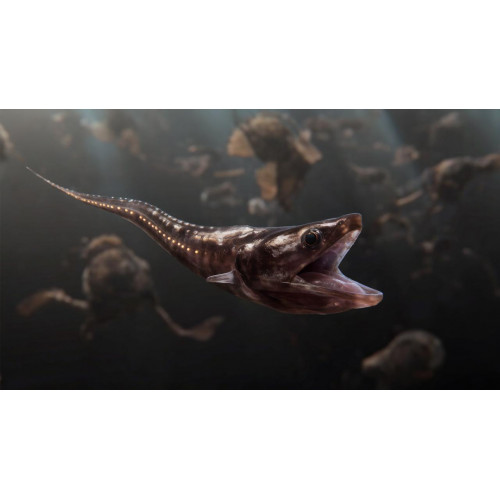
The pelican eel is a fragile, deep-water eel with an extraordinarily large, loosely hinged mouth. Its jaws can make up about a quarter of its total body length, and its lower jaw has no body mass behind it, making the head seem disproportionately large. Its skull is very small, and it has tiny, numerous teeth, minute eyes, and a long, slender tail that ends in a pinkish, bioluminescent light organ. The body is scaleless and covered in black, velvety skin. The lateral line system is unusual, with groups of elevated tubules instead of pores.
Features of Fish Fins
It lacks scales and pelvic fins. The dorsal fin is long, low, and contains 155–196 rays, while the anal fin has 118–147 rays. The pectoral fins are small, rudimentary, and positioned low on the side behind the gill opening. The caudal fin is absent, and the tail ends in a luminous organ. It also lacks a swim bladder.
Fish Colouring
The body is uniformly black or dark brown, with some specimens having a thin white stripe along the dorsal fin. The eel exhibits ultra-black camouflage, reflecting less than 0.5% of light to help it remain hidden in the dark deep sea. The tip of the tail bears a complex organ with numerous tentacles that can glow pink and occasionally flash bright red.
Distribution
The pelican eel is circumglobal, found in tropical and temperate waters of all oceans. In the eastern Pacific, its range extends from northern California to Peru. In the Atlantic, it is found from Iceland to 48°S.
Habitat
It is a bathypelagic (deep-water) species found at depths from 500 to 3,000 meters (1,600 to 9,800 feet), though it has been recorded as deep as 7,625 meters. Adults are typically found between 1,200 and 1,400 meters.
Size
The maximum known length is about 1 meter (3.3 feet), though most specimens are about 0.75 meters (2.5 feet). The common length is around 55 cm.
Behavior
The pelican eel is a poor swimmer, using its long, whip-like tail to undulate through the water. It uses its bioluminescent tail tip to attract prey, luring food towards its large mouth. It is not known to undergo vertical diurnal migration, remaining in the deep ocean. Males are thought to die after spawning.
Food and Feeding Habits
It feeds on crustaceans, fish, cephalopods, and other small invertebrates. Its hunting strategy involves lunge-feeding: opening its enormous mouth to create a net-like trap to scoop up prey or a swarm of small crustaceans. Its stomach can expand to accommodate large meals, but its tiny teeth suggest a diet mainly of small prey. It also takes in large amounts of water, which is expelled through the gills.
Reproduction
The pelican eel is oviparous, releasing eggs that hatch into planktonic leptocephalus larvae. These transparent larvae live in the upper ocean layers before descending to deeper waters. Mature males undergo significant changes, developing enlarged olfactory organs for finding females and degenerating teeth and jaws, suggesting they may not feed and die after spawning.
Fishing
It is of no commercial interest to fisheries and is rarely encountered in fishing nets. Most specimens are inadvertently caught as bycatch in deep-sea nets.
Relationship with a Person
This species poses no threat to humans and is listed as "Least Concern" on the IUCN Red List. Due to its deep-sea habitat, it is rarely seen and is not affected by human activities. Recent direct observations have been made by deep-sea exploration teams, providing valuable behavioral data.
| Classification | |
| Phylum | Chordata |
| Class | Actinopterygii |
| Squad | Anguilliformes |
| Family | Eurypharyngidae |
| Genus | Eurypharynx |
| Species | E. pelecanoides |
| Features | |
| Conservation status | Least Concern |
| Habitat | Bathypelagic |
| Life span, years | No information |
| Maximum body weight, kg | No information |
| Maximum length, cm | 100 |
| Sailing speed, m/s | No information |
| Threat to people | Not edible |
| Way of eating | Predator |
Pelican eel
Tags: pelican eel