
Latin name
Bothus mancus
Other name
Flowery flounder
Identification
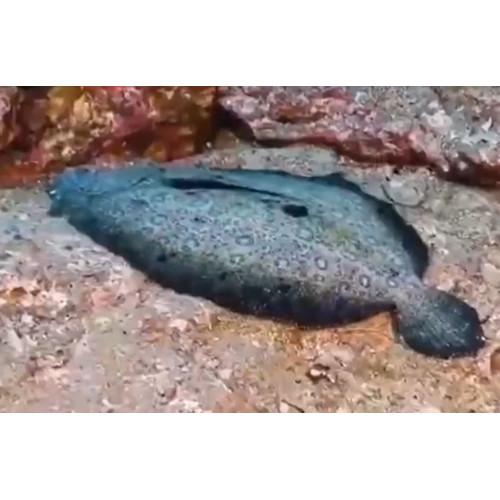
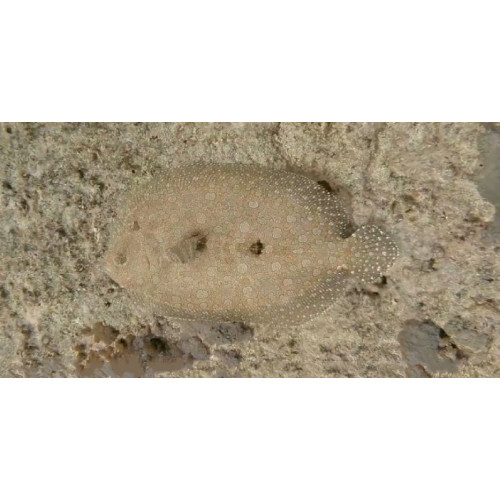
The Peacock flounder is also called the flowery flounder because its body is covered with bluish, flower-like spots. As the family name suggests, bothids have both eyes on the left side of their head. The eyes are located on short stalks, resembling radar dishes, and can move in any direction independently of each other. Thanks to this feature, flounders have a wide field of vision. One eye can look forward while the other looks backward. In juvenile flounders, like ordinary fish, there is one eye on each side of the body, and they swim in the same way as other fish. However, as they mature, the right eye migrates to the left side, and the flounder begins to swim sideways, allowing it to lie flat on the bottom. The lateral line on the eyed side of the body is well-developed, but on the blind side it is usually absent or poorly developed.
Features of fish fins
In the fins of these fish, all rays are simple, except for the principal rays of the caudal fin. The pelvic fin on the blind side of the body has a short base; on the eyed side, it is slightly or significantly elongated, supported by a cartilaginous plate located anterior to the cleithrum. The 2nd to 4th rays on the eyed side are opposed to the first ray on the blind side of the body. The caudal fin has 17 rays.
Fish colouring
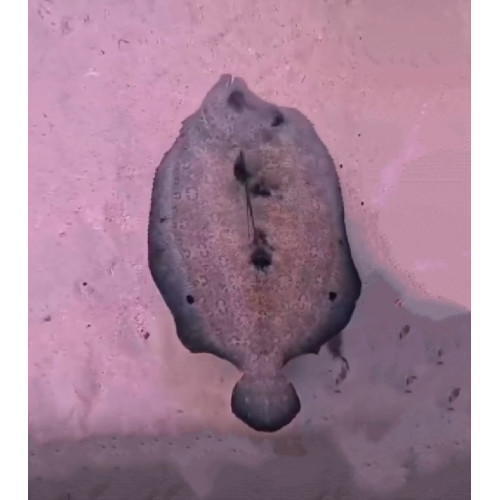
Like all flatfish, the Peacock flounder is a master of camouflage. It uses cryptic coloration to remain unnoticed by both prey and predators. Whenever possible, it does not swim but crawls along the bottom on its fins, constantly changing its color and pattern. In one study, the turbot demonstrated the ability to change color in just eight seconds. Color change is an extremely complex and poorly understood process. It involves the flounder's vision and hormones. The flounder adapts to the color of the surface by releasing cells with various pigments onto the surface of its skin, while some cells remain white because they do not produce pigments. If one of the flounder's eyes is damaged or covered with sand, it becomes more difficult for it to adapt to its surroundings. When hunting or hiding from predators, it buries itself in the sand, leaving only its eyes exposed.
Distribution
This species is widely distributed in relatively shallow waters in the Indo-Pacific region, as well as in the warmer parts of the eastern Pacific Ocean.
Habitat
Peacock flounder are mainly found in shallow waters on sandy bottoms. They sometimes rest on piles of dead coral or on bare rocks. They can be found at depths of up to 150 meters (490 feet).
Size
The maximum length of this flounder is about 45 centimeters (18 inches).
Behavior
If a checkerboard is placed under an aquarium with a glass bottom, the flounder will soon develop cells on its back similar to those of a checkerboard. Place a newspaper underneath, and lines of text will appear on its back. If a flounder is positioned so that its body is over a light background while its head is over a dark one, it will turn dark in color. Conversely, if the flounder's head is over a light substrate while its body is over a dark one, it will take on a light coloration. A blinded flounder turns almost black. This further confirms that the fish's color change is directly linked to its visual perception. Significantly, only the upper part of the flounder's body changes color; the lower part, on which the fish rests, is not visible and always remains light.
Food and feeding habits
Like most flatfish, the Peacock flounder is primarily nocturnal but is sometimes active during the day. It preys on small fish, crabs, and shrimp.
Reproduction
They reproduce in late winter to early spring. After the female lays between two and three million eggs, the males fertilize them. The fertilized eggs float near the surface, are carried away by currents, and hatch into larvae after 15 days. Before hatching, the eggs sink to the bottom. Over the next four to six months, the larvae swim in the open ocean, sometimes hundreds of miles from where the eggs were laid. During these months, the juvenile's right eye slowly migrates to the left side of its body.
Fishing
This species has commercial value in fisheries and in the aquarium trade.
Relationship with a person
Peacock flounder do not pose a significant threat to humans in their natural habitat.
| Classification | |
| Phylum | Chordata |
| Class | Actinopterygii |
| Squad | Carangiformes |
| Family | Bothidae |
| Genus | Bothus |
| Species | B. mancus |
| Features | |
| Conservation status | Least Concern |
| Habitat | Bottom |
| Life span, years | No information |
| Maximum body weight, kg | No information |
| Maximum length, cm | 45 |
| Sailing speed, m/s | No information |
| Threat to people | Edible |
| Way of eating | Predator |
Peacock flounder
Tags: peacock flounder