
Latin name
Sphaeramia nematoptera
Other name
Spotted cardinalfish, coral cardinalfish, or polkadot cardinalfish.
Identification
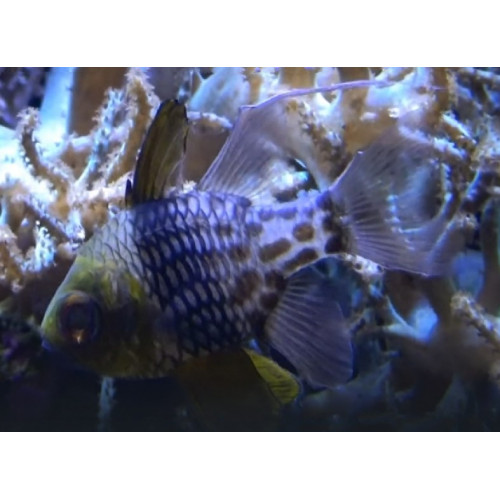
The pajama cardinalfish has a tall, deep body and a large, upper mouth.
Features of Fish Fins
Both dorsal fins, as well as the pelvic and anal fins, are elongated.
Fish Coloration
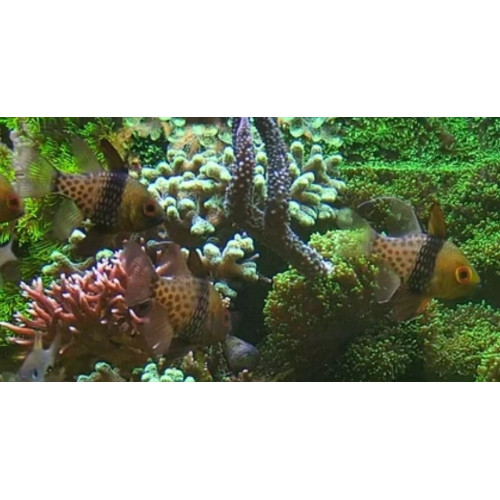
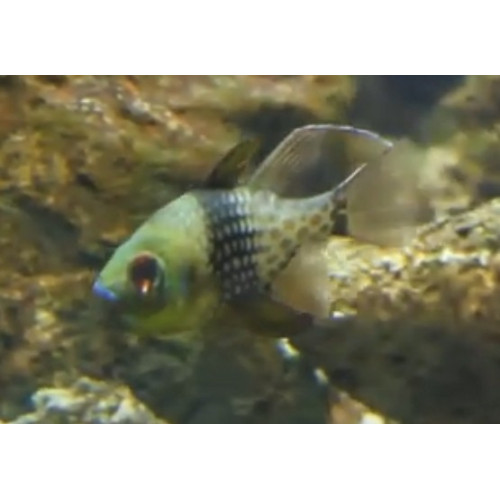
A wide, dark vertical band runs between the first dorsal fin and the pelvic fins, dividing the body into two distinct halves. The anterior half is yellow, while the posterior half is light gray with consistent brown spots. The large eyes are red. The second dorsal, anal, and caudal fins are translucent.
Distribution
This species is found in the western tropical Pacific Ocean, ranging from Java to the Ryukyu Islands, Fiji, Tonga, and the Great Barrier Reef.
Habitat
It inhabits lagoons and protected coral reefs among the branches of madreporic corals (Porites nigrescens and Porites cylindrica) at depths of 1 to 12 meters.
It is nocturnal.
Size
It reaches a maximum length of about 8.5 cm (3.3 inches).
Behavior
Pajama cardinalfish are paternal mouthbrooders. A clutch typically contains around 320 eggs. The male takes the eggs into his mouth and does not eat for the 8–9 days until the larvae hatch. One hundred, two hundred, or sometimes even four hundred eggs form a dense cluster, and for about two weeks—while the eggs develop—the parent must swim with its mouth partially closed. The parents continue to provide care even after the eggs hatch. If danger appears, the fry find shelter in the mouth of the protective parent.
Food and Feeding Habits
It feeds on zooplankton, hunting close to the seafloor.
Reproduction
They are socially monogamous, meaning a male typically forms a long-term bond with a single female. The pair stays close and mates over several breeding cycles, although extra-pair fertilizations have been observed in this species. If one partner dies or is removed, the widowed fish is likely to form a new bond. Both males and females prefer to mate with partners of a similar size.
Mating occurs year-round and at any time of day, but more frequently at night. During mating, a pair may show aggression toward conspecifics. The female releases the eggs directly into the water column. The male then quickly fertilizes them and takes them into his mouth. Like other cardinalfish, male Sphaeramia nematoptera are mouthbrooders; they carry the fertilized eggs in their mouths for 8 to 31 days. This occurs even if not all the eggs are his (though this is rare). In such cases, a male will carry, on average, 18% genetically unrelated eggs. Instances have been recorded where both males and females have mated outside their bonded pair, resulting in males brooding eggs from multiple partners. Overall, only about 70% of all egg clutches result from monogamous mating with the social partner.
The hatched larvae are very slender, measuring 2 mm in length. The juveniles acquire their coloration at a length of about 1 cm.
Fishing
The pajama cardinalfish is not a commercial food fish. It is collected for the aquarium trade.
Relationship with Humans
They are popular aquarium fish. They possess a peaceful temperament, making them well-suited for most common marine aquariums. Like many other schooling fish, they establish a strict hierarchy when kept in small groups in an aquarium. However, unlike some social fish, this member of the Apogonidae family does not use aggression to establish dominance over other cardinalfish.
| Classification | |
| Phylum | Chordata |
| Class | Actinopterygii |
| Squad | Gobiiformes |
| Family | Apogonidae |
| Genus | Sphaeramia |
| Species | S. nematoptera |
| Features | |
| Conservation status | Least Concern |
| Habitat | Coral reef fish |
| Life span, years | No information |
| Maximum body weight, kg | No information |
| Maximum length, cm | 8,5 |
| Sailing speed, m/s | No information |
| Threat to people | Not edible |
| Way of eating | Planktonophage |
Pajama cardinalfish
Tags: pajama cardinalfish