
Latin name
Kurtus gulliveri
Other name
Breakfast-fish, Humphead, Incubator Fish, Incubator-fish, Nursery Fish.
Identification
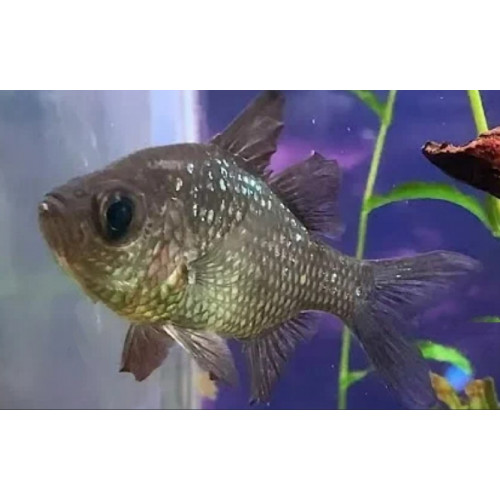
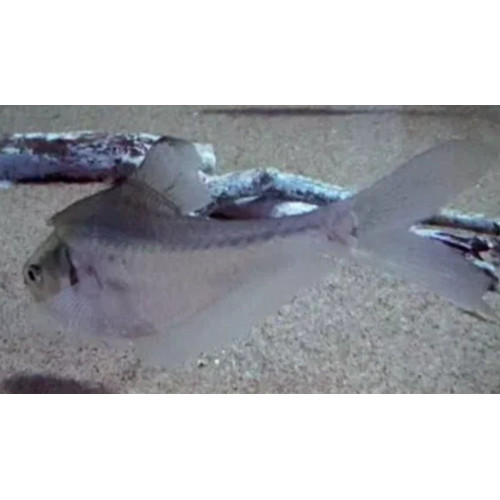
The nurseryfish has an elongated body, tall anteriorly and laterally compressed. The posterior section is long and slender. The entire body and opercula are covered with small cycloid scales; the head is scaleless. The head features a prominent frontal hump. The eyes are small. The mouth is large, protrusible, and oblique. The jaw inclination is approximately 40 degrees relative to the body's horizontal axis. In juveniles, the tip of the upper jaw reaches a vertical line through the anterior margin of the eye, while in large adults it extends beyond the eye. Both jaws bear very small, villiform teeth arranged in bands. Small teeth are also present on the palatine and vomer. Gill rakers are long and slender. Mature males possess a bony hook on the occiput, directed anteroventrally, which is nearly ring-shaped. Females lack this hook. The lateral line is short, extending only to the mid-base of the pectoral fins, and is weakly developed. The anus is positioned slightly posterior to the base of the pelvic fins.
Features of Fish Fins
The dorsal fin has a short base and is preceded by 5–7 rudimentary spines. The fin itself contains 2 spines and 12–14 soft rays. The long anal fin has 2 spines and 40–48 soft rays. The pectoral fins contain 16–21 soft rays. The pelvic fins have 1 spine and 5 soft rays. The caudal fin is deeply forked.
Fish Coloration
The dorsal portion of adult specimens has a purplish tint, transitioning to pink on the mid-body and copper-yellow anteriorly. The anterior body displays silvery or greenish-blue highlights. The fins are transparent or yellowish. Juveniles are whitish or semi-transparent.
Distribution
The species inhabits tropical regions of central southern New Guinea. In Australia, its distribution is fragmented, ranging from rivers in Western Australia draining into the Timor Sea to rivers in the Northern Territory and Queensland draining into the Gulf of Carpentaria.
Habitat
A tropical benthopelagic species, it inhabits freshwater and brackish water bodies.
Size
The maximum recorded total length is 63 cm. The maximum body depth is 1.8–2.7 times the standard length. The eye diameter is 4.8–12.5 times the head length.
Behavior
Adults inhabit mangrove swamps, brackish river estuaries, and slow-flowing, turbid rivers.
Food and Feeding Habits
It is carnivorous, feeding on small fish, crustaceans (especially shrimp), and insect larvae.
Reproduction
Males deposit eggs in clusters or spherical masses. They carry the egg mass on a bony hook on the occiput, where the eggs are securely attached by adhesive filaments. This is likely an adaptation to low-oxygen, highly turbid environments.
Fishing
This species is commercially important for fishing.
Relationship with a person
Nurseryfish flesh is considered edible.
| Classification | |
| Phylum | Chordata |
| Class | Actinopterygii |
| Squad | Gobiiformes |
| Family | Kurtidae |
| Genus | Kurtus |
| Species | K. gulliveri |
| Features | |
| Conservation status | Least Concern |
| Habitat | Pelagic |
| Life span, years | No information |
| Maximum body weight, kg | No information |
| Maximum length, cm | 63 |
| Sailing speed, m/s | No information |
| Threat to people | Edible |
| Way of eating | Carnivorous |
Nurseryfish
Tags: nurseryfish