
Latin name
Astroscopus guttatus
Identification
The Latin name Astroscopus is translated from Greek as "star gazer" (astra — star, skopeo — to look).
This fish is a true master of camouflage, capable not only of delivering electric shocks but also of rotating its eyes to lure prey.
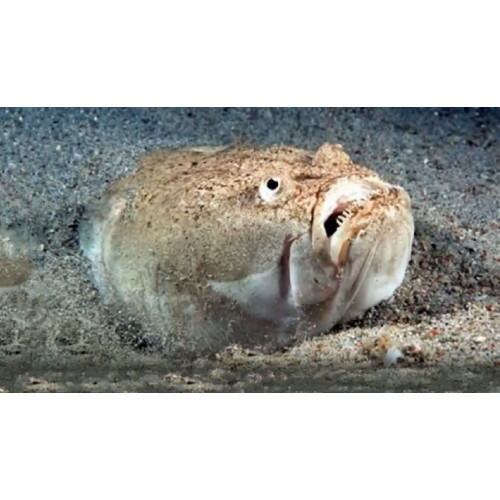
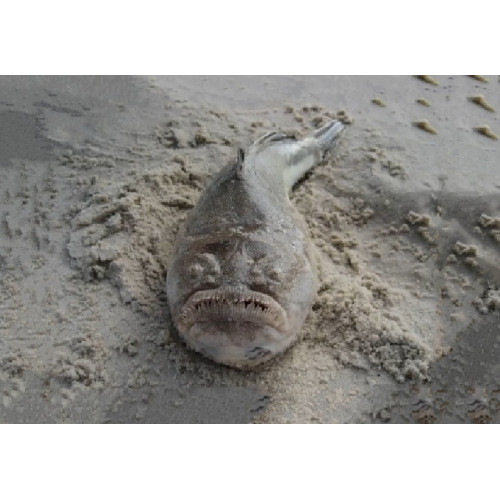
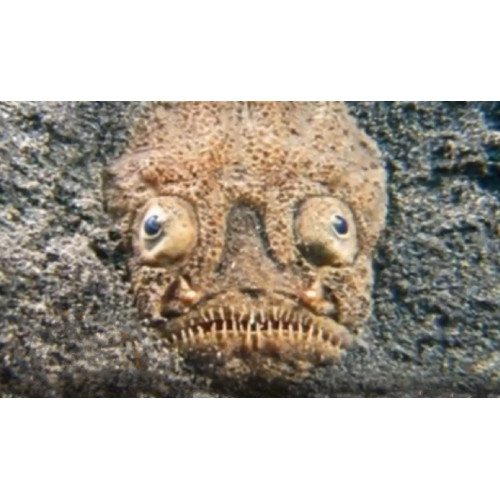
It received its name due to its habit of burying itself in the sand, leaving only its eyes on the surface, gazing upward like stars. It has a dense, spindle-shaped body with a large, square head. The entire front part of the body is massive, helping the fish to bury itself and remain motionless.
The stargazer's mouth is vertical, directed upward. This adaptation allows it, while buried in the substrate, to grab prey swimming directly above its head.
The eyes are small and set high on the top of the head. The adult fish can extend its eyes above the sand surface to better see its surroundings.
Features of fish fins
First dorsal fin: has 3–4 spiny rays. It is short, located just behind the head.
Second dorsal fin: has 1 spiny + 13–15 soft rays. Located closer to the tail.
Anal fin: has 13–14 soft rays. Located on the underside, symmetrical to the second dorsal fin.
Caudal fin: has 12 soft rays.
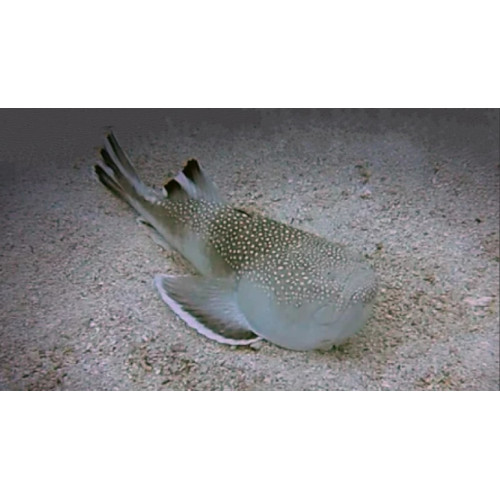
Pectoral fins: have 16–21 soft rays. They are large and fleshy.
Pelvic fins: have 5 soft rays. Located on the belly, shifted forward, closer to the head.
Unlike many fish that use their pectoral fins for maneuvering, the stargazer uses them as shovels. They help it to completely bury itself in the sand within seconds, leaving only its eyes and mouth on the surface for hunting.
Fish coloring
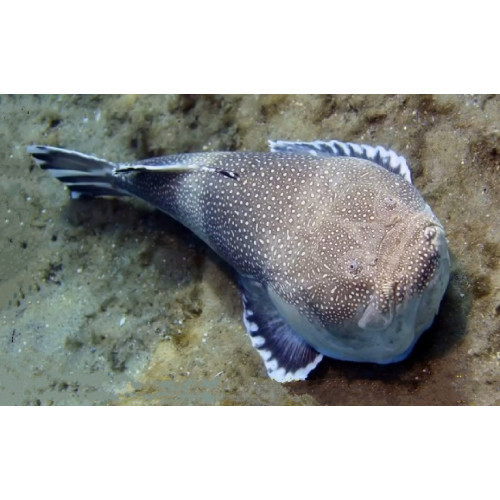
The body is colored dark brown or blackish, with evenly scattered white spots of equal size across the head and back. The caudal fin has three dark horizontal stripes on a light background. The dark first dorsal fin and the striped caudal fin are part of the camouflage strategy. When the fish buries itself in the substrate, it remains invisible to prey swimming above.
Distribution
This is a western Atlantic endemic, found exclusively off the coast of the United States — from New York State in the north to North Carolina in the south.
Habitat
This is a demersal (bottom-dwelling) species. It stays on sandy or pebbly bottoms in coastal zones at depths of up to 36 meters (118 feet).
Size
The maximum length of this fish species is up to 59 cm (23 inches). Maximum weight is up to 9.1 kg (20 lbs). The maximum age is presumably 5–10 years, as in related species.
Despite its impressive weight, this is a rather secretive fish that is difficult to encounter — it spends almost all its time buried in the sand, waiting for prey.
Behavior
The stargazer possesses two truly unique abilities among fish, making it an outstanding hunter.
Electric organ: Capable of generating electricity. It is located behind and under each eye. It consists of about 200 thin layers of modified muscle cells — electroplaques. It formed from four eye muscles — a unique case in the animal world. It generates a discharge of up to 50 volts. Unlike the electric eel (500 V), the stargazer does not use electricity to kill prey. It serves for defense against predators and also helps to stun or disorient prey during the final strike.
"Dancing" eyes: The stargazer's hunt is quite a spectacle, in which its eyes play the main role. The fish buries itself in the sand, leaving only its eyes and specialized nostrils (equipped with filters to keep sand out) on the surface. The gills are positioned so that water exits at the pectoral fins, causing the sand to stir — this attracts small fish, which think that a worm or a small crustacean is moving there. When a curious fish swims too close, the stargazer does something incredible — it begins to rotate the eye facing the prey in an arc, like a small, amusing worm. The prey swims even closer, mesmerized by this movement. As soon as the prey is directly above the predator's open mouth, the stargazer makes a lightning-fast upward lunge, sharply opens its mouth, creating a powerful vacuum, and literally sucks the prey inside.
Food and feeding habits
The diet consists of small fish, squid, and crabs, which the stargazer ambushes from its hiding place.
Reproduction
Spawning begins in late spring to early summer. It lays pelagic eggs (floating in the water column), which rise to the surface. The larva hatches from the egg on the bottom. In fry measuring 12–15 mm (0.5–0.6 inches), electric organs begin to form from the eye muscles. By the time the fry reaches 50 mm (2 inches), the eyes shift from a lateral position to the top of the head, and the fish transitions to a bottom-dwelling lifestyle.
Fishing
This species is not a target of industrial fishing; however, it may be used in recreational fishing or by local inhabitants for sustenance.
Relationship with a person
The northern stargazer poses a potential danger. It has venomous spines above the pectoral fins (cleithral spine with venom gland). Additionally, it can deliver an electric shock. Although 50 volts are not lethal to humans, the shock is very painful and can cause temporary shock. Removing the fish from the water with bare hands is strongly discouraged.
The meat of these fish is edible; however, due to its lifestyle and physiology, it is not caught for food.
The International Union for Conservation of Nature (IUCN) has assigned the species a conservation status of Least Concern.
| Classification | |
| Phylum | Chordata |
| Class | Actinopterygii |
| Squad | Labriformes |
| Family | Uranoscopidae |
| Genus | Astroscopus |
| Species | A. guttatus |
| Features | |
| Conservation status | Least Concern |
| Habitat | Bottom |
| Life span, years | 10 |
| Maximum body weight, kg | 9,1 |
| Maximum length, cm | 59 |
| Sailing speed, m/s | No information |
| Threat to people | Edible |
| Way of eating | Predator |
Northern stargazer
Tags: northern stargazer