
Latin name
Paracheirodon innesi
Other Names
The neon tetra is also known simply as the neon fish. Its scientific name, Paracheirodon innesi, was given by Myers in 1936. The genus name comes from the Greek words "para" (the side of), "cheir" (hand), and "odous" (teeth). The species is named after the American ichthyologist William Thornton Innes. The species was formerly known by the synonym Hyphessobrycon innesi.
Identification
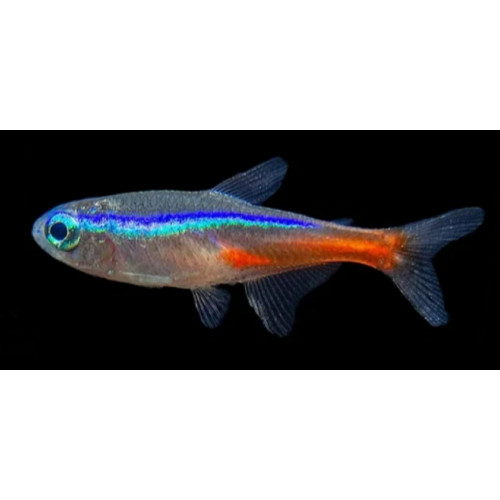
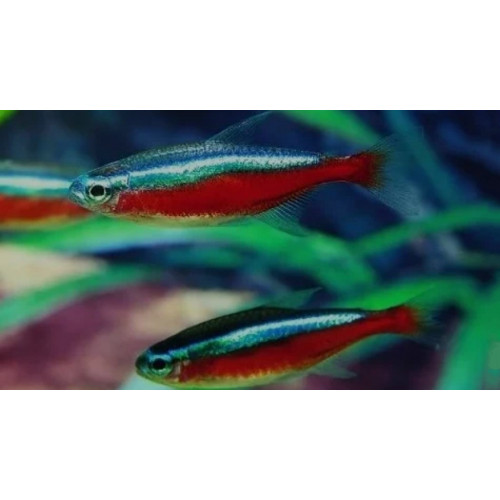
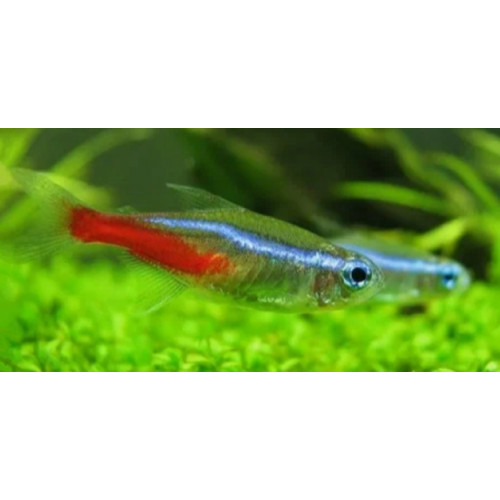
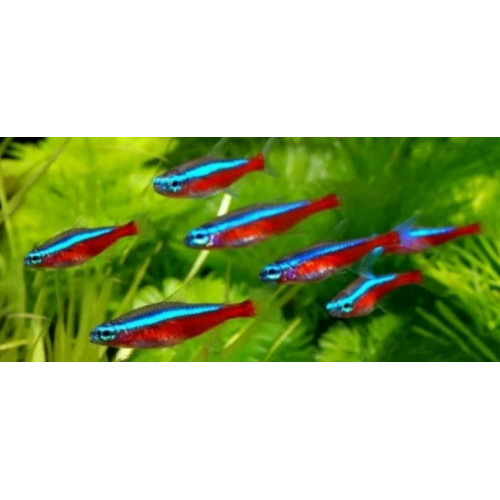
The neon tetra has a small, slender, and partially transparent body. The fish is characterized by a bright, iridescent blue horizontal stripe that runs from its nose to the base of the adipose fin, and an iridescent red stripe that begins at the middle of the body and extends posteriorly to the base of the caudal fin. Sexual dimorphism is slight: females have a slightly larger belly and a slightly bent iridescent stripe, while males have a straighter stripe. During the night, the blue and red colours become grey or black as the fish rests, reactivating in the morning. This colour change is due to the fish's ability to alter its iridescent stripe in response to lighting conditions, a process involving guanine crystals in its cells.
Features of Fish Fins
The neon tetra has fins that are partially transparent. The species has recently become available in a long-fin variety. Fin ray counts for the species, as per its classification under Characiformes, are not specified in detail, but the fins are typical of characins, with a single dorsal fin, a forked caudal fin, and an adipose fin present. The pelvic fins are located in the abdominal region.
Fish Colouring
The neon tetra has a light-blue back over a silver-white abdomen. Its most distinctive features are the bright iridescent blue horizontal stripe along each side of the fish from the nose to the base of the adipose fin, and the iridescent red stripe that begins at the middle of the body and extends to the base of the caudal fin. The fish is partially transparent, including its fins, except for these markings. The species can change the colour of its iridescent stripe in response to lighting: in a light-adapted state it appears blue-green, while in a dark-adapted state it changes to indigo.
Distribution
The neon tetra is native to the western and northern Amazon basin in South America, specifically in southeastern Colombia, eastern Peru, and western Brazil. It is found in blackwater and clearwater streams that are tributaries of the Solimões River. It prefers acidic blackwater streams but can also occur in transparent clearwater streams. It is not found in whitewater rivers. The species has been introduced to Singapore and the United States.
Habitat
This species inhabits freshwater environments and is pelagic. It lives in waters with a temperature range of 20–28°C (68–82°F) and a pH of 4.0–7.5. It prefers very soft, acidic water (pH 4.0 to 4.8) in the wild, but in aquariums, a pH range of 6.0 to 7.0 is recommended. The water hardness should be below 10 dGH. The neon tetra is a shoaling fish and must be kept in groups of at least six, though it will be more active in groups of eight to twelve or more. It is best kept in densely planted tanks to resemble its native Amazon environment.
Size
The neon tetra grows to approximately 4 cm (1.5 inches) in overall length. The maximum standard length is 2.5 cm. The fish is about 0.5 cm wide.
Behavior
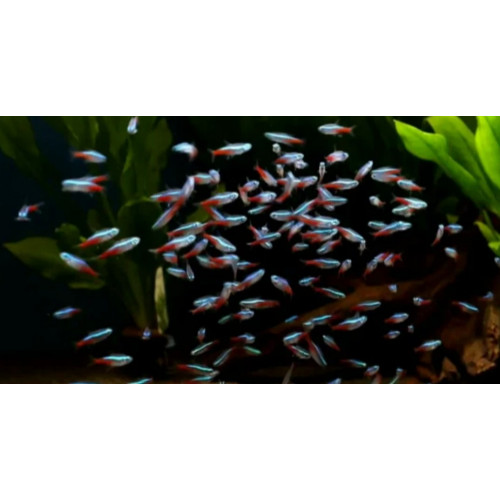
The neon tetra is a highly social shoaling species that forms schools. A school of neon tetras evacuating through a narrow space will form a queue to maintain a preferred social distance and avoid clogging or collisions. This behaviour is similar to that observed in ants but contrasts with the clogging seen in sheep and human crowds. Individual neon tetras modify their position within a school depending on external factors: they stay as close to food as possible to compete with conspecifics, move to the middle of the group in the presence of a predator for dilution effects, and prefer the back of the school when no stimuli are present, likely to benefit from the predator detection of others. The fish is also known for its ability to change the colour of its iridescent stripe at night.
Food and Feeding Habits
The neon tetra is an omnivore. Its diet includes worms, small insects, crustaceans, and plant matter. In the aquarium, they accept most flake foods, as well as small live or frozen foods such as brine shrimp, daphnia, bloodworms, and tubifex to supplement their diet. A tropical sinking pellet is ideal as many brands include natural colour enhancers.
Reproduction
The neon tetra is an egg-scattering species. Reproduction is considered difficult in home aquariums, but it is becoming more common. Breeding requires soft, acidic water, dim lighting, and high tannin content. The female lays a relatively small number of eggs, which hatch in about 24 hours. Spawners produce viable gametes during 5–6 spawning periods, and time between spawns should be 15–20 days. In a controlled study, paired spawning produced an average of 193 eggs per pair with a fertility rate of 80.24% and an average of 113 larvae per pair. The parents should be removed after spawning as they may eat the eggs.
Fishing
The neon tetra is one of the most popular aquarium fish in the world, with about 2 million sold in the US each month. Most neon tetras available in the United States are imported from Southeast Asia, where they are farm-raised, or from Colombia, Peru, and Brazil, where they are collected from the wild. An average of 1.8 million neon tetras with an estimated value of $175,000 are imported into the United States monthly. The species has little to no commercial fishery value outside the aquarium trade.
Relationship with a Person
The neon tetra is not considered a threat to humans and is classified as harmless. It is one of the most widely kept tropical fish in the world. Its bright colouring is the main reason for its popularity among freshwater fish hobbyists. The species is considered easy to keep in a community aquarium, making it a good choice for beginners. It is prone to a disease known as Neon Tetra Disease (NTD), caused by the parasite Pleistophora hyphessobryconis, which is generally incurable and fatal, but preventable. The species is listed as Least Concern (LC) on the IUCN Red List.
The story of the neon fish
One of the most amazing chapters in the history of aquaristics is the appearance in Europe of the small, luminous neon tetra.
In 1934, the French traveler and adventurer Auguste Rabaut set off into the Amazon jungle. According to some accounts, he was hunting caimans; according to others, he was searching for orchids or even diamonds. During the expedition, he fell seriously ill with tropical fever and was saved by local Indians. It was in their dwelling that he first saw a school of unusually bright fish in a clay vessel. The Indians called them "God's spark."
Rabaut immediately realized that this fish could bring him a fortune. He caught several dozen specimens and sent them to France. When the neons appeared in Paris, they caused a real sensation. A single fish sold for up to 100 dollars — and buyers took them without haggling. Because of their bright luminous stripe, they were called "neons" — after neon advertising signs.
However, a problem soon emerged: neons would not breed in captivity. Aquarists around the world tried to obtain offspring, but all attempts ended in failure — the eggs would perish. Rabaut carefully kept secret the location where he caught the fish to maintain his monopoly on their supply. He continued to bring in wild neons, and aquarists continued to buy them, hoping to unlock the secret of their reproduction.
Only years later, German aquarists discovered that the key to success lay in the water's properties. It turned out that neons only spawn in very soft water. In Germany, the water was softer than in other European countries, which became the decisive factor. This discovery gave a powerful impetus to the development of aquarium water chemistry.
In 1936, the ichthyologist George Myers officially described the new species and named it Hyphessobrycon innesi — in honor of the American aquarist popularizer William Innes, who had provided him with specimens for study. The species was later reclassified as Paracheirodon innesi.
| Classification | |
| Phylum | Chordata |
| Class | Actinopterygii |
| Squad | Characiformes |
| Family | Characidae |
| Genus | Paracheirodon |
| Species | Paracheirodon innesi |
| Features | |
| Conservation status | Least Concern |
| Habitat | Pelagic |
| Life span, years | No information |
| Maximum body weight, kg | No information |
| Maximum length, cm | 4 |
| Sailing speed, m/s | No information |
| Threat to people | Not edible |
| Way of eating | Omnivore |
Neon tetra
Tags: neon tetra