
Latin name
Acanthurus monroviae
Identification
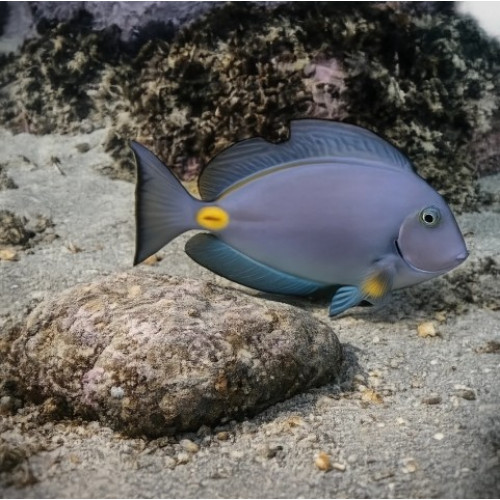
The body of the Monrovia doctorfish is deep and compressed laterally; its depth fits 2 times into the standard body length. On each side of the caudal peduncle, there is one lanceolate spine that can retract into a horizontal groove. The mouth is non-protrusible, small, and located low on the head. The teeth are closely set, spatulate with serrated edges; adults have 18 teeth on the upper jaw and 19 on the lower jaw.
Features of fish fins
The dorsal fin is continuous, without a notch, with 9 spines and 25–27 soft rays. The anal fin has 3 spines and 24–26 soft rays. The pectoral fins have 17 soft rays. The caudal fin is deeply forked.
Fish coloring
The coloration of adults varies from pale yellowish-brown to dark grayish-brown. Along the sides of the body run longitudinal wavy blue and pale yellow stripes, most distinctly expressed on the upper part of the body. On the caudal peduncle, there is an oval area of bright yellow around the orange spine.
Distribution
They are distributed in the eastern Atlantic Ocean from southern Morocco to Angola, including the Canary Islands, Cape Verde, São Tomé and Príncipe. They have recently been found in the Mediterranean Sea and off the southeastern coast of Brazil.
Habitat
Marine coastal fish. They inhabit estuaries and lagoons on rocky and coral bottoms at depths from 5 to 200 m.
Size
The maximum body length of these fish is 45 cm, usually up to 38 cm. There is no information on the weight and lifespan of fish of the species Acanthurus monroviae.
Behavior
In the Monrovia doctorfish, there is an area of bright yellow around the orange spine on the caudal peduncle. In the center of the spots are sharp, stiletto-like spines. At the fish's will, they can be flattened or erected. If a predatory fish from a swimming school attacks a Monrovia doctorfish and, after seizing it, spits it out with a startled movement, then the other predators will subsequently avoid fish with an orange spot near the tail. Evidently, this warning coloration helps the owner survive.
Food and feeding habits
It feeds on zooplankton, phytoplankton, and detritus. They are predominantly herbivorous fish, but occasionally small benthic invertebrates are found in their stomachs.
Reproduction
They are gonochoristic (separate-sex) fish, but do not possess distinct sexual characteristics. They reach sexual maturity at around two years of age. During the breeding season, they gather in large schools. To spawn, Monrovia doctorfish swim to the water surface. The females then release eggs up to 1 mm in diameter. A single female can release up to 40,000 eggs. Embryonic development lasts for one day. Afterwards, transparent, disc-shaped larvae emerge, which lack sharp projections on the sides of the body but have venomous spines on their fins. The larvae actively feed on plankton in the surface layers of the water. The larvae swim toward the shore, where their transformation takes place over 4–5 days. The body becomes covered with small scales, a sharp outgrowth near the tail begins to form, and the digestive tract lengthens. The juveniles become accustomed to feeding on algae, continue to grow, and return to deeper waters.
Monrovia doctorfish do not reproduce at all in aquarium conditions.
Fishing
This fish species is of minor commercial importance and is caught for sale to aquariums.
Relationship with a person
Harmless. The meat of the Monrovia doctorfish is edible but is generally not highly valued as a food product due to the herbivorous nature of these fish.
| Classification | |
| Phylum | Chordata |
| Class | Actinopterygii |
| Squad | Acanthuriformes |
| Family | Acanthuridae |
| Genus | Acanthurus |
| Species | A. monroviae |
| Features | |
| Conservation status | Least Concern |
| Habitat | Neritic |
| Life span, years | No information |
| Maximum body weight, kg | No information |
| Maximum length, cm | 45 |
| Sailing speed, m/s | No information |
| Threat to people | Edible |
| Way of eating | Planktonophage |
Monrovia doctorfish
Tags: monrovia doctorfish