
Latin name
Muraena helena
Other Names
The Mediterranean moray is known by several alternative names, including European moray, Roman eel, marbled moray, black moray, and St. Helena moray. In the English language, it may also be simply referred to as moray or murry.
Identification
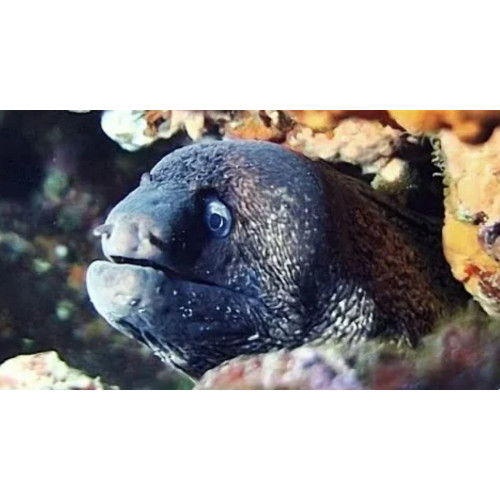
The Mediterranean moray has a long, snake-like (anguilliform) body that is cylindrical in its first half and becomes more laterally compressed towards the tail. Its skin is thick, slimy, and completely lacks scales. A key identifying feature is the mouth: it is long and robust, extending behind the gills, and contains long, sharp, pointed teeth. Pectoral and ventral fins are entirely absent, and the dorsal fin begins just behind the head and runs continuously along the back, merging with the caudal and anal fins.
Features of Fish Fins
The Mediterranean moray is characterized by a single, continuous fin that runs along its entire back and tail. This fin is formed by the fusion of the dorsal fin, which starts behind the head, with the caudal fin and the anal fin. The fish has no pectoral or pelvic fins. This fin structure is typical of the moray eel family.
Fish Colouring
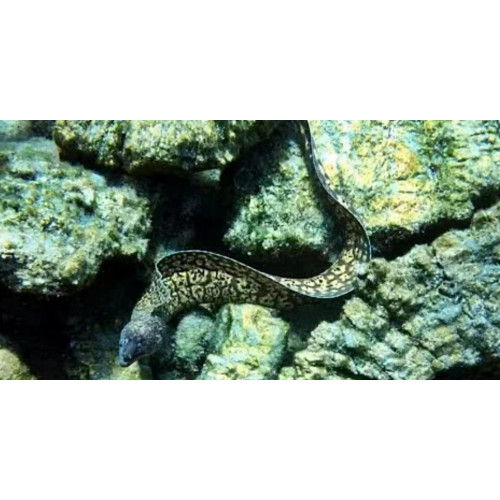
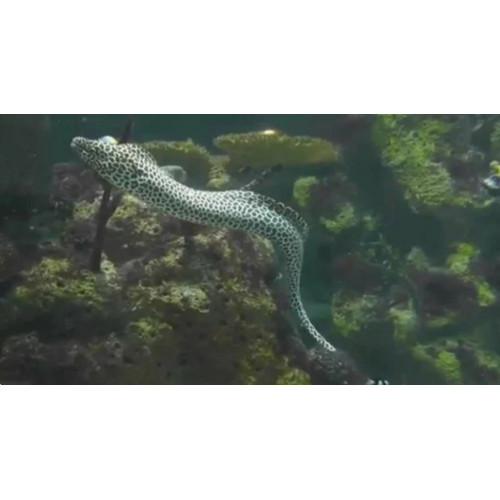
The colour of the Mediterranean moray is variable and can range from dark grey to dark brown or yellowish-brown. The body is marked with fine dark spots or mottled patterns. A detailed description notes a complex pattern: the front half of the head is dark brown, while the rest of the head and trunk are mottled with whitish flecks and irregular lines. The posterior part of the body has three longitudinal rows of large whitish blotches, each with dark brown spots and white dots, and the fin margins have a series of small whitish spots. The gill opening has a blackish edge. It is also noted that its colouration can serve as a warning of its toxicity to other fish.
Distribution
The Mediterranean moray is found in the Eastern Atlantic Ocean, ranging from the British Isles and the Azores in the north to Senegal and Cape Verde in the south. It is also common throughout the Mediterranean Sea. It has been recorded in the Red Sea, where it is considered an immigrant from the Mediterranean via the Suez Canal.
Habitat
This species is a marine, reef-associated fish. It typically inhabits rocky coastal areas with caves and crevices, where it can hide. It can be found over a wide depth range, from very shallow water at 1 meter down to 801 meters, though it is most common between 100 and 300 meters deep. Near the shore, it is often found at depths of 5 to 50 meters.
Size
The Mediterranean moray can reach a maximum total length of up to 1.5 meters (150 cm). The common length for the species is around 80 cm. Its maximum published weight is 6.5 kg, though some sources report weights of over 15 kg. It can reach a maximum recorded age of 38 years.
Behavior
The Mediterranean moray is a nocturnal and territorial species. During the day, it hides in holes, crevices, and under rocks, emerging at night to hunt. It is described as a poor swimmer but is adept at writhing through narrow spaces. While generally not aggressive, it will defend its territory fiercely and will not hesitate to bite if provoked or disturbed. It seldom attacks unless provoked.
Food and Feeding Habits
The Mediterranean moray is a carnivorous and piscivorous (fish-eating) top predator. Its diet primarily consists of fish, but it also feeds on crabs and squid. Studies on its diet have identified over 20 prey species, with bony fish (Osteichthyes) being the dominant food source, making up the majority of its diet by weight and frequency. Common prey fish include seabreams like Diplodus annularis and Diplodus vulgaris. Its trophic level is high, reflecting its position as an apex predator in its ecosystem.
Reproduction
This species is gonochoristic, meaning individuals are either male or female. A study in the Adriatic Sea found that females are more common in shallow coastal waters and can reach lengths of up to 121 cm. The gonadosomatic index (a measure of reproductive activity) shows its greatest increase in summer, and males with maturing testes are observed around the beginning of July. It is believed that moray eels migrate to deeper offshore waters, possibly below 600 meters in the southern Adriatic Pit, to spawn, which would explain the absence of ripe or spent individuals in coastal areas during the summer.
Fishing
The Mediterranean moray is caught using various methods, including fish-traps, spearguns, and long-lining. It is utilized fresh and is considered good for eating; it is commonly broiled, boiled, or baked. Its skin is also used in the production of leather.
Relationship with a Person
While the Mediterranean moray is not an aggressive hunter of humans, it poses a significant danger if disturbed. Its bite can be very serious and is dangerous to humans. The wounds are not only painful and tear the flesh but are also prone to infection. This is partly due to the presence of harmful bacteria that live in the decomposing food particles between its teeth. Furthermore, some sources suggest the moray's saliva may contain hemolytic and neurotoxic substances that make the bite even more dangerous. Due to this risk, it is strongly advised not to provoke or corner this fish. Historically, the Mediterranean moray was considered a delicacy by the ancient Romans, who raised them in large ponds.
Interesting Facts
Many books state that in Ancient Rome, disobedient slaves were thrown into pools with moray eels, and the bloodthirsty fish devoured them. However, some researchers of the past believe that this information is based on a misunderstanding. The reason for this was supposedly the following episode. The patrician Vedius Pollio was hosting a dinner party. Among the invited guests was Emperor Augustus himself. While setting the table, one of the slaves accidentally broke an expensive crystal vase. The enraged owner ordered the slave to be executed by throwing him to the moray eels. The slave prostrated himself before the emperor, begging to be allowed to die any other death. Outraged by the owner's cruelty, the emperor pardoned the slave and ordered all the crystal vases in the house to be smashed and thrown into the pool.
| Classification | |
| Phylum | Chordata |
| Class | Actinopterygii |
| Squad | Anguilliformes |
| Family | Muraenidae |
| Genus | Muraena |
| Species | M. helena |
| Features | |
| Conservation status | Least Concern |
| Habitat | Reef |
| Life span, years | 38 |
| Maximum body weight, kg | 15 |
| Maximum length, cm | 150 |
| Sailing speed, m/s | No information |
| Threat to people | Edible |
| Way of eating | Predator |
Mediterranean moray
Tags: mediterranean moray