
Latin name
Pseudoliparis swirei
Other Names
The Mariana snailfish is also known as the Mariana hadal snailfish. Its scientific name, Pseudoliparis swirei, was given by Gerringer and Linley in 2017. The species is named in honor of Herbert Swire, the First Navigating Sublieutenant of the HMS Challenger expedition, which discovered the Mariana Trench in 1875. The genus name Pseudoliparis comes from the Greek "pseudes" (false) and "liparis" (fat).
Identification
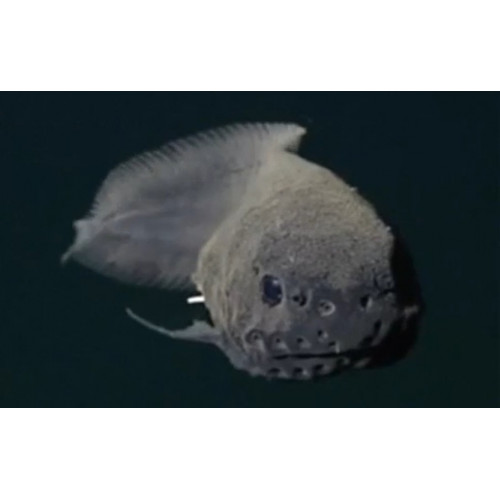
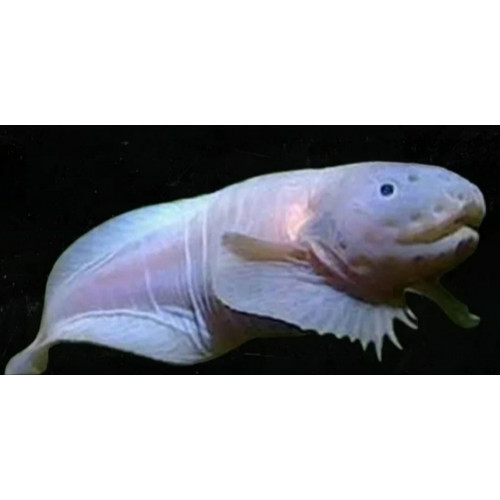
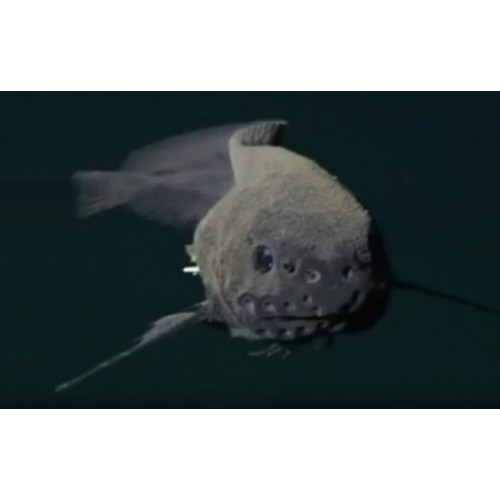
The Mariana snailfish has an elongated, tadpole-like body that is pinkish-white in life. The head is small, low, and wide, with a blunt snout. The mouth is broad, horizontal, and moderately large, with simple, sharp canine teeth arranged in irregular rows. The eyes are very small, about 10% of head length. The absence of light in the habitat of the Mariana snailfish has made large, high-resolution eyes unnecessary. The skin is thin, transparent, and lacks scales. A key identifying feature is the presence of a well-developed suction disk located on the belly, which is used for attaching to surfaces. The pectoral fin is divided into two lobes by a moderately deep notch.
Features of Fish Fins
The Mariana snailfish has no spines in any of its fins. The dorsal fin contains 51–58 soft rays, the anal fin has 43–49 soft rays, the caudal fin has 11–14 rays, and the pectoral fin has 28–32 rays. The pectoral fin has 4 radials (supporting bones), and the pelvic fins are modified into a suction disk.
Fish Colouring
In life, the Mariana snailfish is pinkish-white with transparent skin. The skin and peritoneum are so transparent that internal organs (liver, stomach, pyloric caeca) and trunk muscles are clearly visible through the body wall. The skin lacks pigment, an adaptation to life in the eternal darkness of the hadal zone. Some larger specimens may have dusky skin on the head.
Distribution
The Mariana snailfish is known exclusively from the Mariana Trench in the western Pacific Ocean. It has been recorded at capture depths from 6,198 to 8,076 meters (20,335–26,496 feet). It is endemic to this single location.
Habitat
This species is bathydemersal, living on or near the seafloor at hadal depths. It is most abundant at depths of approximately 7,000–8,000 meters. The species has been observed at depths down to 8,098 meters, but no individuals have been seen below 8,200 meters, which is apparently the physiological depth limit for teleost fish.
Size
The Mariana snailfish can reach a maximum standard length of 28.8 cm (about 11.3 inches) and a weight of 160 g (0.35 lb). The species shows a wide developmental range, with specimens collected ranging from 89 to 235 mm SL.
Behavior
The Mariana snailfish is a slow-moving, bottom-dwelling fish that forms large aggregations of different-sized individuals around food sources. It is the top predator in its deep-water habitat, with few larger predators present. The species has several unique adaptations for surviving extreme pressure: transparent, unpigmented skin; thin muscles; incomplete ossification of bones; enlarged organs and eggs; little or no ability to see; proteins that function under high pressure; and flexible cell membranes. The suction disk on the belly is used for attaching to surfaces.
Food and Feeding Habits
The Mariana snailfish is a carnivorous predator that feeds on tiny crustaceans, particularly swarms of amphipods. Video records show it feeding on Hirondellea gigas amphipods, and one specimen had 98 crustacean individuals in its stomach. It feeds by using suction from its mouth to gulp prey.
Reproduction
The Mariana snailfish lays relatively large eggs, among the largest recorded for teleost fish. Ripe females have eggs up to 9.4 mm in diameter. Two distinct size classes of eggs are present within the gonad: up to 23 large eggs (>5 mm) and up to 851 small eggs. Males have a visible genital papilla that is oriented anteriorly.
Fishing
The Mariana snailfish has no commercial value and is not targeted by fisheries. It is known only from scientific deep-sea expeditions. The first specimens were caught in 2014 using deep-water traps baited with mackerel during an expedition of the research vessel Falkor. Additional specimens were collected in 2017. The species is of high scientific interest due to its remarkable adaptations to the hadal zone.
Relationship with a Person
The Mariana snailfish is not considered a threat to humans and is classified as harmless. It lives at depths of 6,000–8,000 meters and is never encountered by swimmers or recreational divers. The species is of significant scientific interest due to its remarkable morphological, physiological, and genetic adaptations to extreme deep-sea environments. The species has inspired technology: a self-powered robot capable of diving into the ocean's deepest trench was largely inspired by the bones in the skull of Pseudoliparis swirei. The species has not yet been evaluated by the IUCN Red List.
| Classification | |
| Phylum | Chordata |
| Class | Actinopterygii |
| Squad | Scorpaeniformes |
| Family | Liparidae |
| Genus | Pseudoliparis |
| Species | Pseudoliparis swirei |
| Features | |
| Conservation status | Not Evaluated |
| Habitat | Bathydemersal |
| Life span, years | No information |
| Maximum body weight, kg | 0,16 |
| Maximum length, cm | 28,8 |
| Sailing speed, m/s | No information |
| Threat to people | Not edible |
| Way of eating | Predator |
Mariana snailfish
Tags: mariana snailfish