
Latin name
Nomeus gronovii
Other name
Bluebottle fish
Identification
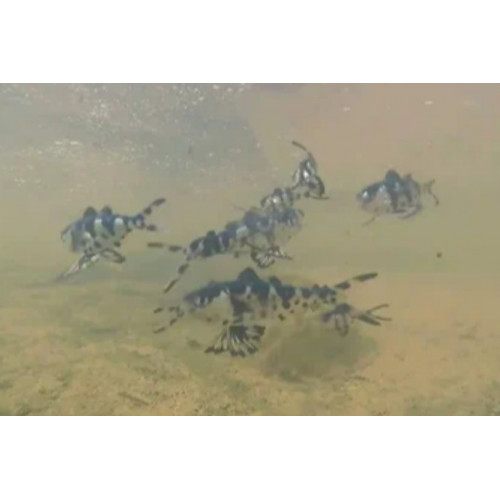
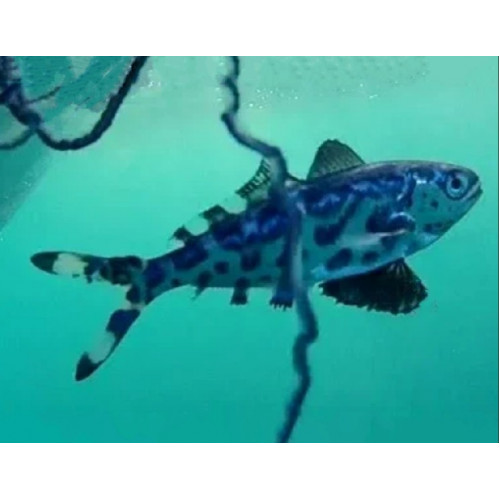
The man-of-war fish has an elongated body and large eyes. This fish has a very high number of vertebrae, which may contribute to its maneuverability and allows it to use primarily its pectoral fins for swimming—a characteristic of fish that specialize in maneuvering within confined spaces. Additionally, it has a complex skin structure and at least one antigen that reacts to the toxin of the cross spider. Although this species is ten times more resistant to the toxin than other fish, it can still be stung by the dactylozooids (large tentacles), which it actively avoids. The smaller gonozooids do not appear to sting the fish, and the fish is reported to often "nibble" on these tentacles. This species is the only known representative of its genus.
Features of fish fins
Dorsal spines (total): 9–13; dorsal soft rays (total): 24–28; anal spines: 1–2; anal soft rays: 24–29; vertebrae: 41.
These fish have highly visible dorsal fins. The caudal fin is deeply forked. The pelvic fin has its inner rays connected to the belly by a membrane along their entire length.
Fish coloring
The man-of-war fish has a striped body with black and blue spots. Juveniles are whitish or silver with dark blue speckles. The pelvic fins are black. The upper part is dark blue, and the sides are silver with dark blue flecks.
Distribution
This species inhabits the Atlantic, Pacific, and Indian Oceans. It is more common in the Pacific and Indian Oceans, but rarer in the eastern Atlantic Ocean.
Habitat
This fish lives in warm, deep pelagic zones at depths from 200 to 1000 meters (656 to 3280 feet), within the tentacles of the Portuguese man o' war. Juveniles inhabit coastal and marine waters at depths of at least 30 meters (98 feet). It is the only known species in its genus that transitions from a pelagic lifestyle to a demersal (bottom-dwelling) one as it matures.
Size
This fish species can reach up to 39 cm (15 inches) in length.
Behavior
This fish lives among the dangerous tentacles of the Portuguese man o' war. Instead of using mucus to protect itself from nematocysts, as some clownfish do when hiding among anemones, this fish appears to swim very skillfully to physically avoid the tentacles. They stay in large groups rather than alone, and can live up to five years.
Food and feeding habits
It is a carnivorous/planktivorous animal, notable for its ability to live among the deadly tentacles of the siphonophore Portuguese man o' war, feeding on its tentacles and gonads. Despite its resistance to the toxin produced by the Portuguese man o' war, this species actively avoids the large tentacles and feeds on the smaller ones.
Reproduction
The man-of-war fish reproduces by releasing eggs, which are subsequently fertilized by the male. The eggs and the larvae that hatch from them are adapted to life in open water. Typically, these fish produce between 100 and 1,000 fry, and fertilized eggs hatch within 4–5 days.
Fishing
This species is of little importance to commercial fisheries.
Relationship with a person
Harmless. It is not edible for humans.
| Classification | |
| Phylum | Chordata |
| Class | Actinopterygii |
| Squad | Scombriformes |
| Family | Nomeidae |
| Genus | Nomeus |
| Species | N. gronovii |
| Features | |
| Conservation status | Least Concern |
| Habitat | Pelagic |
| Life span, years | 5 |
| Maximum body weight, kg | No information |
| Maximum length, cm | 39 |
| Sailing speed, m/s | No information |
| Threat to people | Not edible |
| Way of eating | Planktonophage |
Man-of-war fish
Tags: man of war fish