
Latin name
Pegasus volitans
Other name
Cataphractus anceps
Leptopegasus natans
Pegasus natans
Pegasus pristis
Pegasus spatula
Pegasus volans
Parapegasus natans
Identification
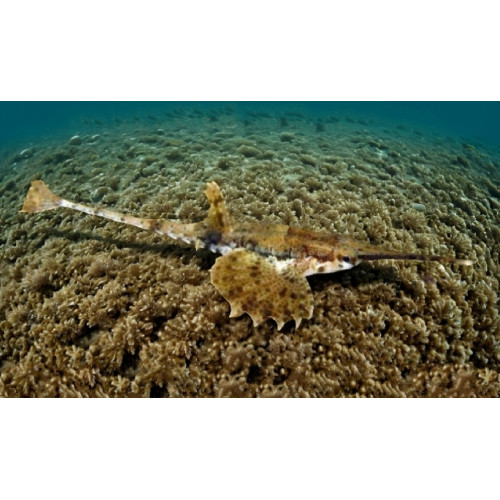
The body of the longtail seamoth is strongly depressed, its depth being 13–14 times in standard length. The tail portion of the body is long, 1.9 times in standard length. It exceeds the length from the tip of the snout to the posterior margin of the trunk armor. The snout is elongated, 20–20.8% of standard length, usually (0.8–0.9 times) exceeding the body width, strongly depressed, rounded at the tip, with one longitudinal row of teeth along the edges. The greatest body width is moderate, 5.5–6.0 times in standard length. The tail portion of the body consists of 12 bony tail rings: the anterior rings are square in cross-section, the posterior ones are strongly depressed, their depth being 90–125 times in standard length. On the back there are two low longitudinal ridges extending parallel to each other from the suborbital ridge to the last tail ring, but on the last 5 rings they are significantly flattened. On each side of the body there is one longitudinal lateral ridge, which begins above the base of the pectoral fin and, descending along the sides of the armor, extends onto the tail rings as far as the tail. In young fish, the dorsal and lateral ridges have sharp points at the end of each ring. In adults, these points become blunt and disappear, except on the last 4 rings, which have one pointed spine each on the front, directed forward, and on the last 2 rings, which, in addition to the forward-directed spines, have one pointed spine each on the back, protruding backward. The anal opening is closer to the tip of the snout than to the base of the caudal fin. The rostrum is monomorphic and shovel-shaped.
Features of fish fins
Dorsal spines (total): 0; Dorsal soft rays (total): 5; Anal spines: 0; Anal soft rays: 5; Vertebrae: 21.
The dorsal and anal fins oppose each other and are located on the 2nd–4th tail rings. Their first rays are the longest, gradually decreasing toward the tail. All rays (10–11) in the pectoral fin are flexible, segmented, and have a hinge joint at the base; the 5th–7th rays are the longest, rarely longer than the snout. The caudal fin is obliquely truncated.
Fish coloring
The coloration of the fish ranges from brownish to greenish, with some rings darker than others. Black dots are sometimes visible on the body and tail portion. The pectoral fin and very often the dorsal fin also have black dots.
Distribution
They are distributed in the Indo-West Pacific Ocean. They inhabit the waters off Australia, Bahrain, China, India, Indonesia, Malaysia, Mozambique, Myanmar, the Philippines, Saudi Arabia, Singapore, Taiwan, Tanzania, and Thailand.
Habitat
A marine tropical species that prefers brackish waters and is demersal (bottom-dwelling). Its depth range is from 1 to 73 meters (3 to 240 feet), typically between 9 and 27 meters (30 to 89 feet). They have been recorded in rocky areas with abundant coral in shallow coastal waters. They are sometimes found in seaweed-rich areas.
Size
The maximum body length of this fish species is 20.0 cm (7.9 inches).
Behavior
They are known to "walk" along the bottom using the tentacles of their pelvic fins. Juveniles migrate to tropical regions, while adults are mostly found in muddy estuaries, where they mate. They can sometimes be seen partially submerged in water and sometimes swimming at the surface. They swim quickly, often in association with shrimp. The sturdy armor of these fish is a defense mechanism against predators.
Food and feeding habits
The longtail seamoth feeds during the day. It eats small benthic organisms.
Reproduction
Larvae 2.5–3 mm in length no longer have a yolk sac. The head is relatively large, the body is wide and flattened. The snout equals the diameter of the eye, about 11% of standard length. The mouth is at the tip of the snout. 17 myotomes are visible. Ridges are present above the eye, a long median ridge above the supraoccipitale, above and below the body in front of the bases of the dorsal and anal fins, and on the tail portion of the body there are 5 small ridges, which are the rudiments of the rings. The dorsal and anal fins are developed, have rays, but are connected by a fin fold to the caudal fin, which lacks individual rays. The pelvic fin is rudimentary. Larvae 4–5 mm in length have 12 tail rings. The caudal fin is heterocercal. The pelvic fin appears as two curved, elongated structures but without formed rays. The snout exceeds the diameter of the eye. The temporal and median occipital ridges are more noticeable. The pectoral fin is longer than the snout and the diameter of the eye. Larvae 7–9 mm in length have a short, wide body and a short snout. The mouth is still at the tip of the snout. There are 12 tail rings, but unlike those of adult fish, they are short. In fish 11–12 mm in length, the snout lengthens, and rudiments of the 1st and 2nd pairs of teeth appear on it. At a length of 14–15 mm, the snout is already moderately elongated, with 4 pairs of teeth; the tail portion of the body lengthens noticeably, and the anterior spines have 10–12 rings. At a length of 30–36 mm, individuals have the proportions of adult fish.
Fishing
This species is commercially important for fishing.
Relationship with a person
Harmless. It is not an edible fish. It is used in Chinese medicine and in the aquarium trade.
| Classification | |
| Phylum | Chordata |
| Class | Actinopterygii |
| Squad | Syngnathiformes |
| Family | Pegasidae |
| Genus | Pegasus |
| Species | P. volitans |
| Features | |
| Conservation status | Data Deficient |
| Habitat | Bottom |
| Life span, years | No information |
| Maximum body weight, kg | No information |
| Maximum length, cm | 20 |
| Sailing speed, m/s | No information |
| Threat to people | Not edible |
| Way of eating | Bentophage |
Longtail seamoth
Tags: longtail seamoth