
Latin name
Macroramphosus scolopax
Other name
Bellowfish, common bellowsfish, snipe-fish, snipefish, spine trumpet fish, trumpetfish, slender snipefish
Identification
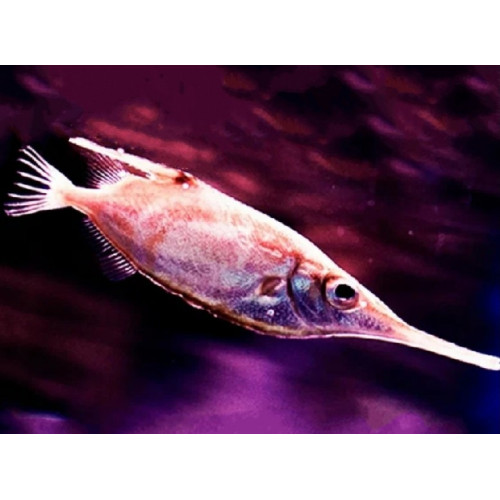
The longspine snipefish is distinguished by a head extended into a long tube, bony stripes along the sides of the back and on the edges of the chest and belly, and the absence of a lateral line. The body is compressed laterally with small, rough scales; there are no teeth. They have large eyes, long snouts, and a thin spine protruding from the back.
Features of fish fins
This fish species has two dorsal fins, the first of which is short and spiny. The pelvic fins on the belly are not fully developed. One of the rays of the first dorsal fin is highly developed. The second ray of the first dorsal fin is very large and serrated on the rear edge.
Fish coloring
The body coloration is reddish, with silvery, golden-shimmering sides and belly, and whitish fins.
Male fish change coloration before courtship begins to attract females. The brownish abdominal area and the base of the dorsal spine become darker, while the rear part of the body turns brick red. This dark area spreads forward along the back and sides. This color pattern can disappear within seconds if the fish is frightened.
Distribution
They are distributed in the Atlantic, Indian, and Pacific Oceans. They are found mainly in temperate latitudes at 20–40° north latitude, although they also occur in the southern hemisphere as far south as 43° south latitude.
Habitat
A marine demersal species. It inhabits tropical and subtropical waters at depths of 25 to 600 meters (82 to 1,969 feet), particularly preferring depths exceeding 100 meters, with a clear preference for deeper areas along the continental shelf and slope regions.
Size
The maximum body length of these fish is 20 cm (7.9 inches), typically up to 12 cm (4.7 inches). Length ranges from 4.8 to 16.0 cm (1.9 to 6.3 inches), including head length, fin features, and snout characteristics. Males range from 9.1 cm to 13.8 cm, averaging 11.74 cm, while females are slightly larger, ranging from 9.7 cm to 16.0 cm, averaging 13.12 ± 1.743 cm.
Behavior
Not infrequently encountered in huge numbers and very dense schools.
Males exhibit aggressive behavior during courtship, and these fights are closely linked to obtaining mating opportunities. Parallel swimming serves as a signaling behavior, after which actual competition occurs. Striking another male with the erect dorsal spine is a common aggressive behavior among males during courtship.
Food and feeding habits
It feeds on a variety of crustacean zooplankton, such as copepods and ostracods, as well as benthic invertebrates. When they are young, mysid shrimp are their primary prey, but as they grow, their diet shifts to include more decapods and amphipods. Seasonal and ontogenetic variations also affect their feeding behavior: more amphipods and gastropods are consumed in winter.
Reproduction
Courtship occurs near evening, when the fish are near the bottom. Courting males follow the female and swim parallel to her near the bottom in a head-down position. When the male approaches closely enough, the female erects her dorsal spine. The male follows the female's movement, often changing position from side to side. The male then slowly tilts his caudal peduncle toward the female at a 90-degree angle, while the female turns her belly toward the male. The two fish connect their caudal peduncles and become locked together. Together they rise to the surface, where during the ascent the female's genital papilla expands and repeatedly contacts the male's genital area. During the ascent, eggs are released and fertilized. Upon reaching the water's surface, the fish separate and return to the bottom.
Fishing
It has no commercial fishing value.
Relationship with a person
The longspine snipefish is not an edible fish.
| Classification | |
| Phylum | Chordata |
| Class | Actinopterygii |
| Squad | Syngnathiformes |
| Family | Centriscidae |
| Genus | Macroramphosus |
| Species | M. scolopax |
| Features | |
| Conservation status | Least Concern |
| Habitat | Pelagic |
| Life span, years | No information |
| Maximum body weight, kg | No information |
| Maximum length, cm | 20 |
| Sailing speed, m/s | No information |
| Threat to people | Edible |
| Way of eating | Planktonophage |
Longspine snipefish
Tags: longspine snipefish