
Latin name
Diogenichthys atlanticus
Other name
Diogenichthye atlanticus
Diogenichthys atlanticum
Diogenichthys scofieldi
Myctophum laternatum atlanticum
Identification
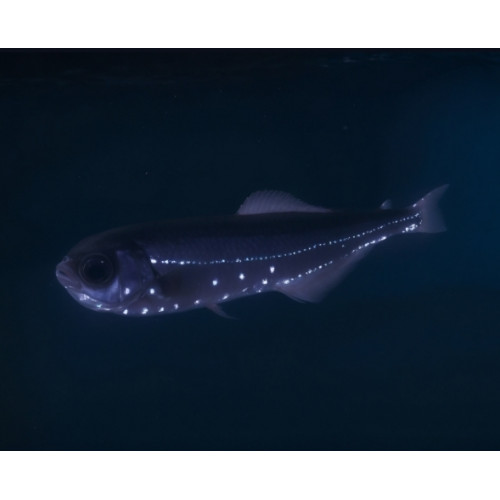
The longfin lanternfish has a laterally compressed body, a large head, and a very large mouth resembling that of a common anchovy. It possesses a subocular projection. Small photophores are arranged in groups and rows on the trunk and head. The body is covered with thin, easily shed scales. The adipose fin is supported by a distinct cartilaginous plate.
Features of Fish Fins
This species possesses 11 to 12 dorsal fin rays, 16 to 17 anal fin rays, and 14 pectoral fin rays. The origin of the anal fin is located beneath the base of the dorsal fin or slightly posterior to it.
Fish Coloration
Longfin lanternfish are typically dark brown to black; freshly caught specimens exhibit iridescent blue, green, or silvery hues. They possess specialized light-emitting organs (photophores) that produce blue, green, or yellowish light via chemical reactions within photocyte cells.
Distribution
This is a widely distributed species, found in the Atlantic, Pacific, and Indian Oceans.
Habitat
A marine bathypelagic, oceanodromous species. It inhabits depths ranging from 18 to 1250 meters below the ocean surface. During the day, it is typically found at depths of 400 to 930 meters, migrating to shallower depths of 18 to 1050 meters at night.
Size
This species reaches a maximum length of 2.9 cm.
Behavior
They undergo diel vertical migrations. Larvae and juveniles do not migrate, at least in the waters near the Canary Islands.
Food and Feeding Habits
Typical zooplanktivores; their diet consists of planktonic crustaceans, and more rarely, fish larvae and fry.
Reproduction
Spawning occurs year-round, peaking in winter and early spring. Fecundity is relatively low, ranging from 100 to 2000 eggs measuring 0.7–0.9 mm in diameter. The buoyant eggs and small larvae remain near the sea surface as part of the neustonic plankton. As they grow, the juveniles descend into progressively deeper water layers, gradually adopting the adult lifestyle. The lifespan of this species is short, typically less than one year.
Fishing
There is no large-scale, international, specialized fishery for the longfin lanternfish. Virtually all caught specimens are used as feed for fur-bearing animals.
Relationship with Humans
Harmless. This is a species with a stable population, posing no known major threats, and it occurs in numerous marine protected areas. Consequently, it is classified as Least Concern on the IUCN Red List.
| Classification | |
| Phylum | Chordata |
| Class | Actinopterygii |
| Squad | Myctophiformes |
| Family | Myctophidae |
| Genus | Diogenichthys |
| Species | D. atlanticus |
| Features | |
| Conservation status | Least Concern |
| Habitat | Pelagic |
| Life span, years | 1 |
| Maximum body weight, kg | No information |
| Maximum length, cm | 2,9 |
| Sailing speed, m/s | No information |
| Threat to people | Edible |
| Way of eating | Planktonophage |
Longfin lanternfish
Tags: longfin lanternfish