
Latin name
Pristis pristis
Other name
Common sawfish, wide sawfish, freshwater sawfish, river sawfish, Leichhardt's sawfish, northern sawfish.
Identification
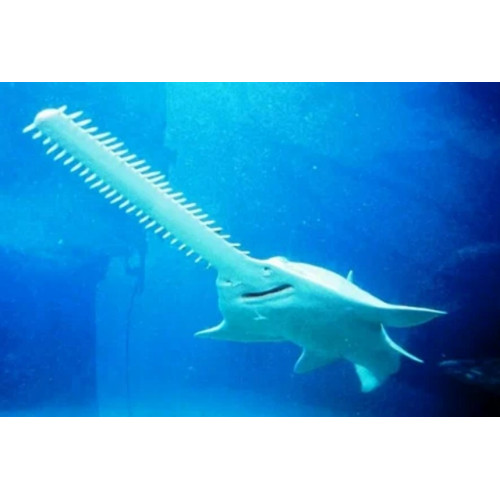
This is a fish that cannot be mistaken for any other due to its unique "weapon"—the rostrum. Along its sides are large tooth-like projections (rostral teeth): 14–24 pairs on each side. The rostrum itself is wide at the base and tapers noticeably toward the tip. The teeth are large, with a groove running from the base to the tip. Unlike sawsharks, the teeth of sawfish do not regenerate when damaged. Externally, the largetooth sawfish resembles a shark more than the ray to which it is related.
Features of fish fins
The body of these fish is elongated, with two large dorsal fins and a caudal fin with a well-developed upper lobe (the lower lobe is small but distinct). The anal fin is absent. Unlike the dwarf sawfish (P. clavata) and the longcomb sawfish (P. zijsron), in the largetooth sawfish the first dorsal fin begins in front of the base of the pelvic fins (rather than above or behind them), and the pectoral fins are triangular with pointed tips.
Fish coloring
The back and sides of the largetooth sawfish are gray, brownish, or olive-brown, while the belly is lighter, whitish or grayish. Individuals living in freshwater may develop a reddish tint due to visible blood vessels beneath the skin.
Distribution
The habitat of this species is the tropical and subtropical waters of all oceans (historically), but currently is fragmented. At present, a relatively stable population remains only in northern Australia. In the Atlantic, the species has virtually disappeared and is found only in a few places off the coasts of Central and South America and West Africa. It has also disappeared from the Mediterranean Sea (the last recorded occurrence dates to 1959) and from European waters.
Habitat
This is a demersal (bottom-dwelling) species that prefers to stay near the bottom in shallow water. It is unique in that it thrives in waters of varying salinity (an euryhaline species). Juveniles spend their first 3–5 years in freshwater rivers and estuaries, traveling upstream for hundreds of kilometers (up to 1,340 km [830 miles] from the sea in the Amazon). As they mature, adults migrate to brackish and marine waters, preferring shallow areas (from 1 to 25–26 meters [3–85 feet] deep) with muddy, sandy, or clay bottoms.
Size
This is a giant species. It reaches up to 7.5 meters (25 feet) in length (unconfirmed); the maximum recorded size is 7 meters (23 feet), with a weight of up to 590 kg (1,300 lbs). On average, adults rarely exceed 2–2.5 meters (6.5–8 feet) due to overfishing. Lifespan is estimated at 30–44 years, with some reports suggesting up to 80 years.
Behavior
Juveniles are capable of "climbing" using their pectoral fins and can jump high out of the water. In one recorded instance, a 1.8-meter (6-foot) individual jumped to a height of 5 meters (16 feet). This is believed to be an adaptation for overcoming waterfalls and rapids during upstream migration.
Food and feeding habits
A benthic predator. The sawfish's rostrum is a complex multifunctional tool, not just a weapon. The saw is covered with thousands of tiny pores—ampullae of Lorenzini—that detect the weakest electric fields generated by the muscle and gill movements of potential prey buried in the substrate. This allows the sawfish to hunt in murky water or in the dark, relying almost entirely on electroreception. Once prey (fish or crustaceans) is detected, the sawfish attacks, delivering lightning-fast lateral swipes with its rostrum. The sharp teeth slash and stun the prey, after which the fish swallows it whole. The sawfish also uses its rostrum to stir up sand or mud on the bottom, digging out hidden invertebrates.
Reproduction
The largetooth sawfish has a slow reproductive cycle, making it extremely vulnerable to overfishing. Reproductive mode: ovoviviparous. Fertilization is internal (males possess specialized organs called claspers). Embryos develop within eggs inside the mother's body, hatch from them, and continue to feed on yolk. Gestation lasts about 5 months. The female gives birth to 1 to 13 pups (average 7–9) once every 1–2 years. Newborns measure 72–90 cm (28–35 inches). The teeth of newborns are covered with a soft sheath to prevent injury to the mother during birth. Juveniles grow quickly (up to 100 cm [39 inches] in the first year) but reach sexual maturity late—at 7–10 years of age, at a length of about 3 meters (10 feet).
Fishing
Despite its protected status, this fish is intentionally caught due to the high value of all its parts. Moreover, in the vast majority of cases, this species ends up in catches not as a target, but as "bycatch" in shrimp and other fisheries.
Relationship with a person
This species poses no threat to humans. It is a timid and peaceful fish that tries to swim away when it sees people. The rostrum of the largetooth sawfish is a valuable souvenir and trophy, highly prized by collectors and sold on black markets. The fins are highly valued in Asia as an ingredient for shark fin soup, which is considered a delicacy. The meat is considered tasty, and the skin is used to produce various goods.
| Classification | |
| Phylum | Chordata |
| Class | Chondrichthyes |
| Squad | Rhinopristiformes |
| Family | Pristidae |
| Genus | Pristis |
| Species | P. pristis |
| Features | |
| Conservation status | Critically Endangered |
| Habitat | Bottom |
| Life span, years | 80 |
| Maximum body weight, kg | 590 |
| Maximum length, cm | 750 |
| Sailing speed, m/s | No information |
| Threat to people | Edible |
| Way of eating | Predator |
Largetooth sawfish
Tags: largetooth sawfish