
Latin name
Canthidermis macrolepis
Other name
Large-scale triggerfish
Identification
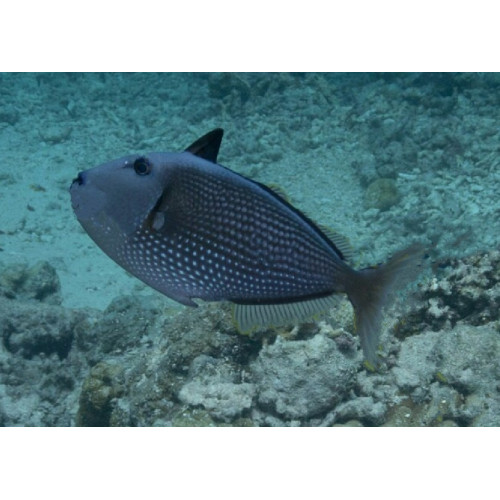
The body of the largescale triggerfish is short, compressed laterally, and deep, but thinner than that of its relatives (deeper in juveniles). The dorsal profile of the snout is slightly concave in juveniles and slightly convex in adults. There is a deep groove in front of the eye, passing below the nostrils along the upper third of the snout. The nostrils are small, located directly in front of the orbital margin. The interorbital spaces are somewhat depressed. The mouth is small and terminal. The teeth are incisor-like, sharp, and serrated along the edges, with three inner plate-like teeth on each side of the upper jaw. The gill opening is slightly oblique. Enlarged scales behind the gill opening are absent. There are 35 to 39 scale rows on the body; 25 to 29 scale rows on the head.
Features of fish fins
Dorsal spines (total): 3; dorsal soft rays (total): 23–26; anal spines: 0; anal soft rays: 21–23.
The dorsal fin slopes backward. The soft dorsal and anal fins in adults are sharply pointed and falcate (sickle-shaped), approximately equal in size. The caudal peduncle is long and moderately wide. The caudal fin of adults is double, with protruding lobes. Juveniles have a rounded caudal fin.
Fish coloring
The color of the largescale triggerfish is gray, brown, or purplish-brown, with a lighter ventral shade. The distal margins of the caudal, anal, and second dorsal fins are darker, almost blackish. The pectoral fins are gray.
Distribution
They are distributed in the Indo-West Pacific Ocean: the Red Sea, Arabian Sea, northern South China Sea, Japan, and Micronesia.
Habitat
A marine tropical benthopelagic species. It primarily inhabits coral reefs.
Size
The maximum length for males of this species is 60.0 cm (23.6 inches).
Behavior
A relatively aggressive fish species. The first dorsal fin, which is folded when at rest, contains three large spines, the longest of which is the first. The second spine serves as a lock. When in danger, the fish erects the fin; then the second spine moves slightly upward, causing the first two spines to lock into place, making it impossible to fold the dorsal fin without breaking the spines. To fold the dorsal fin on its own, the fish must lower the second spine.
Food and feeding habits
They feed on benthic invertebrates such as mollusks and echinoderms. Their teeth are adapted for crushing and biting through the shells of sea urchins, mollusk shells, and similar items.
Reproduction
Oviparous (egg-laying); they pair up during the breeding season. They move into shallow water to lay eggs in a nest dug in the sand.
Fishing
This species is not commercially important. They are caught by hand; they are a relatively rare component of the catch, but observed periodically. In aquaristics, they are used as an ornamental fish.
Relationship with a person
Harmless. When guarding their laid eggs, triggerfish can behave aggressively and inflict quite noticeable bites on divers. They can accumulate toxins from food in their bodies and cause ciguatera poisoning, so it is also important to exercise caution when handling them.
| Classification | |
| Phylum | Chordata |
| Class | Actinopterygii |
| Squad | Tetraodontiformes |
| Family | Balistidae |
| Genus | Canthidermis |
| Species | C. macrolepis |
| Features | |
| Conservation status | Least Concern |
| Habitat | Pelagic |
| Life span, years | No information |
| Maximum body weight, kg | No information |
| Maximum length, cm | 60 |
| Sailing speed, m/s | No information |
| Threat to people | Not edible |
| Way of eating | Planktonophage |
Largescale triggerfish
Tags: largescale triggerfish