
Latin name
Dalatias licha
Other Names
The kitefin shark is known by several alternative names, including black shark, darkie charlie, and seal shark. Its scientific name, Dalatias licha, was given by Bonnaterre in 1788. The species belongs to the family Dalatiidae (sleeper sharks).
Identification
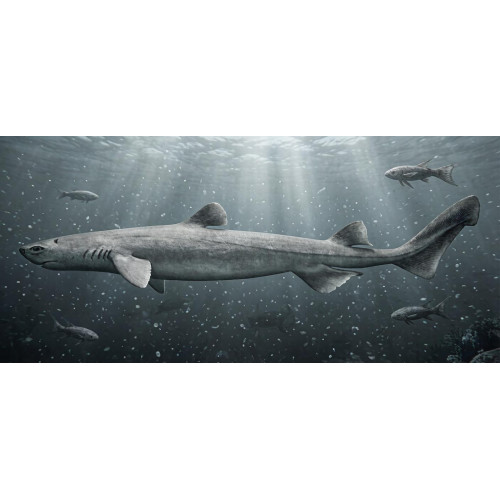
The kitefin shark has a moderately sized, elongate body with a short and blunt snout. The mouth is small with thick, fleshy lips covered in papillae (small fleshy bumps). The eyes are large, green in color, and have no nictitating eyelids. Large spiracles are present behind each eye. A key identifying feature is the asymmetrical dentition: the upper jaw teeth are small, slender, needle-like, and smooth-edged, while the lower jaw teeth are very large, broad, triangular, and serrated, with overlapping bases. Gill slits are short and small, increasing in size from first to fifth.
Features of Fish Fins
The kitefin shark has no spines in its dorsal fins. It possesses two small, rounded dorsal fins of almost equal size: the first dorsal fin is smaller than the second, with its origin behind the pectoral rear tips, and its base is closer to the pectoral base than the pelvic fins. The second dorsal fin is larger, with its origin near the rear base of the pelvic fins. The pectoral fins are long and paddle-shaped. There is no anal fin. The caudal fin is asymmetrical, with a relatively broad upper lobe and no distinct lower lobe or expanded ventral lobe.
Fish Colouring
The kitefin shark is uniformly dark grey-brown to blackish. The trailing edges of all fins are translucent or pale. The lips are pale or white, sometimes with white corners. The eyes are green.
Distribution
The kitefin shark has a cosmopolitan distribution and is found worldwide in tropical and warm-temperate waters. In the western Atlantic, its range extends from Georges Bank to the northern Gulf of Mexico and the southeastern Caribbean. In the eastern Atlantic, it is found from Iceland, Scotland, and the Irish Atlantic slope south to Morocco, including the western Mediterranean, Madeira, and Cameroon. It also occurs in the western Indian Ocean (Mozambique and South Africa) and the western Pacific (Japan, Australia, New Zealand, Taiwan). It has also been recorded in the central Pacific (Hawaii) and recently in the Guatemalan Caribbean.
Habitat
This species is bathydemersal (bottom-dwelling in deep water), inhabiting outer continental and insular shelves and slopes. It is found at depths ranging from 37 to 1800 meters, but is usually found deeper than 200 meters. It is mainly found on or near the bottom but can also occur well off the substrate and is often pelagic. The species is found singly or in small schools.
Size
The kitefin shark can reach a maximum total length of up to 182 cm (about 6 feet). Individuals are commonly around 120 cm in length. A recorded adult female from the Guatemalan Caribbean measured 142 cm total length. In the Ligurian Sea, specimens collected ranged from 38 to 116 cm total length, with weights from 198 to 8000 g.
Behavior
The kitefin shark is a notable bioluminescent shark and is currently considered the largest luminous vertebrate. It emits light ventrally (from its underside) through a mechanism called counterillumination. This light is thought to serve multiple purposes: to camouflage the shark from predators below by matching the downwelling light (counterillumination), to illuminate the ocean floor while searching for prey, and to stealthily approach prey before striking fast. It is a slow-growing, long-lived species with late maturation.
Food and Feeding Habits
The kitefin shark is a carnivorous predator that feeds primarily on deepwater bony fish, including lanternfishes and macrourids (rattails), as well as skates, other sharks (including etmopterids), cephalopods (squid and octopus), and crustaceans (shrimps, crabs). Like the related cookiecutter sharks, it is capable of gouging out chunks of flesh from larger fishes. Diet studies in the Mediterranean Sea showed a diet dominated by bony fish (especially Macrouridae) and other small sharks.
Reproduction
The kitefin shark is ovoviviparous (aplacental viviparous), meaning eggs are fertilized and hatched inside the mother's body, and the young are born live. Females give birth to litters of 10 to 20 pups, with newborns measuring 30–42 cm in total length. Adults are typically 120–160 cm in length. The species shows low fecundity and late maturation, making it vulnerable to fishing pressure. In the Mediterranean, mature males were observed throughout the year, while mature females were only seen in spring and summer, suggesting spatial segregation between the sexes.
Fishing
The kitefin shark is caught as bycatch in deepwater trawl, gill net, and longline fisheries throughout its range. It is used for its squalene liver oil (valued in cosmetics and pharmaceuticals), leather, and meat. It is also processed into fishmeal. The species is of commercial value in some regions.
Relationship with a Person
The kitefin shark is not considered a threat to humans and is classified as harmless. It is sometimes encountered as bycatch in deepwater fisheries. The species is listed as Vulnerable (VU) on the IUCN Red List. In European waters, including the Mediterranean Sea, it is considered Endangered. The species faces threats from habitat destruction, fishing pressure, and its slow life history (late maturation, low fecundity, slow growth rates), which makes it particularly vulnerable to overexploitation. Conservation actions include monitoring its population and habitat due to its restricted distribution and vulnerability to deep-sea fishing.
| Classification | |
| Phylum | Chordata |
| Class | Elasmobranchii |
| Squad | Squaliformes |
| Family | Dalatiidae |
| Genus | Dalatias |
| Species | Dalatias licha |
| Features | |
| Conservation status | Vulnerable |
| Habitat | Bathydemersal |
| Life span, years | No information |
| Maximum body weight, kg | 8 |
| Maximum length, cm | 182 |
| Sailing speed, m/s | No information |
| Threat to people | Edible |
| Way of eating | Predator |
Kitefin shark
Tags: kitefin shark