
Latin name
Zeus faber
Other name
St Pierre, or Peter's fish.
Identification
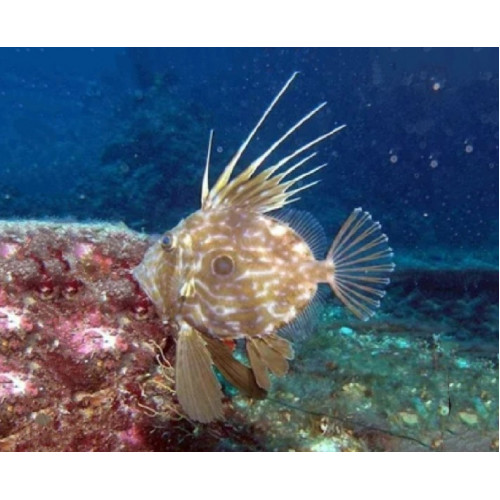
The body of John Dory is oval in shape, very deep, and strongly compressed laterally. Along the base of the fins there is a row of bony plates. The back and belly are studded with forked spines. The gill rakers are rudimentary.
Features of fish fins
Dorsal spines (total): 9 - 11; Dorsal soft rays (total): 22 - 24; Anal spines: 4; Anal soft rays: 20 - 23.
The dorsal and anal fins are supported by spiny rays that rise when the fish is excited. When folded, the long dorsal spines reach as far as the caudal peduncle. The rays of the anterior dorsal fin are very long and, when the fish swims, resemble fluttering ribbons.
Fish coloring
The body of John Dory is colored greenish-brown. The belly is silver-white. Yellowish stripes run along the sides of the body. The membranes of the anal and pelvic fins are black. On both sides of the body there is a round black spot, often bordered by a yellow band. According to legend, this is the fingerprint of the Apostle Peter. It is also said that Peter pulled a gold coin from the fish's mouth. For better protection against enemies, this species can change its coloration to match the surrounding environment.
Distribution
They are found in the eastern Atlantic Ocean from South Africa to Norway, as well as in the Mediterranean and Black Seas. They are widely distributed in the Indian Ocean. In the Pacific Ocean, they inhabit the coasts of Japan, Australia, and New Zealand.
Habitat
A marine, brackish, benthopelagic, oceanodromous species that prefers a temperate climate. Depth range is 5–400 meters (16–1,312 feet), typically 50–150 meters (164–492 feet).
Size
John Dory reaches an average size of 60 cm (24 inches) and weight of 4 kg (8.8 lbs). Occasionally, individuals up to 90 cm (35 inches) and 8 kg (17.6 lbs) have been found. Body height fits 1.5–2 times into body length. In the wild, the lifespan of these fish is about 12 years.
Behavior
John Dory live solitary lives. Juveniles gather in small groups.
Food and feeding habits
John Dory feed mainly on herring and other schooling fish. They carefully approach a school of fish and suddenly suck in their prey, possessing a well-developed mouth apparatus necessary for this. They also partially hunt invertebrates, particularly squid and crustaceans. Hatched fry feed on plankton at first.
Reproduction
Sexual maturity is reached at three to four years of age. They spawn during the winter and spring months. The northernmost region where spawning has been recorded is the Irish Sea. Eggs are laid at depths of up to 100 meters (328 feet), fertilized in the water, and then drift freely.
Fishing
A valuable commercial fish. It is mainly caught by Morocco, Senegal, and Madeira. Fishing is carried out using bottom trawls.
Relationship with a person
Harmless. The flesh of these fish is excellent in taste, but is little used.
| Classification | |
| Phylum | Chordata |
| Class | Actinopterygii |
| Squad | Zeiformes |
| Family | Zeidae |
| Genus | Zeus |
| Species | Z. faber |
| Features | |
| Conservation status | Data Deficient |
| Habitat | Pelagic |
| Life span, years | 12 |
| Maximum body weight, kg | 8 |
| Maximum length, cm | 90 |
| Sailing speed, m/s | No information |
| Threat to people | Edible |
| Way of eating | Predator |
John Dory
Tags: john dory