
Latin name
Sardinops melanosticta
Other name
The Japanese pilchard is also widely known as the Far East sardine or, in Russian, "ivasi". Its Japanese name is ma-iwashi. This species is closely related to the Pacific sardine (Sardinops sagax), with which it was sometimes considered a subspecies.
Identification
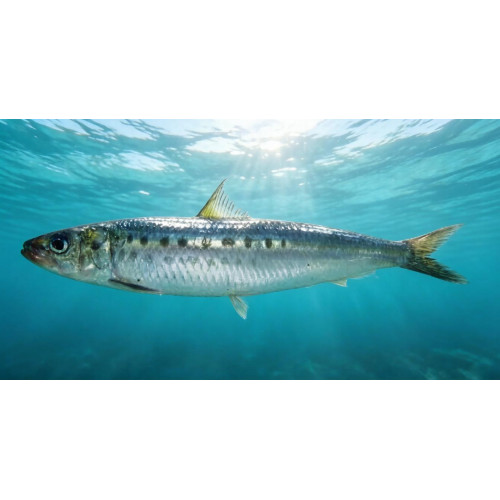
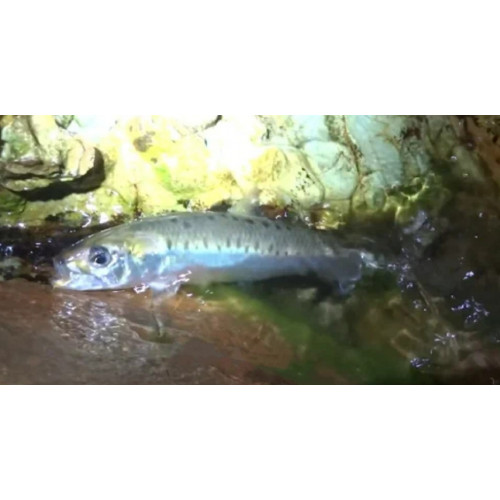
The Japanese pilchard is a small, slender, silvery fish with a streamlined body typical of the herring family (Clupeidae). Adults typically measure 16.0 to 26.0 cm in total length and weigh between 42 and 223 g, with females generally larger and heavier than males. It has a single dorsal fin located near the middle of the body, abdominal scutes (modified scales along the belly), and a deeply forked caudal fin. The head is relatively small with a terminal mouth.
Features of fish fins
The Japanese pilchard has a typical clupeid fin arrangement. The dorsal fin contains 17–19 soft rays and is positioned roughly at mid-body. The anal fin is located closer to the tail. The pectoral fins are situated low on the body, and the pelvic fins are positioned below the dorsal fin, near the middle of the body. The caudal fin is deeply forked, adapted for fast, sustained swimming. The swimming mode is carangiform, meaning propulsion comes mainly from movements of the caudal fin and the posterior part of the body.
Fish colouring
The back of the Japanese pilchard is dark blue to greenish-blue, while the flanks and belly are bright silver. The head is usually darker. Observations from aerial surveys show that when in schools, the front of the school appears a darker blue, while the rear appears a lighter, watery blue, indicating the direction of movement. Like many sardines, it lacks distinctive dark spots or stripes on its sides, though some individuals may have small dark speckling.
Distribution
The Japanese pilchard is widely distributed in the northwest Pacific Ocean, primarily in the seas of far-eastern Asia. Its range includes the Sea of Japan, the East China Sea, and waters around the Japanese archipelago. It also occurs in the Bering Sea . Historically, this species was believed to be restricted to the western North Pacific, but recent genetic studies have detected its presence along the west coast of North America as far south as the California Current, likely due to range shifts driven by marine heatwaves.
Habitat
This species is a coastal pelagic fish, meaning it inhabits the upper layers of the water column in shelf waters. It is commonly found in coastal areas, often near the surface, and forms large schools that are easily visible from the air. It is sensitive to water temperature; during its northward feeding migration, catches are associated with sea surface temperatures averaging around 11.0°C.
Size
As noted, adults range from 16.0 to 26.0 cm in total length, with females (average ~20.9 cm) being significantly larger than males (average ~19.6 cm). The maximum recorded weight is approximately 223 g.
Behavior
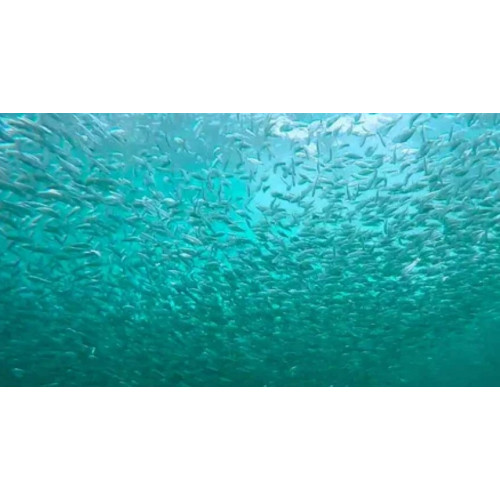
The Japanese pilchard is a highly schooling fish, forming dense, large aggregations. It undertakes seasonal migrations—moving northward in spring and summer for feeding, and southward in autumn and winter for spawning. Aerial observations show that schools have a distinct front and rear, and can move in unpredictable waves rather than a continuous sequential flow. Warm ocean currents, like the warm streamer off the Sanriku coast, can serve as a migration route. At night, spawning groups form pairs, where a single male and female mate in a 1-to-1 pairing, likely due to limited visual information in darkness.
Food and feeding habits
Larval Japanese pilchard, measuring 5–17 mm, feed primarily on copepod nauplii (larvae) and copepodites (juvenile copepods). As juveniles and adults, their diet expands to include a wider range of zooplankton and, to a lesser extent, phytoplankton. The availability of prey, particularly copepods, varies spatially and can influence larval survival. Larvae in the western Sea of Japan often have access to larger copepods, which may create more favorable feeding conditions than in the eastern areas.
Reproduction
The Japanese sardine spawns mainly in winter and spring, with the main spawning period shifting depending on population size and environmental conditions. Historically, when catches were high, the main spawning ground shifted northward; during periods of low abundance, it shifted back southward. Sea surface temperature plays a significant role in these shifts. Spawning occurs at night in single-pair units—a unique behavior for a schooling fish. A single female can release 24,000 to 48,000 eggs per spawning event and may spawn two or more times in a season. The eggs are fertilized externally, and development is temperature-dependent. Early mortality is extremely high, with only about 0.1% of fertilized eggs surviving to the postlarval stage (~15 mm). Individuals reach sexual maturity by approximately 16–20 cm in length.
Fishing
The Japanese pilchard is a major fishery resource and a key component of the marine ecosystem. The most commonly used fishing gear is the purse seine, targeting the large coastal schools. Catches have fluctuated dramatically over the past century: they boomed in the 1970s–1980s, collapsed in the early 1990s, and have been increasing again since about 2010.
Relationship with a person
This species has high economic importance as a food fish. Its dramatic population swings have had significant social and economic impacts on fishing communities in Japan, Russia, and other coastal nations. Additionally, it plays an essential ecological role in the marine food web, as a major forage fish for larger predators like tuna, seabirds, and marine mammals. Its sensitivity to climate variation, particularly to marine heatwaves, makes it an important indicator species for understanding and monitoring the impacts of climate change on marine ecosystems.
Interesting facts
The migrations of the Japanese pilchard are not just a simple "north in summer, south in winter" movement. This process is more complex and is heavily influenced by climatic cycles. The influence of temperature can be traced not only on a seasonal scale. In the 20th century, there were periods when catches of this fish reached millions of tons, and then, within a few years, fell to zero. These enormous fluctuations in abundance occurred synchronously across the entire Pacific Ocean, indicating the action of a global climatic mechanism. Cooling periods in the Arctic coincided with the disappearance of this species from northern areas, while warming periods coincided with new massive population surges.
| Classification | |
| Phylum | Chordata |
| Class | Actinopterygii |
| Squad | Clupeiformes |
| Family | Clupeidae |
| Genus | Sardinops |
| Species | S. melanostictus |
| Features | |
| Conservation status | Least Concern |
| Habitat | Pelagic |
| Life span, years | No information |
| Maximum body weight, kg | 0,223 |
| Maximum length, cm | 26 |
| Sailing speed, m/s | No information |
| Threat to people | Edible |
| Way of eating | Planktonophage |
Japanese pilchard
Tags: japanese pilchard