
Latin name
Salangichthys microdon
Identification
Since 2012, the species has been placed within the monotypic genus Salangichthys. Until a recent revision, this genus also included Neosalangichthys ishikawae (=Salangichthys ishikawae).
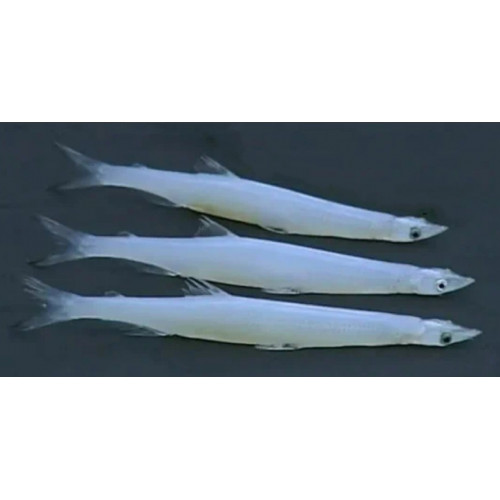
The body of Salangichthys microdon is elongated, with its greatest body depth located in the region anterior to the anal fin (this is more pronounced in males). The head is depressed, meaning its width significantly exceeds its height. Males possess several thin scales at the base of the anal fin, while females lack scales entirely. Sexual dimorphism is also evident in males having a deeper, shorter body and longer pectoral fins compared to females. A swim bladder is absent. There are no pyloric caeca in the intestine. Vertebrae: 59 – 73.
Features of fish fins
Dorsal soft rays (total): 10 – 13; Anal soft rays: 22 – 28.
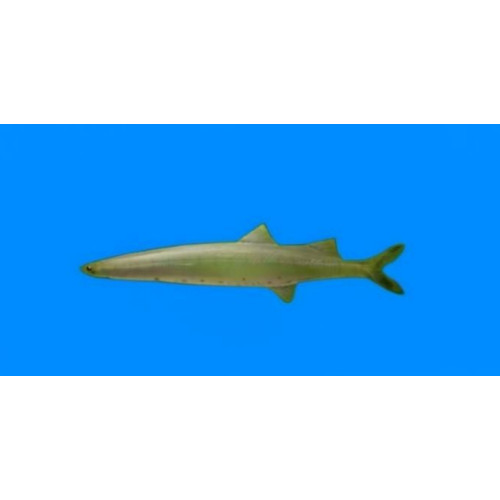
The dorsal fin is positioned posteriorly on the body, originating far behind the pelvic fins, slightly posterior to the end of the anal fin base. A small adipose fin is present. The anterior portion of the anal fin is considerably deeper than its posterior portion (a trait particularly noticeable in males).
Fish colouring
The fish is colorless and nearly transparent. A narrow stripe composed of individual melanophores (pigment spots) runs along each side of the ventral surface. Additionally, black spots are visible along the edge of the operculum (gill cover) and along the ventral margin of the caudal peduncle.
Distribution
A numerous and widely distributed species. It is found in the Sea of Japan, ranging from the coast of eastern Korea in the south to the Amur Estuary in the north. Its range also includes the southern part of the Sea of Okhotsk near the coasts of Japan and Sakhalin.
Habitat
This is a cold-water, marine demersal (bottom-dwelling) fish that spawns in estuaries, rivers, and lakes. It inhabits shallow coastal zones.
Size
A small fish, typically reaching 8–10 cm in length and a body weight of up to 1.5 g. Its lifespan is one year.
Behavior
It is an anadromous fish. Depending on the location and spawning conditions, the juveniles may feed and grow in lagoons, lakes, or the marine coastal zone, migrating to the sea in autumn.
Food and feeding habits
Its diet consists primarily of small pelagic crustaceans.
Reproduction
The species is considered to be neotenic, meaning it reaches sexual maturity while still in its larval or juvenile stage. The spawning run occurs from March to May, typically during nighttime hours. During this period, fish congregate in large schools. Spawning takes place in May and June in river mouths, as well as in lagoon lakes and within the rivers themselves. Fecundity ranges from 1,300 to 2,700 eggs. The eggs are adhesive, attaching to aquatic vegetation and various submerged objects. Adults die shortly after spawning.
Fishing
It supports a small-scale commercial fishery in Japan. Within Russian waters, it is harvested in southern Sakhalin, Peter the Great Bay, and Lake Khanka (where the population is sustained by Chinese aquaculturists releasing fish from their side of the lake). Since 2012, the Japanese icefish has been included in the list of species targeted for coastal commercial fishing in Russia.
Relationship with a person
The species is harmless to humans. It is primarily utilized as food, most often prepared by frying.
| Classification | |
| Phylum | Chordata |
| Class | Actinopterygii |
| Squad | Osmeriformes |
| Family | Salangidae |
| Genus | Salangichthys |
| Species | S. microdon |
| Features | |
| Conservation status | Least Concern |
| Habitat | Bottom |
| Life span, years | 1 |
| Maximum body weight, kg | 0,0015 |
| Maximum length, cm | 10 |
| Sailing speed, m/s | No information |
| Threat to people | Edible |
| Way of eating | Planktonophage |
Japanese icefish
Tags: japanese icefish