
Latin name
Hyporhamphus sajori
Other name
Japanese needlefish, or sayori.
Identification
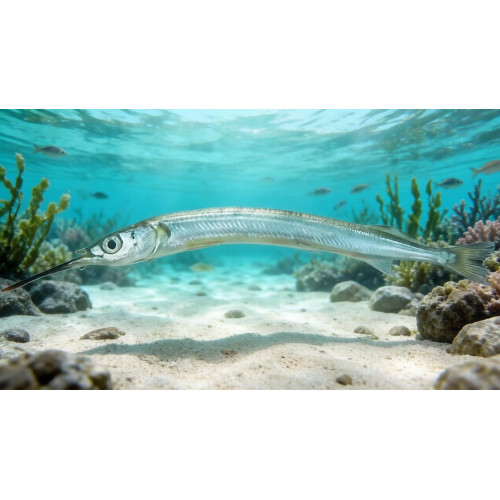
The Japanese halfbeak received its name due to the unique structure of its jaws, which defines its recognizable appearance.
Its body is elongated, cylindrical (almost round in cross-section), and slightly compressed laterally. The back and belly are nearly parallel, with the tail portion gradually tapering. The fish is covered with large, rounded scales that easily detach.
In adults, the lower jaw is significantly elongated forward, forming a long, sharp "beak" (hence the English name "needlefish"), while the upper jaw is short and triangular in shape. It is this inequality of the jaws that gave the entire family its name — "halfbeaks."
This fish is sometimes confused with the garfish — another fish with an elongated "beak" — but the garfish belongs to a different family and has both jaws elongated, not just the lower.
Features of fish fins
This fish species, like its relatives the sauries, has no spiny rays in its fins — all rays are soft. The dorsal fin has 14–18 soft rays, and the anal fin has 15–18 soft rays. The pectoral fins are short, with 12–14 rays (usually 13). The dorsal and anal fins are set far back, and the caudal fin is forked.
Fish coloring
The back is dark blue or greenish-brown, the sides and belly are silvery, with a bright silver stripe running along the entire body. The lower jaw may have a reddish or red tint at the base.
Distribution
An inhabitant of temperate and subtropical waters of the northwestern Pacific Ocean. The species is distributed in the Sea of Japan and the Yellow Sea, along the Pacific coast of Japan (from Hokkaido in the north to Taiwan in the south), as well as in Peter the Great Bay near Vladivostok and off the coast of southern Sakhalin.
Habitat
This is a coastal neritic species (inhabiting coastal waters over the continental shelf) that prefers the upper water layers. It stays in shallow waters, often entering river estuaries and even fresh water (into the lower reaches of rivers, such as the Yangtze in China). The maximum depth of habitation is up to 30 meters (98 feet).
Size
Adults typically reach a length of 20–30 cm (8–12 inches), but can grow up to 40 cm (16 inches). The most commonly encountered specimens are about 22 cm (8.7 inches) long. The weight of this fish varies widely. Individuals weighing from 14.5 to 102 grams (0.5 to 3.6 ounces) have been recorded. In practice, fish weighing 30–40 grams (1.1–1.4 ounces) are most common. The maximum reported weight is about 300 grams (10.6 ounces).
This is a fish with a short life cycle and a fast growth rate. The exact maximum lifespan has not been scientifically established. However, based on the biology of the species, it is generally accepted to be no more than 3–4 years.
Behavior
Forms small schools. It is an active, mobile fish that swims near the surface. In winter, the Japanese halfbeak migrates south to warmer waters, returning to the shores in spring.
Food and feeding habits
Despite its intimidating "needle-like" appearance, the Japanese halfbeak is a peaceful planktivore. Its diet consists mainly of zooplankton — small crustaceans — as well as invertebrate larvae. With its long, thin snout, it can extract worms and snails from the narrowest crevices. It does not use its long "beak" to hunt fish; rather, it strains the water, gathering small food. It may also feed on aquatic vegetation (e.g., eelgrass — Zostera) and detritus.
Reproduction
Spawning occurs in coastal areas in June–July, when the water warms to 14–23°C (57–73°F). The eggs are small, equipped with long thread-like filaments, with which they attach to aquatic vegetation. This protects the eggs from being washed away by currents. The larvae hatch after approximately two weeks (the timing depends on water temperature). Notably, in the larvae, both jaws are of equal length. The lower jaw begins to actively grow and surpass the upper jaw only as the fish matures. Sexual maturity is reached at a length of about 17 cm (6.7 inches).
Fishing
The commercial significance of this species is relatively small. Most often, the Japanese halfbeak is caught as bycatch in fisheries targeting other fish species. It is also caught using lift nets (dip nets).
Relationship with a person
The meat of this fish is considered very tasty and tender. In Japanese cuisine, sayori is a traditional spring delicacy served in restaurants as "seasonal fish."
In addition to culinary uses, this fish is used in traditional Chinese medicine.
| Classification | |
| Phylum | Chordata |
| Class | Actinopterygii |
| Squad | Beloniformes |
| Family | Hemiramphidae |
| Genus | Hyporhamphus |
| Species | H. sajori |
| Features | |
| Conservation status | Least Concern |
| Habitat | Pelagic |
| Life span, years | 4 |
| Maximum body weight, kg | 0,3 |
| Maximum length, cm | 40 |
| Sailing speed, m/s | No information |
| Threat to people | Edible |
| Way of eating | Planktonophage |
Japanese halfbeak
Tags: japanese halfbeak