
Latin name
Holocentrus adscensionis
Other Names
The squirrelfish is known by several alternative names, including common squirrelfish, longjaw squirrelfish, Ascension squirrelfish, striped squirrelfish, wenchman, cook, and hardback soldier. In Spanish, it is called candil de vidrio or carajuelo de ascención. Its scientific name, Holocentrus adscensionis, was given by Osbeck in 1765.
Identification
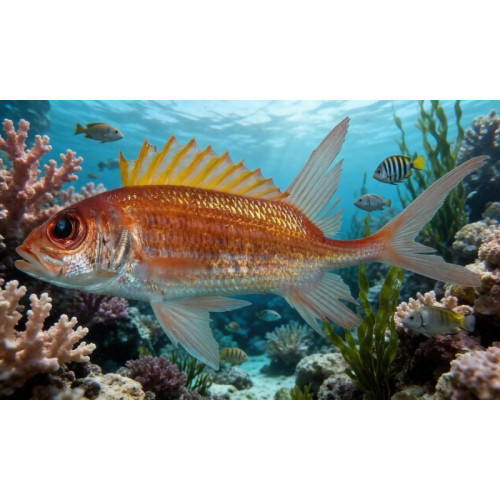
The squirrelfish has a fusiform (spindle-shaped) body that is oblong and moderately compressed. The head is pointed with large eyes, and the bones on the head are serrated and spiny. The mouth is large and positioned at the front. The preopercle has an angular corner bearing a large, long spine, and there is a large spine at the top corner of the operculum. The tail base is long and slender, and the caudal fin is deeply forked with pointed tips, the upper lobe being distinctly longer than the lower lobe. The body scales are very spiny.
Features of Fish Fins
The squirrelfish has a single dorsal fin with 11 spines and 15–16 soft rays. The spiny and soft parts of the dorsal fin are nearly separate, but connected by a low membrane. The anal fin has 4 spines and 9–10 soft rays. The pelvic fins have 1 spine and 7 soft rays, and the pectoral fins have 15–17 soft rays. There is no adipose fin. The tip of the membranes of the spinous dorsal fin is reddish or translucent.
Fish Colouring
The squirrelfish is generally dull red or pinkish, sometimes blotched. The upper head and body are pink, sometimes with a white blotch on the rear back. The lower parts and tail base are white. The spiny dorsal fin is yellowish, without white blotches behind the spine tips. The soft dorsal, tail, anal, pelvic, and pectoral fins are pinkish white.
Distribution
The squirrelfish has a transatlantic distribution. In the western Atlantic, it ranges from North Carolina, USA, and Bermuda to Brazil, including the Gulf of Mexico, the West Indies, and the Caribbean. In the eastern Atlantic, it is found from São Tomé Island and Gabon to Angola, and at St. Paul's Rocks, St. Helena, and Ascension Island. It has also been recorded as a new alien species in the Mediterranean Sea.
Habitat
This species is marine and reef-associated. It occurs in shallow coral reefs, as well as deeper offshore waters. The depth range is from 0 to 180 meters, though it is usually found between 8 and 30 meters. It is a subtropical species, found in tropical, subtropical, and temperate waters.
Size
The squirrelfish can reach a maximum total length of 61 cm (about 24 inches). The common length is around 25 cm (about 10 inches). The length at first maturity is about 14.6 cm.
Behavior
The squirrelfish is a nocturnal species. During the day, it hides in deep crevices or under coral ledges, defending its hiding place from intruders using calls produced by its swim bladder, displays, and lunges. At night, it moves over sand and grass beds to feed. It is capable of producing sounds.
Food and Feeding Habits
The squirrelfish is a nocturnal carnivore. Its diet consists mainly of crabs, shrimps, and other small crustaceans. It also feeds on small fishes and mobile benthic worms. Its large eyes are an adaptation for nocturnal foraging.
Reproduction
The squirrelfish has external fertilization. It is an open water/substratum egg scatterer that does not guard its eggs. Spawning occurs in the water column, and larvae enter a pelagic stage until they settle on the reef. Spawning has been documented as far north as North Carolina in May.
Fishing
The squirrelfish is of minor commercial importance and is marketed fresh. It is also used in the aquarium trade.
Relationship with a Person
The squirrelfish is not considered a threat to humans through aggression. However, there are reports of ciguatera poisoning from consuming this fish, which is a significant health risk. The species is listed as Least Concern (LC) on the IUCN Red List.
Interesting facts
The name "squirrelfish" for Holocentrus adscensionis is associated with several characteristic features that resemble a land squirrel.
The main reason for this name is its large eyes, which strongly resemble those of a squirrel. They play an important role, as the fish is nocturnal and relies on excellent vision in the dark. This fish is distinguished by quick and sudden movements that resemble the maneuvers of a squirrel among tree branches. The sharp and spiny rays of the dorsal fin may be associated with the fluffy tail of a squirrel. The scientific name of the genus, Holocentrus, means "full of spines" (from the Greek holos — whole, and kentron — sting, spine). This connects this fish to the squirrel family (Sciuridae), which is also characterized by spiny needles. Thus, this name is a combination of a recognizable appearance with eyes and behavior reminiscent of a land animal.
| Classification | |
| Phylum | Chordata |
| Class | Actinopterygii |
| Squad | Beryciformes |
| Family | Holocentridae |
| Genus | Holocentrus |
| Species | Holocentrus adscensionis |
| Features | |
| Conservation status | Least Concern |
| Habitat | Demersal |
| Life span, years | No information |
| Maximum body weight, kg | No information |
| Maximum length, cm | 61 |
| Sailing speed, m/s | No information |
| Threat to people | Edible |
| Way of eating | Predator |
Holocentrus adscensionis
Tags: holocentrus adscensionis