
Latin name
Myrichthys colubrinus
Other name
Banded snake eel, ringed snake eel or harlequin eel.
Identification
The harlequin snake eel has a long, tubular body shape and a narrow head. They are also distinguished by their particularly sharp and hard snouts and tails. The number of vertebrae is 190–202.
A unique feature is that their posterior nostrils are located either inside the mouth or along the upper lip. The anterior nostrils, on the other hand, protrude noticeably above the surface of the snout and are tubular in shape. They have grain-like teeth arranged in two rows in the jaw.
Features of fish fins
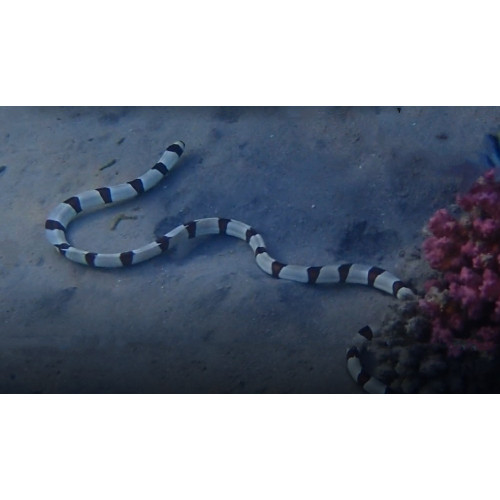
This species lacks clearly defined fins, apart from a large dorsal fin and small pectoral fins. The pectoral fins can be seen by looking behind the gills. The dorsal fin merges with the body but runs along the entire back of the fish to the very tail. This fin supports their movement as well as their body shape. They move very methodically and generally slowly, in an undulating manner. The fish move by changing the shape of their entire body along the spine in an S-shape to propel themselves through the water and across the rocky and coral-filled reefs where they live.
Fish coloring
They are covered with broad transverse black and white bands, sometimes spots. The coloration can be more detailed, as the white parts of the eel's body have a slightly gray tinge. This allows the eel to maintain a semblance of shading. The white bands also become lighter as they approach the black bands. There is great variation in this species regarding band size. It is hypothesized that this is because banded snake eels in different regions mimic the phenotypic variations observed in the sea snakes they imitate. The bands also vary in frequency, and adults can be seen with 25 to 35 bands.
Distribution
They are distributed in the Indo-Pacific region: from the southern Red Sea to Maputo Bay, Mozambique, and eastward to the Society Islands in French Polynesia. They are most often found in coastal areas of these oceans from Australia to Japan and the Hawaiian Islands. Some species are even found along the coast of Mexico.
Habitat
A marine tropical eel. Adults are found in shallow waters over sandy bottoms and in seagrass beds. It is a demersal fish.
Size
The body length of fish of this species reaches up to 97 cm. The average body length is 51–68 cm, with the largest specimen found measuring 97 cm from the tip of the snout to the tip of the tail. Weight can vary from 0.4 to 11.3 kg.
Behavior
They resemble the venomous sea snake, the yellow-lipped sea krait (Laticauda colubrina), in appearance, but are completely harmless. They typically hunt during the day.
Food and feeding habits
They feed on small fish and crustaceans.
The hunting style of these eels can be described by how they actively search sandy flats and seagrass beds where they live. Using their narrow heads, they explore openings in rocks in search of prey. They rely not only on their heads for finding food but also on their tails to flush out or feel for prey in narrow burrows. They are active hunters rather than sitting and waiting for prey to come to them.
Reproduction
The larval stages and developmental stages are not widely studied. They are predominantly nocturnal. This also applies to their larvae. They are known to have pelagic leptocephalus larvae. It is also believed that these eels have a prolonged larval stage, with larvae and eggs being very difficult to identify in a species-specific manner without genetic testing. Additional information on reproductive methods has not been studied.
Fishing
This species is not commercially important.
Relationship with a person
Harmless. It is an edible fish. It is sometimes found in the aquarium trade.
| Classification | |
| Phylum | Chordata |
| Class | Actinopterygii |
| Squad | Anguilliformes |
| Family | Ophichthidae |
| Genus | Myrichthys |
| Species | M. colubrinus |
| Features | |
| Conservation status | Least Concern |
| Habitat | Bottom |
| Life span, years | No information |
| Maximum body weight, kg | 11,3 |
| Maximum length, cm | 97 |
| Sailing speed, m/s | No information |
| Threat to people | Edible |
| Way of eating | Predator |
Harlequin snake eel
Tags: harlequin snake eel