
Latin name
Argyropelecus hemigymnus
Other Names
The half-naked hatchetfish is also known as the short silver hatchetfish and spurred hatchetfish. Its scientific name, Argyropelecus hemigymnus, was given by Cocco in 1829. The genus name Argyropelecus comes from the Greek words "argyros" (silvered, silver) and "pelekys" (axe), referencing the characteristic deep, axe-shaped body.
Identification
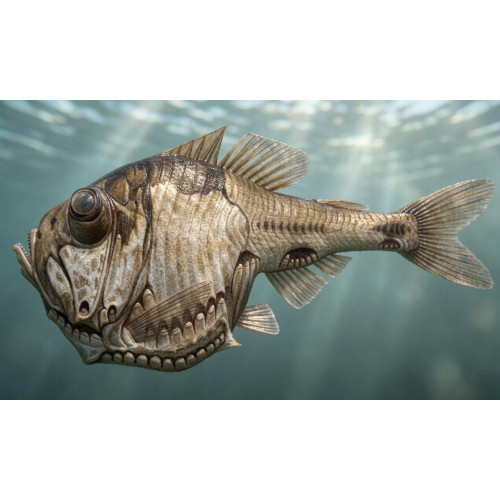
The half-naked hatchetfish has a strongly compressed, deep body that is bright silvery in color. It is the smallest species in its genus, reaching only about 5.1 cm total length. The head is small, and the mouth is nearly vertical, adapted for feeding on small prey. The eyes are tubular and directed upwards, allowing the fish to detect prey silhouetted against the faint light from the surface. The trunk is narrow, and the species has a single post-abdominal spine with serrated margins. The teeth are minute.
Features of Fish Fins
The half-naked hatchetfish has no spines in its fins. The dorsal fin contains 8–9 soft rays, followed by a small adipose fin. The anal fin has 11–12 soft rays, divided into two groups (6 + 5) separated by a photophore. The pectoral fins contain 10–11 rays, and the pelvic fins contain 6 rays. The vertebrae number 36–39.
Fish Colouring
The half-naked hatchetfish is bright silvery on the body, with a dark back and silver flanks. The body and trunk become dusky at night. The midline has pigment patches dorsal to the photophores, with the latter chromatophore distinct to about 9 mm standard length. As with other hatchetfishes, the photophores are thought to luminesce continuously, with the intensity rapidly adjusted to match the background twilight.
Distribution
The half-naked hatchetfish has a circumglobal distribution in tropical and temperate waters of all oceans, between approximately 60°N and 60°S. In the eastern Atlantic, it ranges from north of the British Isles to South Africa, including the western Mediterranean Sea. In the western Atlantic, it is found from New Jersey (USA) to Argentina, including the Gulf of Mexico and the Caribbean Sea. In the eastern Pacific, it occurs throughout the California Current area, seaward of the continental shelf. The species has also been recorded in the South China Sea.
Habitat
This species is marine and bathypelagic to mesopelagic, inhabiting depths from the surface to 2,400 meters. It is typically found at 200–700 meters during the day, concentrated between 350–550 meters, and between 100–650 meters at night, preferring a depth of 150–380 meters. Adults make marked vertical migrations, rising at dusk to feed in shallower waters. The species is found singly or in small groups and is actively swimming, horizontally oriented.
Size
The half-naked hatchetfish is a small species, reaching a maximum total length of 5.1 cm (about 2 inches). The maximum published weight is 1.42 g. The maximum reported age is 1 year. Females reach a larger size than males, with females up to 39 mm standard length and males up to 28 mm SL.
Behavior
The half-naked hatchetfish is an oceanic, mesopelagic species that makes marked daily vertical migrations. Adults move upward at dusk to feed and return to deeper water during the day. The species is found singly or in small groups. The photophores are thought to luminesce continuously, with the intensity rapidly adjusted and modulated to match the background twilight. Sexual dimorphism is present: adult males have more developed olfactory organs than females, and the males are slightly smaller.
Food and Feeding Habits
The half-naked hatchetfish is an opportunistic feeder, primarily feeding at dusk on zooplankton. Its diet consists mainly of calanoid copepods, ostracods, and small fishes. The upward-directed tubular eyes help the fish detect prey silhouetted against the faint light from the surface.
Reproduction
The half-naked hatchetfish is dioecious (separate sexes) with external fertilization. It is oviparous, with planktonic eggs and larvae. The species is a batch spawner, spawning more than once per season. Each batch contains about 50–500 eggs per ovary pair, with the number increasing with the size of the fish. The spawning season varies by latitude: north of 40°N it is restricted to early summer to midsummer, while south of 40°N it occurs throughout the year, peaking in early summer. In the Mediterranean, spawning occurs throughout the year, peaking in winter and early spring. Females first mature at about 25 mm SL, while in Wikipedia the maturation length is given as about 22 mm. The ripe eggs are 0.92–1.08 mm in diameter.
Fishing
The half-naked hatchetfish is not a commercial species and has no significant economic value. It is caught primarily as bycatch in scientific deep-sea trawling surveys. The species is of scientific interest due to its bioluminescent capabilities and vertical migration ecology.
Relationship with a Person
The half-naked hatchetfish is not considered a threat to humans and is classified as harmless. It is a small deep-sea fish that lives at depths of 100–2,400 meters and is never encountered by swimmers or recreational divers. The species is of scientific interest due to its remarkable bioluminescent photophores and vertical migration behavior. The species is listed as Least Concern (LC) on the IUCN Red List, assessed on 4 February 2009.
| Classification | |
| Phylum | Chordata |
| Class | Actinopterygii |
| Squad | Stomiiformes |
| Family | Sternoptychidae |
| Genus | Argyropelecus |
| Species | Argyropelecus hemigymnus |
| Features | |
| Conservation status | Least Concern |
| Habitat | Bathypelagic |
| Life span, years | 1 |
| Maximum body weight, kg | 0,00142 |
| Maximum length, cm | 5,1 |
| Sailing speed, m/s | No information |
| Threat to people | Not edible |
| Way of eating | Predator |
Half-naked hatchetfish
Tags: half-naked hatchetfish